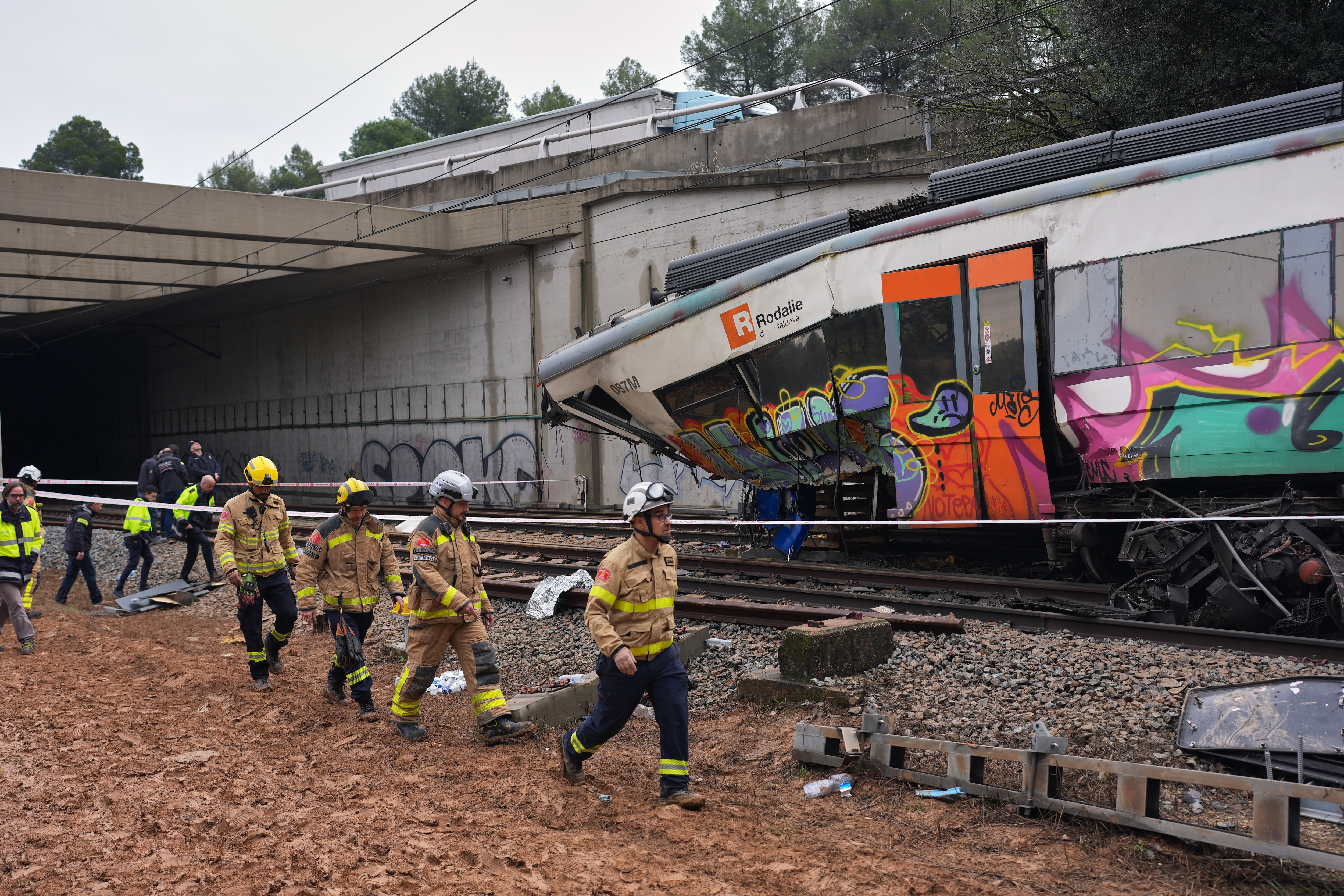


GELIDA, Spain (AP) — Commuter rail service in Spain's northeastern Catalonia region was suspended Wednesday after a Barcelona commuter train crashed the night before, killing one person and injuring 37 others, authorities said.
The crash came two days after Spain’s worst railway disaster since 2013, which left many Spaniards in disbelief. The death toll in that crash, in southern Spain, rose to 43.
The commuter train on Tuesday night hit a retaining wall that fell onto the tracks near the Catalan town of Gelida, about 37 kilometers (23 miles) outside Barcelona, authorities said.
“It's very strange, all of this. It doesn't make sense,” said Antonella Miranda, a barista in Madrid. “Let's see what explanations they provide after the second one.”
Authorities haven't ruled out the possibility of finding more victims in the wreckage from Sunday’s high-speed crash, about 800 kilometers (500 miles) from Gelida. Three days of national mourning are underway, while the cause is being investigated.
The victim of Tuesday's crash was a conductor in training, regional authorities said. Most of the injured rode in the first train carriage.
Rail disruptions on Wednesday caused significant traffic jams on roads leading into Barcelona. Catalonia's regional authorities asked people to reduce unnecessary travel and companies to allow remote work until service was resumed.
“This is very bad. If (the infrastructure) was already faulty and there were complaints, they should have done something earlier," Dolores Sogas said in a commuter town where hundreds of people were delayed or stranded on Wednesday.
Spanish Prime Minister Pedro Sánchez offered his condolences on X, writing: “All my affection and solidarity with the victims and their families.”
While Spain’s high-speed rail network generally runs smoothly, and at least until Sunday had been a source of confidence, commuter rail networks are plagued by reliability issues. However, crashes causing injury or death aren't common.
Spain’s railway operator Adif said the containment wall likely collapsed because of heavy rainfall that swept across the northeastern Spanish region this week.
Tragedy in southern Spain
Sunday evening's crash happened when the tail end of a train carrying 289 passengers on the route from Malaga to the capital, Madrid, derailed and crashed into an incoming train traveling from Madrid to Huelva, another southern city, according to Adif. The collision took place near Adamuz, a town about 370 kilometers (roughly 230 miles) from Madrid.
The front of the second train, which was carrying 184 people, took the brunt of the impact, which knocked its first two carriages off the track and down a 4-meter (13-foot) slope. Bodies were found hundreds of meters from the crash site, according to Andalusia regional President Juanma Moreno.
Authorities continued their search Wednesday, finding a 43rd victim. Another 37 people remained hospitalized Wednesday morning, while 86 people were treated and discharged, regional officials said.
Among the injured was Santiago Tavares, a Portuguese traveler who broke his leg.
“Minutes before the train crash I had a feeling that an accident would happen because the carriage was moving a lot,” Tavares told Portuguese broadcaster TVI. “Ten minutes later the accident happens, I started to fly ... Then, I woke up and I realized I was alive.”
‘All hypotheses are open’
Officials are investigating what caused both train crashes. Transport Minister Óscar Puente called Sunday's collision “truly strange” since it occurred on a straight section of track and neither train was speeding.
Puente said that officials had found a broken section of track that could be related to the origin of the crash, but insisted that it's just a hypothesis and that it could take weeks to reach any conclusions.
In August, the Spanish Union of Railway Drivers sent a letter asking Spain’s rail operator to investigate flaws on train lines across the country due to increased usage and to reduce speeds at certain points until the tracks were fully repaired. The recommendations were made for high-speed train lines, including the one where Sunday’s crash happened, the union told The Associated Press.
The train that jumped the track belonged to the private company Iryo, while the second train belonged to Spain’s public train company, Renfe.
Iryo said Monday the train was manufactured in 2022 and had passed a safety check on Jan. 15.
Puente and Renfe president Álvaro Fernández said both trains were traveling well under the speed limit of 250 kph (155 mph) and “human error could be ruled out.”
The crash shook a nation that leads Europe in high-speed train mileage with a cutting edge network of rail transport.
___
Naishadham reported from Madrid.
Copyright 2026 The Associated Press. All rights reserved. This material may not be published, broadcast, rewritten or redistributed without permission.