
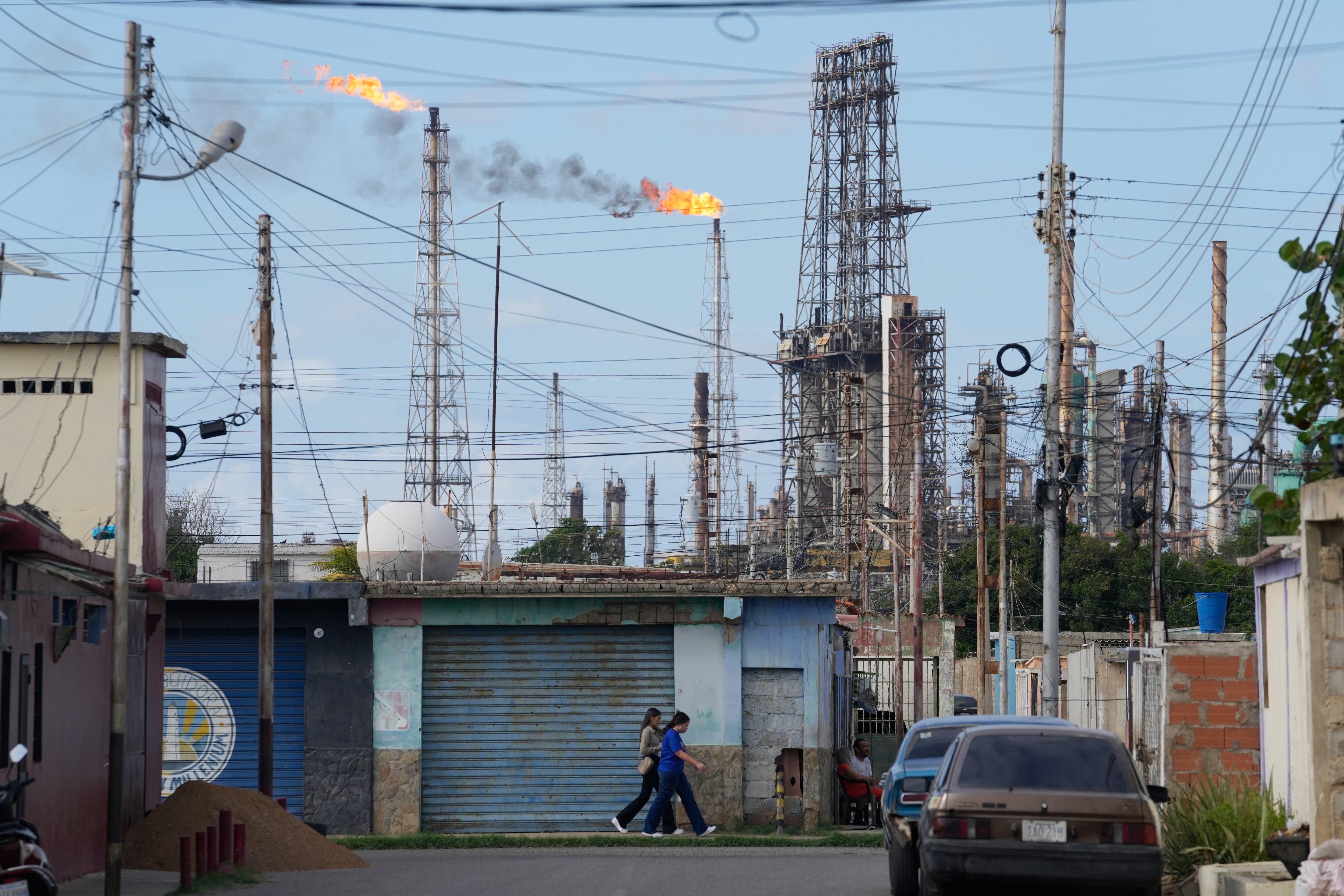


CARACAS, Venezuela (AP) — Venezuela’s acting President Delcy Rodríguez used her first state of the union message on Thursday to advocate for opening the crucial state-run oil industry to more foreign investment following the Trump administration's pledge to seize control of Venezuelan crude sales.
For the first time, Rodríguez laid out a vision for Venezuela’s new political reality — one that challenges her government’s most deeply rooted beliefs less than two weeks after the United States captured and toppled former President Nicolás Maduro.
Under pressure from the U.S. to cooperate with its plans for reshaping Venezuela’s sanctioned oil industry, she declared that a “new policy is being formed in Venezuela” and urged the nation’s diplomats to tell foreign investors about it.
The Trump administration has said it plans to control future oil revenue to ensure it benefits the Venezuelan people. Rodríguez on Thursday painted a picture of money from the oil sales flowing into the national budget to bolster crisis-stricken health services and deteriorating infrastructure — much of which was constructed under Maduro’s predecessor, Hugo Chávez, and neglected in recent years.
While Rodríguez criticized the U.S. capture of Maduro and referred to a “stain on our relations," she also promoted the resumption of diplomatic ties between the historic adversaries. Her succinct, 44-minute speech and largely mollifying tone marked a dramatic contrast to her predecessors' often daily, hourslong rants against U.S. imperialism.
The day before, she gave a 4-minute briefing to the media to say her government would continue releasing prisoners detained under Maduro.
“Let us not be afraid of diplomacy,” Rodriguez said on Thursday.
But she also appeared to be threading a needle. A portrait of Maduro and his wife was displayed right next to Rodríguez as she spoke. She portrayed herself as defending Venezuela's national interests and sovereignty even as the country warmed up to the U.S.
“If one day, as acting president, I have to go to Washington, I will do so standing up, walking, not being dragged," she said. "I will go standing tall ... never crawling.”
She spoke as Venezuelan opposition leader María Corina Machado met with U.S. President Donald Trump in Washington after being frozen out of the U.S. military intervention and subsequent discussions over Venezuela's political fate.
Machado, whose party is widely considered to have won 2024 elections despite Maduro's claims of victory, said she presented her Nobel Peace Prize medal to Trump “as a recognition for his unique commitment with our freedom.”
After a closed-door discussion with Trump, she greeted dozens of cheering supporters waiting for her near the gates, stopping to hug many of them.
"We can count on President Trump,” she told them, prompting some to briefly chant “Thank you, Trump."
Machado did not elaborate on what she meant, and her role in Venezuela’s political scene remains uncertain as Rodríguez’s government has been effectively relieved of having to hold elections for the foreseeable future.
That’s because when Venezuela’s high court granted Rodríguez presidential powers on an acting basis, it cited a provision of the constitution that allows the vice president to take over for a renewable period of 90 days.
Machado’s meeting with Trump received no coverage in Venezuela. State TV still pumps out a steady stream of pro-government images, including of the frequent state-orchestrated marches, where crowds of public employees chant pro-government slogans calling for Maduro’s release and return.
___
Follow AP’s coverage of Latin America and the Caribbean at https://apnews.com/hub/latin-america
Copyright 2026 The Associated Press. All rights reserved. This material may not be published, broadcast, rewritten or redistributed without permission.