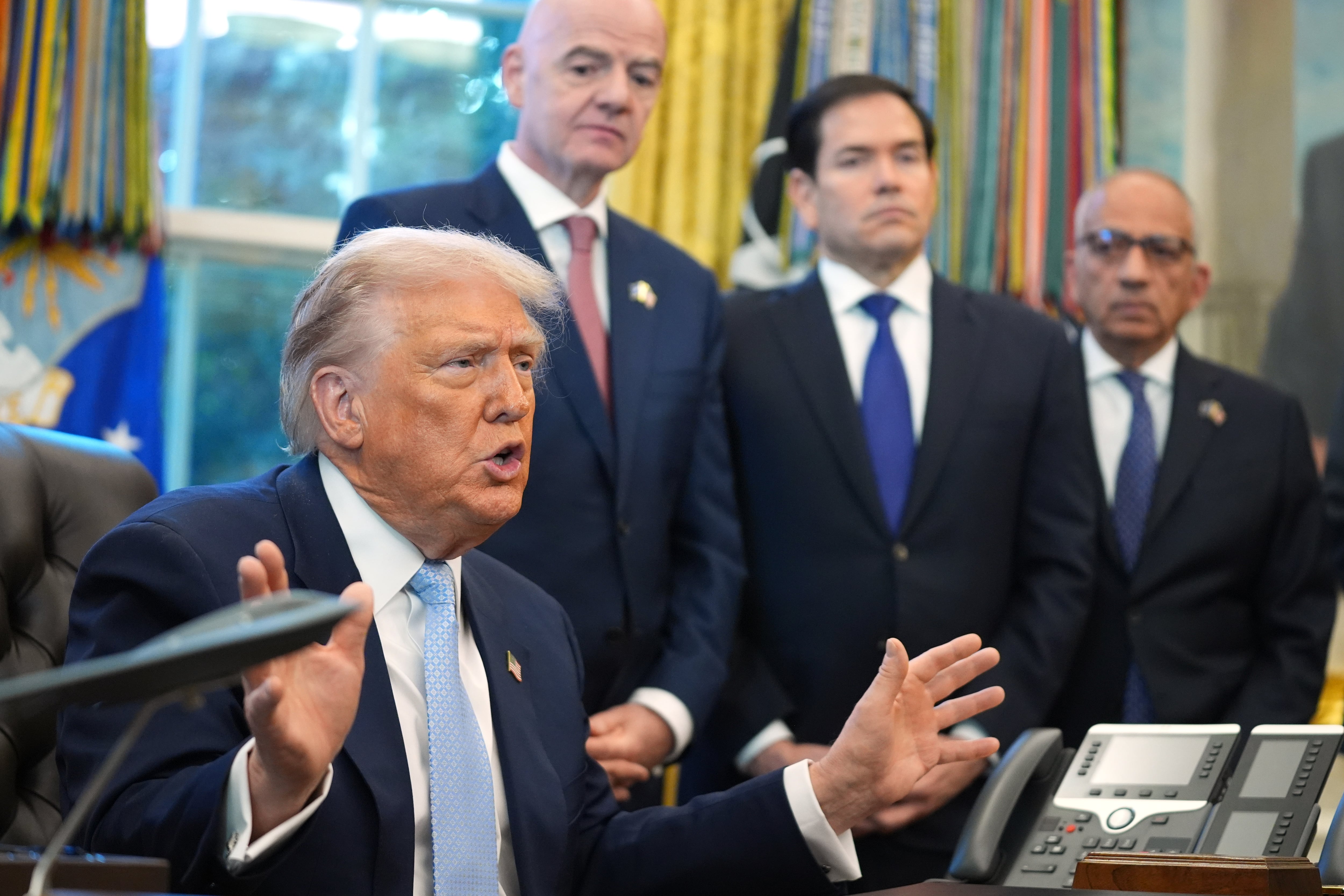
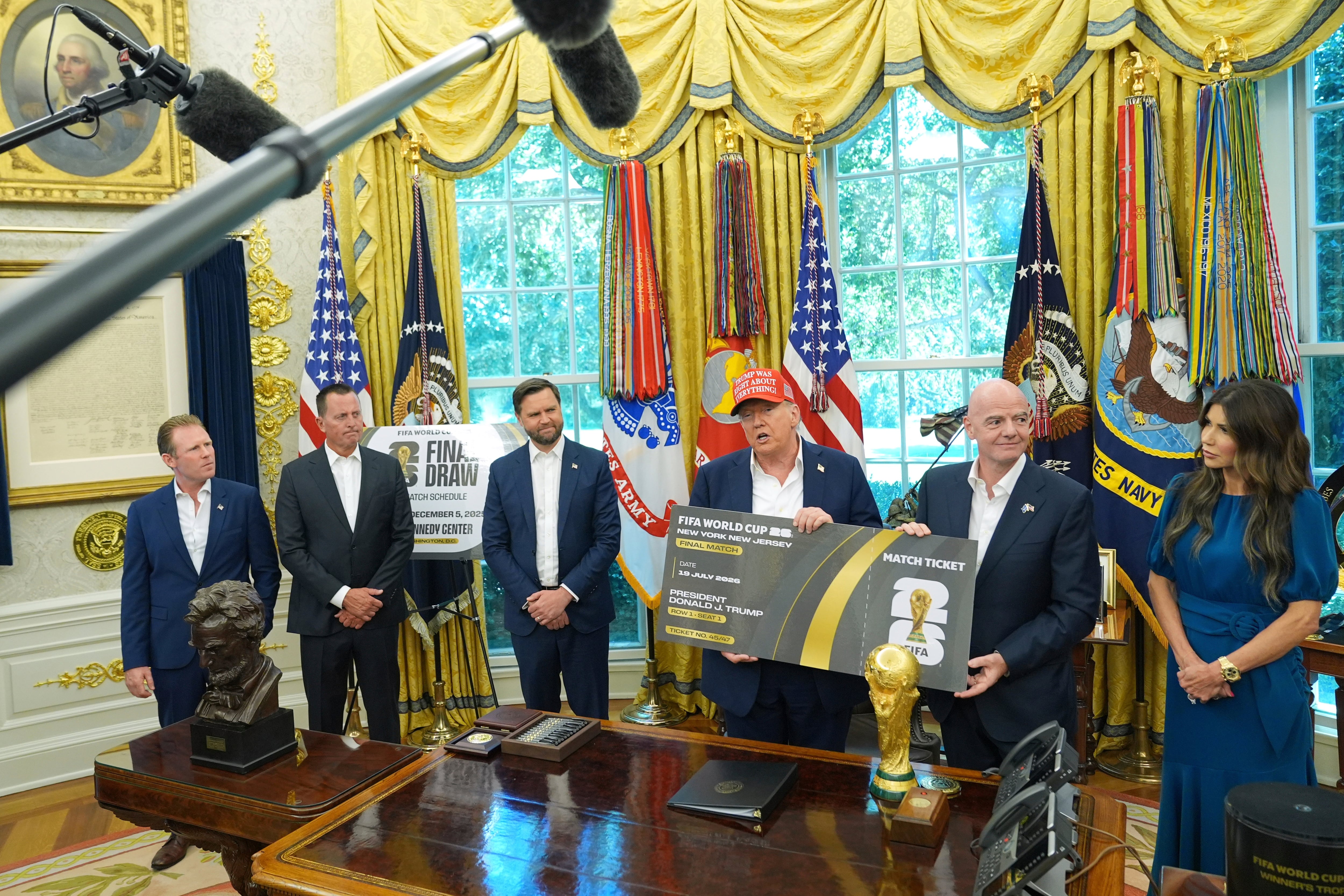
WASHINGTON (AP) — President Donald Trump will take center stage at Friday's World Cup draw in Washington, rolling out the welcome mat for teams and fans from around the globe at a time when his administration is expanding restrictions on travel to the United States for people from 19 countries and he has hardened his rhetoric against immigrants.
The administration is betting that its push to expedite visa processing for visitors and the excitement about the matchups for next summer’s tournament — hosted by the United States, Canada and Mexico — will outweigh concerns that Trump's immigration messaging undercuts the theme of global unity that the World Cup is meant to represent.
In the past week, Trump has said he wants to permanently pause immigration from poor countries and he has singled out Afghans and Somalis for particular contempt. The Republican president is also overseeing the signing a peace agreement between Rwanda and Congo on Thursday at an event with leaders from a host of foreign countries and he is expected to be honored for his peacemaking efforts by FIFA, international soccer's governing body, during the World Cup draw.
Critics say the dueling messages are jarring.
“The Cup is supposed to be a moment when the world comes together, puts aside the differences to celebrate sport, and while it symbolizes the world coming together, you have a president of the United States who is trying to keep the world out, to keep people out,” said Sen. Chris Van Hollen, D-Md., a member of the Senate Foreign Relations Committee.
“Right there at the most fundamental level, you have a president who represents everything that the World Cup does not stand for," Van Hollen said.
But Andrew Giuliani, the executive director of the White House FIFA task force, told foreign reporters Wednesday that “there is a fictional narrative out there that the president is not welcoming to foreigners to come into the United States” and he dismissed concerns about Trump's rhetoric.
“He’s a New Yorker like me; sometimes we say things that are a little different than polished politicians say,” Giuliani said.
Some Iranian officials were denied US entry
Trump's administration is preparing to expand a travel ban enacted in June. Homeland Security Secretary Kristi Noem said Monday that she plans to recommend a “full travel ban on every damn country that’s been flooding our nation with killers, leeches, and entitlement junkies.”
The restrictions have ensnared two countries that have qualified for the quadrennial tournament — Iran and Haiti. The ban bars entry to the U.S. for citizens from 12 countries, and there are heightened restrictions for visitors from seven others.
The ban includes exceptions for World Cup athletes, coaches, “persons performing a necessary support role” and their immediate relatives. Fans, a major source of tourism revenue for any World Cup event, from those banned nations cannot enter.
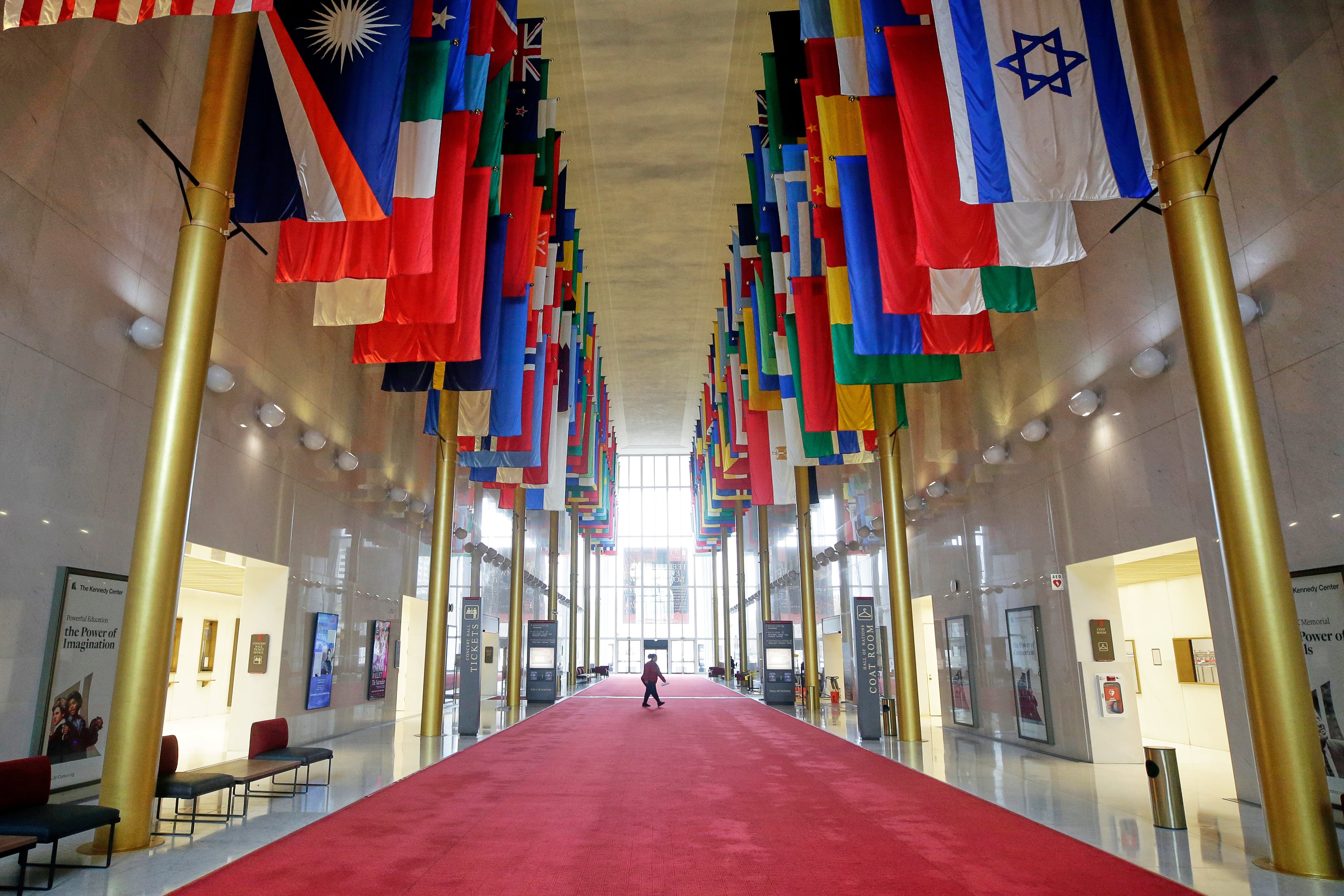
Iran has said it will boycott the draw at the Kennedy Center after visas were denied to key members of its delegation.
The spokesman for the soccer federation of Iran said its officials faced visa obstacles that went beyond sports considerations. The White House referred comment on the matter to the State Department, which said the administration is committed to supporting the World Cup while upholding U.S. law and ensuring national security and public safety.
“Part of the delegation got approved and part of the delegation did not get approved,” Giuliani said. “Every single decision is a national security decision."
The visa denials came despite assurances earlier this year by Gianni Infantino, the FIFA president who has close ties to Trump and is a frequent White House visitor. In October, he told reporters at a European Football Clubs assembly in Rome that "there will be no issues with regard to visas obviously for the participating teams and delegations and so on. And we are working on something for fans, hopefully some good news will come out very soon.”
A World Cup balancing act
The White House has emphasized it is pouring resources to expedite visa processing elsewhere for fans coming to 48-nation tournament, with the majority of the matches held across 11 U.S. cities.
Rep. Darin LaHood, who has participated in multiple FIFA task force meetings at the White House this year and is one of Capitol Hill’s most avid soccer fans, pointed to shortened visa wait times as proof of the administration “wanting to make this work and wanting people to come here.”
“I think sports and the World Cup transcends politics," said LaHood R-Ill. He said FIFA will be part of a new public relations campaign featuring soccer legends emphasizing the welcoming nature of the United States.
“There has to be a welcoming message of people feeling comfortable to come to the United States,” LaHood said. “I think you’ll start to see that after the draw and things are set.”
The State Department has deployed more than 400 additional consular officers to handle global visa demand, and Secretary of State Marco Rubio has said that in about 80% of the world, travelers to the U.S. can get a visa appointment within 60 days. A new system, “FIFA Pass,” allows those who have purchased World Cup tickets through FIFA to get expedited visa appointments.
Yet there have been very visceral reminders of how the administration's immigration crackdown could interfere with World Cup events.
During the Club World Cup tournament this summer, Alex Lasry, the CEO of the New York/New Jersey World Cup host committee, noticed official government social media posts warning that federal immigration agents would be “suited and booted” at the matches. Lasry recalled that he immediately flagged the issue to Giuliani, who assured him that the agents' presence would be the same as at any other major event.
Asked on Wednesday about the possibility of immigration raids at World Cup matches, Giuliani told reporters that Trump “does not rule out anything that will help make American citizens safer.”
Disappointed fans from Haiti
Some fans are already confronting the reality that they will not be able to travel to the United States.
Rich André, the director of state and local initiatives at the American Immigration Council, is the son of immigrants from Haiti, a “soccer-crazed nation” that qualified for the World Cup for the first time in 50 years. He said many Haitians would love nothing more than to come to the U.S. for the World Cup, but likely will not get the chance.
“Certainly, they’re trying to create a carve-out here so the show can go on,” André said, pointing to the exemptions for athletes, coaches and others close to the team. “But the show doesn’t go on without the fans being able to come and cheer their team on in person.”
—
AP Sports Writer Graham Dunbar in Geneva, and AP Diplomatic Writer Matthew Lee contributed to this report.
Copyright 2025 The Associated Press. All rights reserved. This material may not be published, broadcast, rewritten or redistributed without permission.