DAVOS, Switzerland (AP) — Investors appeared to have gotten through to President Donald Trump about the risk posed by his designs for Greenland with a message he wasn't hearing from European leaders: Threatening allies with tariffs and land seizure isn't exactly the type of policy that generates confidence in the global economy.
Trump on Wednesday backed off his threat to slap punishing tariffs on eight European allies for opposing his insistence on acquiring Greenland from longtime ally Denmark after the plan spooked Wall Street by sparking serious talk within NATO about a fundamental rupture to the transatlantic military alliance that's been a linchpin of post-World War II security.
Markets had seen their biggest losses since October as Trump prepared to travel to Davos, Switzerland, to give a keynote address to leaders and the global elite at the World Economic Forum.
Trump grumbled about what he called a stock market “dip” with some annoyance during the speech, complaining the market gyrations happened despite the U.S. “giving NATO and European nations trillions and trillions of dollars in defense.”
But during that speech, he made his first abrupt shift in position for the day: He took off the table the option of using military force to take over Greenland.
"I won’t do that. OK?” Trump told the packed conference room.
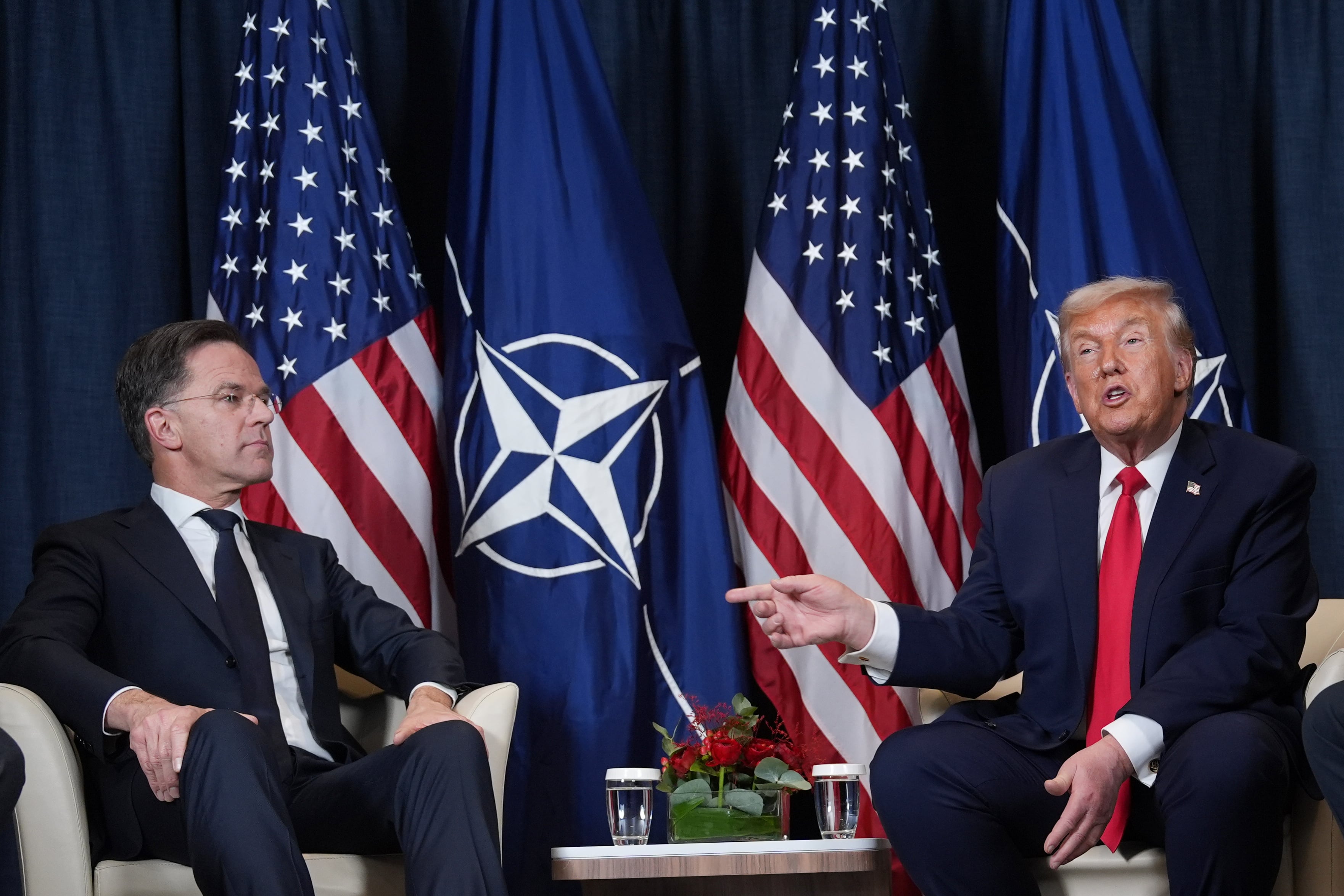
Then, hours later, Trump announced he was retreating from the tariffs altogether after he said he had come to terms with NATO Secretary-General Mark Rutte on a “framework” on Greenland that "gets us everything we needed to get” if the agreement is consummated.
Trump promptly took to financial network CNBC just before Wall Street trading ended for the day, boasting that the framework was “going to be a very good deal for the United States” and allies.
He downplayed the role that the jittery market played on his decision on tariffs. “No, we took that off because it looks like we have pretty much a concept of a deal,” Trump said.
Trump didn't offer details on the terms of that framework. But the S&P 500 rallied 1.2% after his remarks, recovering about half the ground it had lost a day earlier. The Dow Jones Industrial Average also rose 1.2%, as did the Nasdaq Composite.
A concept of a deal, without many details
After the retreat, Denmark's foreign minister Lars Løkke Rasmussen cautiously offered that “the day is ending on a better note than it began" but said the details of the agreement still need to be worked out.
One idea NATO members have discussed as part of the compromise would see Denmark and the alliance working with the U.S. to build out more U.S. bases in Greenland, according to a European official familiar with the matter but not authorized to comment publicly. The official said it was not immediately clear if that idea was included in the contours of the framework that Trump and Rutte discussed on the sidelines of Davos on Wednesday.
Rutte in an appearance on Fox News on Wednesday evening gave little hint about what precisely he and Trump agreed to.
“We agreed that he’s right, and he’s right that collectively we have to protect the Arctic regions,” Rutte said. “But also, of course, the U.S. continue its conversations with Greenland and Denmark when it comes to how can we make sure that the Russians and China will not gain access to the economy or a military sense of Greenland.”
It wasn't just the financial markets that were telling Trump to rethink the tariffs and tough rhetoric toward allies.
A number of U.S. officials had also been concerned about Trump’s hardline stance and bellicose language toward Greenland, Denmark and other NATO allies because they feared it could harm other foreign policy goals.
These officials thought the fixation on Greenland and Trump's earlier comments suggesting that the potential splintering of NATO was a cost he might be willing to pay were complicating the president’s effort to form the Board of Peace, which he's expected to spotlight Thursday in Davos. The U.S. officials spoke on condition of anonymity to discuss concerns being floated inside the administration.
Many European countries, which were already skeptical of the proposed board’s broad global mandate, had reacted even more negatively to the concept after Trump’s tariff threat. The board, which was born from Trump's 20-point plan to end the Israel-Hamas war, was initially envisioned as a small group of world leaders overseeing the Gaza ceasefire but has morphed into something far more ambitious.
A few European nations have even declined their invitations.
“The interpretation that European leaders are going to take from this is that actually standing up and being firm defused the crisis,” said Max Bergmann, director of the Europe, Russia and Eurasia Program at the Center for Strategic and International Studies. “Trump is acting like a bully, and the only way that we’re going to have a stable relationship is if we push back.”
But Matthew Kroenig, vice president and senior director of the Atlantic Council’s Scowcroft Center for Strategy and Security, countered that the idea that Trump would seize Greenland seemed more like a bluff all along — and one that may have worked.
“Most of the world was freaking out over these threats,” Kroenig said. But he he noted there are some downsides to that negotiating style.
For one, it drove the prime minister of Canada, a close U.S. ally, to propose that smaller countries unite against aggressive superpowers.
“It’s been unnecessarily dramatic, costly and damaging, but all the damages so far are repairable,” added Daniel Fried, a former U.S. ambassador to Poland who is now a distinguished senior fellow at the Atlantic Council in Washington.
That possibility, Fried noted, would be harder to achieve had Trump continued on the path with Greenland where he appeared to be heading.
—
AP writers Stan Choe in New York and Matthew Lee in Washington contributed reporting.
Copyright 2026 The Associated Press. All rights reserved. This material may not be published, broadcast, rewritten or redistributed without permission.