

WASHINGTON (AP) — Senate Majority Leader John Thune said Thursday that demands made by Democrats for new restrictions on federal immigration officers are “unrealistic” and warned that the Department of Homeland Security will shut down next week if they do not work with Republicans and the White House.
Democrats say they will not vote for a DHS spending bill when funding runs out unless there are “dramatic changes” at U.S. Immigration and Customs Enforcement and other federal law enforcement agencies in the wake of the fatal shootings of two protesters in Minneapolis last month.
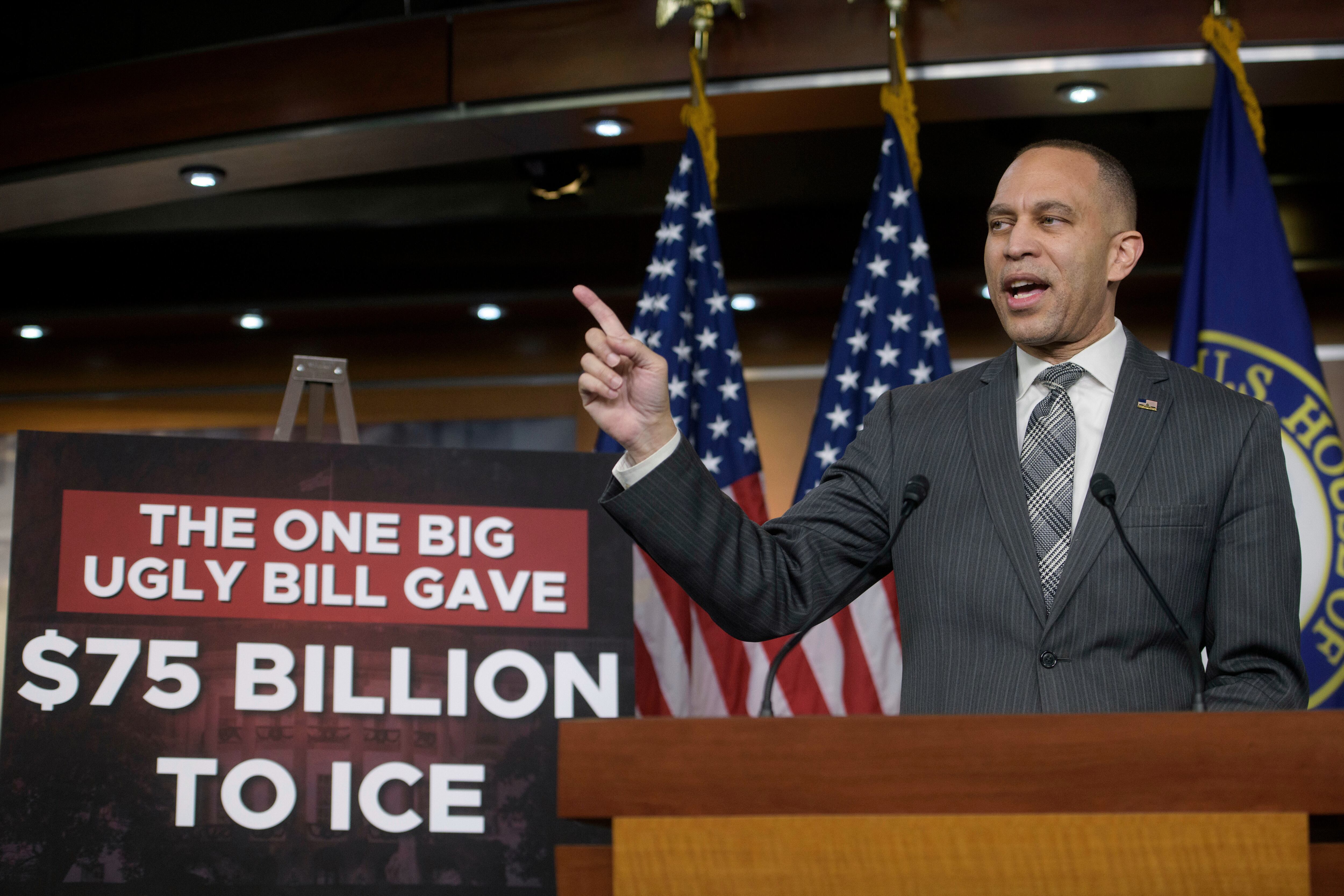
The Democratic leaders, Sen. Chuck Schumer and Rep. Hakeem Jeffries, released an expanded list of 10 detailed proposals on Wednesday night for restraining President Donald Trump’s aggressive campaign of immigration enforcement. Among the demands are a requirement for judicial warrants, better identification of DHS officers, new use of force standards and a stop to racial profiling.
Congress is trying to renegotiate the DHS spending bill after Trump last week agreed to a Democratic request that it be separated from a larger spending measure and extended at current levels for two weeks while the two parties negotiate. The deal came after ICU nurse Alex Pretti was shot and killed by a U.S. Border Patrol officer in Minneapolis on Jan. 24, and some Republicans agreed that new restrictions were necessary.
But with nearly a week gone, a shutdown is becoming increasingly likely starting Feb. 14 as Republicans have been cool to most of the Democrats’ requests.
“This is not a blank check situation where Republicans just do agree to a list of Democrat demands,” said Thune, R-S.D. “The only way to get reforms to ICE is to agree to a bill.”
As of now, Thune said, “we aren’t anywhere close to having any sort of an agreement.”
In addition to ICE and U.S. Customs and Border Protection, the homeland security bill includes funding for the Federal Emergency Management Agency and the Transportation Security Administration. If DHS shuts down, Thune said, “there’s a very good chance we could see more travel problems” similar to the 43-day government closure last year.
Democratic demands
Schumer, D-N.Y., said he is “astounded to hear” Republicans say his party’s proposals were political or unworkable.
“It’s about people’s basic rights, it’s about people’s safety,” Schumer said. If Republicans do not like the ideas, he said, “they need to explain why.”
Schumer and Jeffries, D-N.Y., have made several demands, including no masks for officers, judicial warrants and better federal coordination with local authorities. The list they released Wednesday added several new items, including a stricter use of force policy, legal safeguards at detention centers and a prohibition on tracking protesters with body-worn cameras.
Democrats say Congress should end indiscriminate arrests, “improve warrant procedures and standards,” ensure the law is clear that officers cannot enter private property without a judicial warrant and require that before a person can be detained, it's verified that the person is not a U.S. citizen.
They also want an end to racial profiling, saying DHS officers should be prohibited from stopping, questioning or searching people "based on an individual’s presence at certain locations, their job, their spoken language and accent or their race and ethnicity.”
For officers conducting immigration enforcement, Democrats say that in addition to officers taking off their masks and showing identification, DHS should regulate and standardize uniforms and equipment to bring them in line with other law enforcement agencies.
Republican pushback
Schumer called it a “gut check moment for Congress" as the immigration enforcement operations have rocked Minneapolis and other U.S. cities. But Republicans were dismissive.
Wyoming's John Barrasso, the No. 2 Republican senator, said the demands are “radical and extreme” and a “far-left wish list.”
Sen. Katie Britt, who is helping lead negotiations, said the list is “a ridiculous Christmas list of demands" and warned that time is running out before the deadline.
“I encourage them to talk to the White House,” she said. “We only have one week left.”
Down to the last funding bill
Thune has also encouraged Democrats and the White House to talk. It is unclear whether they are or whether Democrats would be willing to back down on any of their demands.
Some Republicans have demands of their own, including adding legislation that would require proof of citizenship before Americans register to vote and restrictions on cities that they say do not do enough to crack down on illegal immigration.
Sen. Chris Murphy, D-Conn., said it is up to Republicans to ensure the government does shut down because they are in charge.
“The American people want this abuse to stop,” Murphy said.
Some look to limit shutdown pain
Other lawmakers are searching for options to prevent another partial shutdown.
One idea being floated is to essentially fund some of the other agencies within DHS -– the Coast Guard, airport operations under TSA and disaster assistance from FEMA.
“Why not take that off the table?” said Republican Sen. Thom Tillis of North Carolina, whose state is in need of FEMA funds from recent disasters.
“If it doesn’t look like they can get it done,” he said about the immigration enforcement overhaul, “I really think they should look at a la carte funding of agencies.”
Some Democrats have said they agree, but Thune said Thursday that splitting apart the DHS appropriations bill to single out ICE would “defund law enforcement.”
Splitting the bill would mean essentially cutting ICE loose by allowing it to go without its routine federal funding because the agency already has such a robust budget from Trump’s tax and spending cut bill from last year.
ICE is expected to receive about $10 billion in the annual appropriations bill, a fraction of the $175 billion-plus for homeland security for the administration’s mass deportation agenda.
___
Associated Press writer Stephen Groves contributed to this report.
Copyright 2026 The Associated Press. All rights reserved. This material may not be published, broadcast, rewritten or redistributed without permission.