

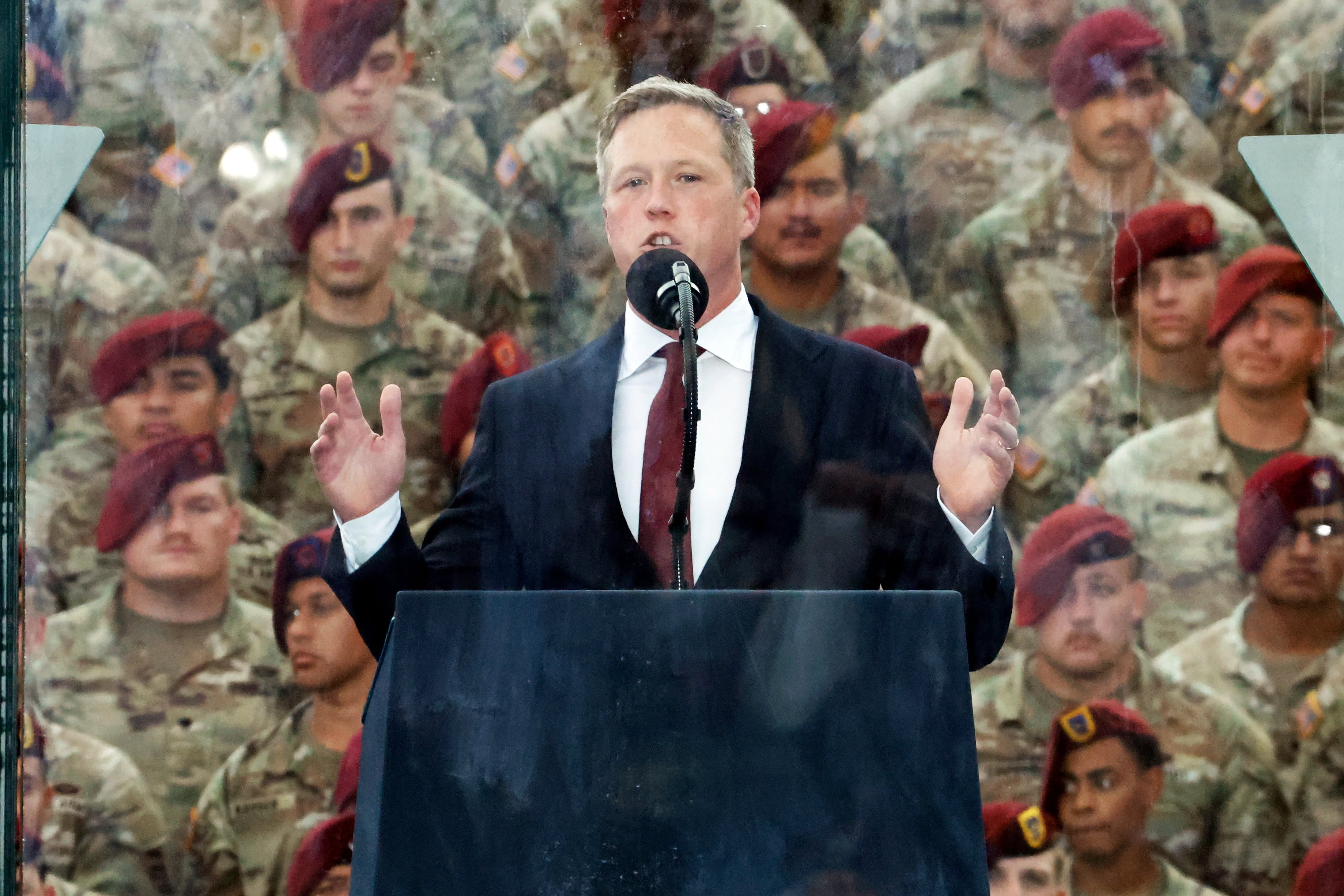
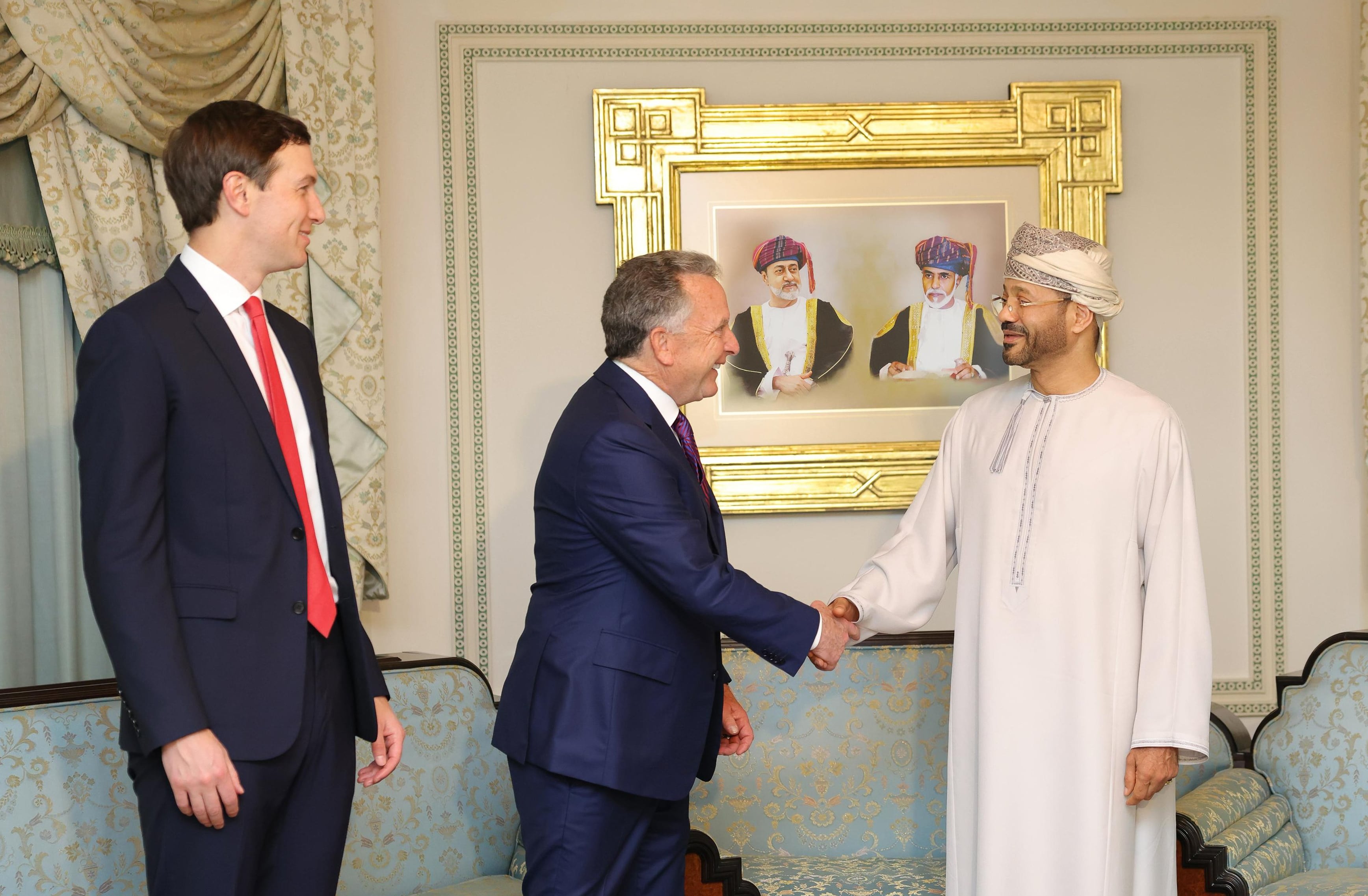


WASHINGTON (AP) — President Donald Trump has taken the unusual step of tapping military leaders for high-level diplomacy, sending the top U.S. commander in the Middle East to talks over Iran’s nuclear program and positioning the Army secretary as a key negotiator on ending the Russia-Ukraine war.
Adm. Brad Cooper, head of U.S. Central Command, for the first time joined indirect U.S.-Iran talks Friday in Oman, appearing in his dress uniform as a reminder of the American buildup of military might in the region. As Army Secretary Dan Driscoll reprised his role at Russia-Ukraine talks this week, he worked to keep the conversation going with Ukrainian officials in the downtime between sessions, according to a person familiar with the negotiations who spoke on condition of anonymity to discuss the sensitive talks.
With special envoy Steve Witkoff and Trump's son-in-law Jared Kushner balancing both sets of thorny negotiations, the choice to bring in military leaders — whether for their expertise, connections or to signal potential tougher options — reflects how the Republican administration has upended traditional U.S. foreign policy and diplomacy.
Elisa Ewers, who served in national security positions in the George W. Bush and Obama administrations, said placing active-duty military leaders like Cooper in diplomatic roles shows how the Trump administration has devalued skilled diplomats and the tools of diplomacy in favor of an overreliance on the military to try to solve foreign policy challenges.
“It often takes an enormous amount of time, investment and hard work to get to the point where you can say diplomacy has succeeded,” said Ewers, now a Middle East scholar at the Center for a New American Security, quoting the idiom that "not every nail needs a hammer."
But Eliot Cohen, who served as counselor of the State Department in the George W. Bush administration, noted how American generals were involved in arms control talks with the Soviet Union during the Cold War.
Cohen said Trump's move to send in Driscoll, the Army’s top civilian leader, was more unusual. But he said, “Presidents do this kind of thing.”
“There’s a long tradition of American presidents using unusual people as emissaries if they trust them and think they can deliver the message,” Cohen said.
‘Intended to send a message’
The talks in Oman aimed to cool escalating tensions between Iran and the U.S. that have the region on edge. Trump said the talks were “very good” and more were planned for early next week. But he warned that if Iran did not make a deal over its nuclear program, “the consequences are very steep.”
Trump has repeatedly threatened to use force to compel Iran to reach an agreement, and he sent the aircraft carrier USS Abraham Lincoln and other warships to the region during Tehran’s bloody crackdown on nationwide protests.
Michael O’Hanlon, a defense and foreign policy analyst at the Brookings Institution, said Cooper's presence was meant to “signal resolve and to intimidate.”
“Including the CENTCOM commander is quite unusual and seems intended to send a message more than to add to the heft of the negotiating team for the talks themselves,” O'Hanlon wrote in an email.
“But the relationship is already so tense and bad that I doubt it’ll make much difference, unless the Iranians have had a fundamental rethinking on their nuclear program,” O'Hanlon added.
Michael Singh, who was senior director for the Middle East at the White House National Security Council in the George W. Bush administration, said he saw Cooper's presence as more to do with his expertise.
Witkoff and Kushner are not experts on Iran but generalists engaged in diplomatic talks worldwide, while Cooper has knowledge of the region and access to military experts who can evaluate any proposed concessions to Iran's nuclear program, Singh said.
Cooper spoke at length about Iran’s nuclear and military capabilities during his nomination hearing in June, shortly after the U.S. launched strikes on the Islamic Republic's key nuclear sites.
“These are very technical issues we’re dealing with,” said Singh, managing director at the Washington Institute for Near East Policy. “They’re not issues you can deal with instinctively. Adm. Cooper will have access to that expertise in a way that Witkoff and Kushner either don't or might not choose to access.”
Cooper brings both knowledge and the implicit threat of force, “which is part of the negotiation,” said Cohen, the former Bush official who is now a scholar at the Center for Strategic and International Studies.
The White House has not responded to a request for comment about why Trump sent Cooper to participate in the talks.
Building relationships
In November, Driscoll was suddenly tapped for negotiations to try to end Russia's nearly 4-year war in Ukraine.
Talks back then had stalled, and Driscoll used an already planned trip to Ukraine as an opportunity to meet with President Volodymyr Zelenskyy and other top government, military and defense industry officials.
Since then, Driscoll has been part of several other negotiation sessions, including in Abu Dhabi this week.
The person familiar with the negotiations said Driscoll’s role has coalesced around acting as a kind of liaison between the Ukrainians and Trump officials like Witkoff and Kushner.
The person said the relationship with the Ukrainians was the result of Driscoll's ability to keep the dialogue going between negotiation sessions as well as his military perspective as a leader and former Army officer.
Driscoll served as an armor officer for more than three years and earned the rank of first lieutenant. He deployed to Iraq from October 2009 to July 2010.
In Abu Dhabi, he was joined by U.S. Gen. Alexus Grynkewich, commander in Europe of both U.S. and NATO forces, who helped negotiate the reestablishment of high-level military-to-military dialogue between the United States and Russia for the first time in four years.
It “will provide a consistent military-to-military contact as the parties continue to work towards a lasting peace,” a U.S. military statement said.
Copyright 2026 The Associated Press. All rights reserved. This material may not be published, broadcast, rewritten or redistributed without permission.