


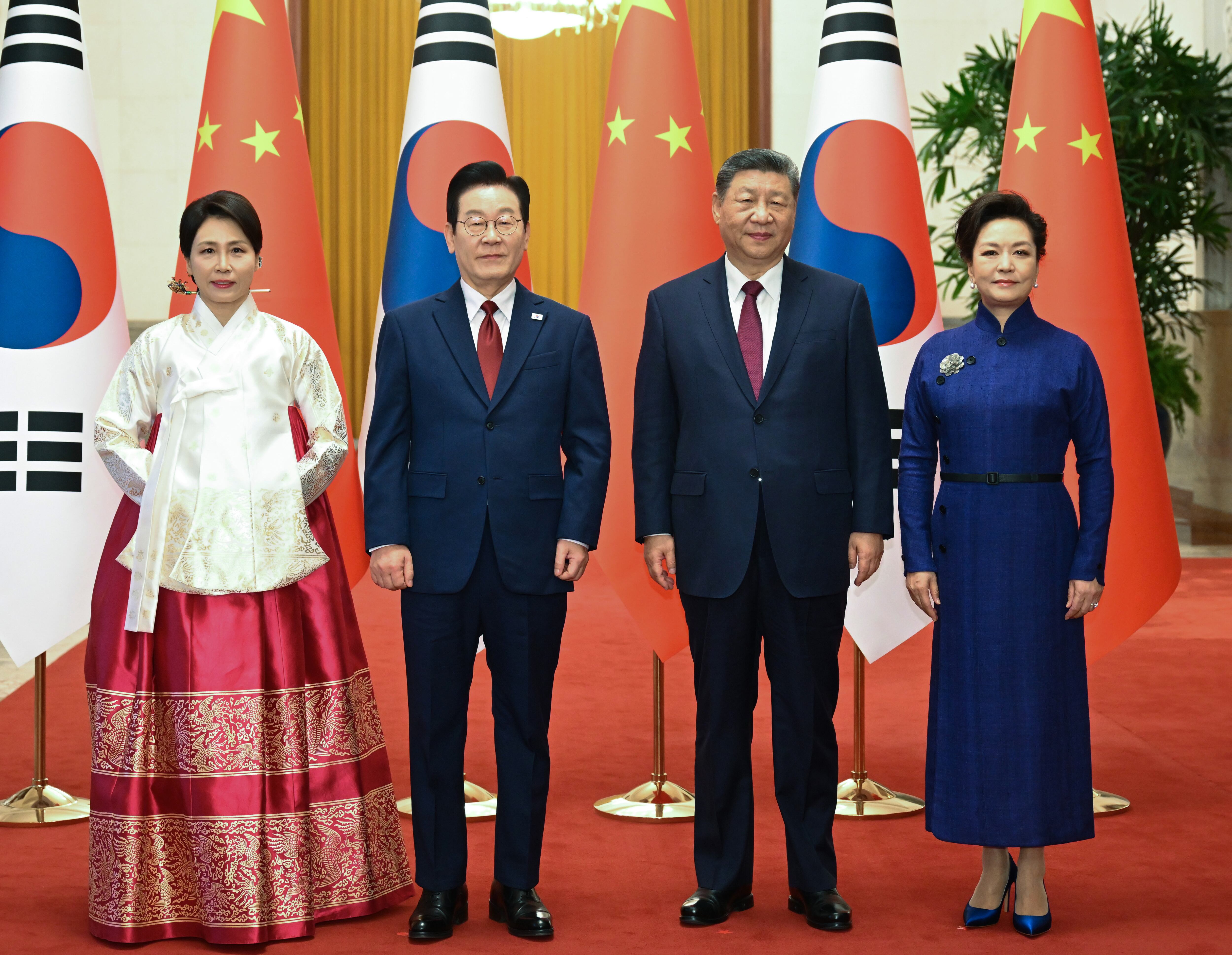
BEIJING (AP) — China and South Korea’s leaders pledged to boost trade and safeguard regional stability on Monday during a visit to Beijing by the South Korean president that was overshadowed by North Korea’s recent ballistic missile tests.
South Korean President Lee Jae Myung met Chinese President Xi Jinping as part of his four-day trip to China — his first since taking office, in June.
As Xi hosted Lee at the imposing Great Hall of the People, the Chinese president stressed the two countries’ “important responsibilities in maintaining regional peace and promoting global development,” according to a readout of their meeting broadcast by state-run CCTV.
Lee spoke about opening “a new chapter in the development of Korea-China relations” during “changing times.”
“The two countries should make joint contributions to promote peace, which is the foundation for prosperity and growth,” Lee said.
The visit comes as China wants to shore up regional support amid rising tensions with Japan. Beijing and South Korea’s ties themselves have fluctuated in recent years, with frictions over South Korea’s hosting of U.S. military troops and armaments.
North Korea launches ballistic missiles ahead of the meeting
Just hours before Lee’s arrival in China, North Korea launched several ballistic missiles into the sea, including, it said, hypersonic missiles, which travel at five times the speed of sound and are extra-difficult to detect and intercept.
The tests came as Pyongyang criticized a U.S. attack on Venezuela that included the removal of its strongman leader Nicolás Maduro.
North Korea, which has long feared the U.S. might seek regime change in Pyongyang, criticized the attack as a wild violation of Venezuela's sovereignty and an example of the “rogue and brutal nature of the U.S.”
China had also condemned the U.S. attack, which it said violated international law and threatened peace in Latin America.
China is North Korea’s strongest backer and economic lifeline amid U.S. sanctions targeting Pyongyang's missile and nuclear program.
China’s frictions with Japan also loom over the visit
Lee’s visit also coincided, more broadly, with rising tensions between China and Japan over recent comments by Japan’s new leader that Tokyo could intervene in a potential Chinese attack on Taiwan, the island democracy China claims as its own.
Last week, China staged large-scale military drills around the island for two days to warn against separatist and “external interference” forces.
In his meeting with Lee, Xi mentioned China and Korea’s historical rivalry against Japan, calling on the two countries to “join hands to defend the fruits of victory in World War II and safeguard peace and stability in Northeast Asia.”
Regarding South Korea's military cooperation with the U.S., Lee said during an interview with CCTV ahead of his trip that it shouldn't mean that South Korea-China relations should move toward confrontation.
He added that his visit to China aimed to “minimize or eliminate past misunderstandings or contradictions (and) elevate and develop South Korea-China relations to a new stage.”
Agreements in technology, trade and transportation
China and South Korea maintain robust trade ties, with bilateral trade reaching about $273 billion in 2024.
During their meeting, Xi and Lee oversaw the signing of 15 cooperation agreements in areas such as technology, trade, transportation and environmental protection, CCTV reported.
Earlier on Monday, Lee had attended a business forum in Beijing with representatives of major South Korean and Chinese companies, including Samsung, Hyundai, LG and Alibaba Group.
At that meeting, Lee and Chinese Vice Premier He Lifeng oversaw the signing of agreements in areas such as consumer goods, agriculture, biotechnology and entertainment.
___
AP reporter Hyung-jin Kim in Seoul contributed to this report.
Copyright 2026 The Associated Press. All rights reserved. This material may not be published, broadcast, rewritten or redistributed without permission.