DORAL, Fla. — The U.S. government’s capture and prosecution of Nicolás Maduro and Cilia Flores raised questions about President Donald Trump’s immigration policy.
On Monday, Attorney Angel F. Leal, Jr., based in Doral, said there was a lot of confusion among Venezuelan migrants about their migratory status in the U.S.
Homeland Security Secretary Kristi Noem told Fox News on Sunday that Venezuelans who had Temporary Protected Status could apply for asylum.
“Asylum is not like TPS,” Leal said, adding that Venezuelan migrants who apply for asylum face “a series of requirements to qualify.”
The requirements include applying within a year of arrival and proving that they have been a victim of past persecution, Leal said.
Related story: Venezuelan UF graduate reacts to Trump sharing his message of gratitude after Maduro’s capture
“I have been here almost my whole life, all of my youth, and I do believe that the future of Venezuelans is in Venezuela, but I also think that some of us and some people here also want to continue working here in the United States,” Edgar Rodriguez said during a celebration at El Arepazo in Doral.
The United Nations estimated more than 7.9 million Venezuelans were either migrants or refugees, and over 2.2 million were in an irregular situation.
In the U.S., more than 605,000 Venezuelans lost the TPS, which included a work permit, earlier this year. It expired for most on May 19 and for the rest on Nov. 7.
Related story: Florida awaiting federal approval for 3rd immigration detention center
Immigration and Customs Enforcement reported there had been more than 600,000 deportations since Trump took office in January.
On Monday, at the Baker Correctional Institution, Gov. Ron DeSantis told reporters that state and local law enforcement had contributed to arresting and holding migrants more than any other state.
“I support making sure Venezuelans have the opportunity to be here until it’s safe,” Sen. Rick Scott told Local 10 News during an event with Sen. Ashley Moody on Monday in Doral.
Also on Monday, the U.S. State Department announced an expansion of the list of countries whose citizens are subject to U.S. Visa bonds -- ranging from $5,000 to $15,000.
Related story: ‘What a great day’: Lawmakers celebrate Maduro ouster in Doral, Scott weighs in on TPS
Maduro in court

Also on Monday, Maduro and Flores arrived at federal court in Manhattan and pleaded not guilty to narco-terrorism charges. The U.S. didn’t recognise Maduro as the legitimate president of Venezuela.
U.S. District Judge Alvin Hellerstein is presiding over the case. Attorney Barry J. Pollack, based in Washington, D.C., represented Maduro. Attorney Mark Donnelly, based in Houston, represented Flores. Their next court hearing is on March 17.
United Nations
Nearby, during the United Nations Security Council’s emergency meeting, Samuel Moncada, Venezuela’s UN ambassador, said Delcy Rodríguez had been sworn into office as the new acting Venezuelan president.
Mike Waltz, the U.S. ambassador to the UN, posed a question during his statement: “If the United Nations in this body confers legitimacy on an illegitimate narco-terrorist with the same treatment in this charter of a democratically elected president or head of state, what kind of organization is this?”
U.S. plans for Venezuela
On Sunday, State Secretary Marco Rubio said the U.S. was enforcing an “oil quarantine.” Rubio and Defense Secretary Pete Hegseth met with lawmakers for a briefing on Monday.
On Saturday, Trump announced his administration planned to allow U.S. companies to control Venezuela’s oil industry, so oil stocks were sharply higher on Monday.
Related story: Cuba says 32 Cuban officers were killed in US action in Venezuela
Timelines
Here is a timeline of events during Operation Absolute Resolute:
At about 10:45 p.m. on Jan. 2: President Donald Trump issued the order to move forward with Maduro’s capture. U.S. Air Force Lt. Gen. Dan “Razin” Caine said every branch of the U.S. military worked with the CIA, the National Security Agency, and the National Geospatial-Intelligence Agency before Trump moved forward with the mission.

At about 1 a.m. on Jan. 3: A U.S. military team captured Maduro and Flores, according to Cain.
At about 3:30 a.m. on Jan. 3: The team, Maduro, and Flores were over the water and landed on the USS Iwo Jima (LHD-7), a Wasp-class amphibious assault ship.
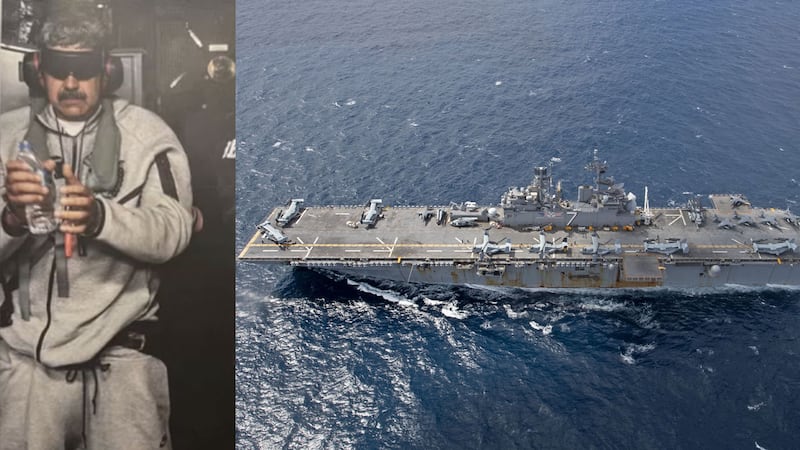
At about 4:25 a.m. on Jan. 3: Trump announced the capture and extraction from Venezuela after “a large-scale strike.”
At about 7:25 a.m. on Jan. 3: U.S. Attorney General Pamela Bondi announced the cases against Maduro and Flores, “two alleged international narco traffickers,” were in the Southern District of New York. Maduro faced charges of narco-terrorism conspiracy, cocaine importation conspiracy, possession of machine guns and destructive devices, and conspiracy to possess machine guns and destructive devices against the United States.
At about 11:30 a.m. on Jan. 3: Federal agents officially took custody of Maduro and Flores, according to federal prosecutors.
At about 4:30 p.m. on Jan. 3: Maduro and Flores arrived at the Stewart Air National Guard base in Windsor, New York.
Here is a timeline of some of U.S. actions before Maduro’s capture:
Nov. 18, 2013: The U.S. Justice Department announced that a senior official with the Banco de Desarrollo Económico y Social de Venezuela, or BANDES, a state-run economic development bank in Venezuela, admitted to corruption involving accounts in Switzerland.
Feb. 13, 2017: The U.S. Treasury announced sanctions against Tareck Zaidan El Aissami Maddah, who Maduro had appointed as the Venezuelan vice president on Jan. 4, 2017.
May 29, 2019: The State Department announced that a Venezuelan-American businessman based in Miami admitted to his role in a bribery scheme involving Petroleos de Venezuela S.A. and the Citgo Petroleum Corporation.
July 25, 2019: The U.S. Justice Department indicted Alex Nain Saab Moran, a close associate of Maduro, for money laundering related to foreign corruption.
Aug. 5, 2019: The U.S. Embassy in Venezuela reported that nearly 90% of hospitals in Venezuela reported shortages of medicine and inconsistent water supplies.
Sept. 17, 2019: The U.S. Treasury announced new sanctions related to Saab’s network.
March 26, 2020: The Justice Department announced the filing of federal charges against Maduro and 14 current and former Venezuelan officials in New York City, Washington, DC, and Miami.
The State Department announced there was a $15 million reward for Maduro’s capture and a $10 million reward for El Aissami Maddah, the former Venezuelan vice president.
Sept. 29, 2020: The State Department announced there was a $10 million reward for Pedro Luis Martin-Olivares, the former chief of the Venezuelan intelligence service. There were also announcements about a $5 million reward for Jesus Alfredo Itriago, the former chief of Venezuela’s counter-narcotics agency, and a $5 million reward for Rodolfo McTurk-Mora, the former head of Interpol in Venezuela.
Jan. 19, 2021: The State Department announced that the U.S. Treasury’s Office of Foreign Assets Control had designated and blocked three companies in Russia, Ukraine, and Venezuela and identified six vessels allegedly “involved in the lifting and transport of Venezuelan oil” in an effort to “limit” Maduro’s options.
Nov. 9, 2023: U.S. Department of Agriculture releases the Analysis of the 2022 Venezuela Food Security Situation reporting that the economy had declined 88% from 2012 to 2020, and the food supply growth did not fully meet the needs of Venezuelans.
Aug. 1, 2024: The State Department announced the U.S. did not recognise Maduro as the winner of the presidential election on July 28, 2024, in Venezuela.
Jan. 10, 2025: The U.S. offers a $25 million reward for the capture of Diosdado Cabello Rondón, a Venezuelan minister, and a $15 million reward for the capture of Vladimir Padrino López, a Venezuelan four-star general.
Jan. 20, 2025: Trump expands foreign terrorist organizations’ designation.
Feb. 20, 2025: The Trump administration designates Venezuelan gang Tren de Aragua as a foreign terrorist organization.
July 25, 2025: The U.S. Treasury announced the Cartel de Los Soles was to be treated as a “specially designated global terrorist.”
Aug. 7, 2025: State Secretary Marco Rubio announced that the reward for Maduro’s capture had increased to $50 million under the U.S. Narcotics Rewards Program.
Aug. 19, 2025: The U.S. Navy deploys three guided-missile destroyers to the southern Caribbean near Venezuela.
Sept. 2, 2025: The U.S. military reported killing 11 drug trafficking suspects during a strike in the Caribbean. After a controversial strike killed the two survivors of an initial strike, more followed on Sept. 15 and 19.
Oct. 2, 2025: Trump declared drug trafficking suspects as “unlawful combatants.”
Oct. 3, 2025: The U.S. military carried out a fourth fatal strike in the Caribbean, a fifth on Oct. 14, a sixth on Oct. 16, a seventh on Oct. 17, an eighth on Oct. 21, a ninth on Oct. 22, and a tenth on Oct. 24.
Oct. 15, 2025: Trump announced that he had authorized the CIA to conduct covert operations in Venezuela.

Oct. 24, 2025: The Pentagon deploys the USS Gerald R. Ford to the southern Caribbean.
Nov. 10, 2025: After several fatal strikes in the Pacific, the Pentagon announced there was a fatal strike in the Caribbean.
Nov. 16, 2025: The USS Gerald R. Ford arrives in the Caribbean.
Nov. 24, 2025: Rubio announced that the Cartel De Los Soles was a foreign terrorist organization headed by “Maduro and other high-ranking individuals of the illegitimate Maduro regime who have corrupted Venezuela’s military, intelligence, legislature, and judiciary.”
Dec. 1, 2025: The USS Gerald R. Ford arrives in St. Thomas.
Dec. 10, 2025: The U.S. seized an oil tanker with Venezuelan oil off the coast of Venezuela.
Dec. 16, 2025: Trump announced a blockade on all “sanctioned oil tankers” going to and leaving Venezuela.
Dec. 20, 2025: The U.S. seized a second tanker off the coast of Venezuela.
Dec. 30, 2025: The U.S. Treasury announced sanctions related to Iran-Venezuela trade in Mohajer-6, a combat drone with intelligence, surveillance, and reconnaissance capabilities. The Associated Press reported the CIA was behind a drone strike at a docking area in Venezuela.
Copyright 2026 by WPLG Local10.com - All rights reserved.

