

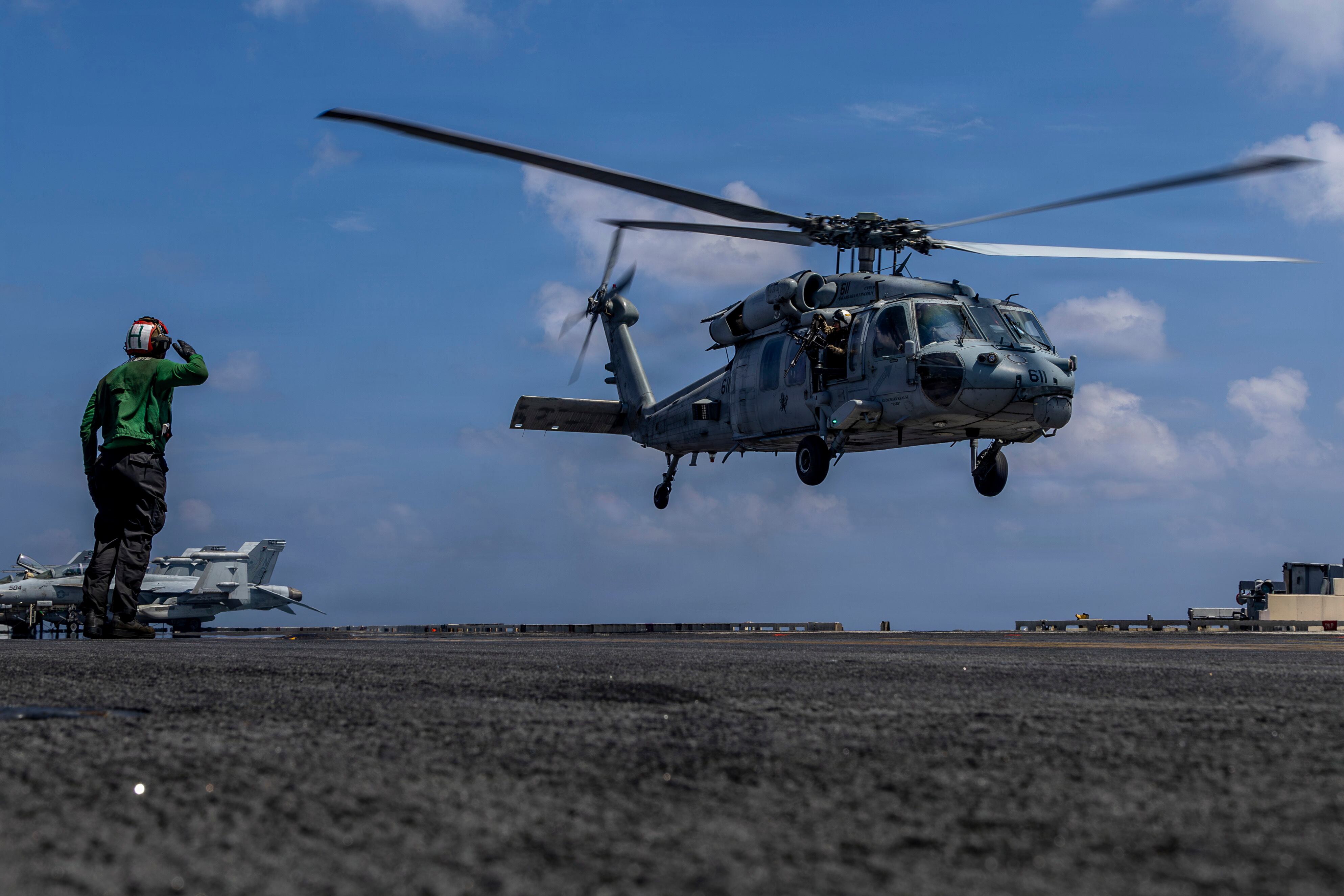
WASHINGTON (AP) — A U.S. Navy fighter jet shot down an Iranian drone that was approaching the aircraft carrier USS Abraham Lincoln in the Arabian Sea, U.S. Central Command said Tuesday, threatening to ramp up tensions as the Trump administration warns of possible military action to get Iran to the negotiating table.
The drone “aggressively approached” the aircraft carrier with “unclear intent” and kept flying toward it "despite de-escalatory measures taken by U.S. forces operating in international waters,” Central Command spokesman Capt. Tim Hawkins said in a statement.
The shootdown occurred within hours of Iranian forces harassing a U.S.-flagged and U.S.-crewed merchant vessel that was sailing in the Strait of Hormuz, the American military said.
The developments could escalate the heightened tensions between the longtime adversaries as President Donald Trump has threatened to use military action first over Iran’s bloody crackdown on nationwide protests and then to try to get the country to make a deal over its nuclear program. Trump's Republican administration has built up military forces in the region, sending the aircraft carrier, guided-missile destroyers, air defense assets and more to supplement its presence.
The Shahed-139 drone was shot down by an F-35C fighter jet from the Lincoln, which was sailing about 500 miles (800 kilometers) from Iran’s southern coast, Hawkins said. No American troops were harmed, and no U.S. equipment was damaged, the military’s statement noted.
Iranian state media reported that Iran’s paramilitary Revolutionary Guard is investigating the “interruption” of the drone. Semi-official Tasnim news agency posted on its Telegram that before the footage cut out, the drone was able to successfully transfer the images it took back to Iran.
US says Iran also harassed a merchant vessel
After the shootdown, Revolutionary Guard forces harassed the merchant vessel Stena Imperative, the U.S. military said. Two boats and an Iranian Mohajer drone approached the ship “at high speeds and threatened to board and seize the tanker,” Hawkins’ statement said.
The destroyer USS McFaul responded and escorted the Stena Imperative “with defensive air support from the U.S. Air Force,” the statement said, adding that the merchant vessel was now sailing safely.
Talks between special envoy Steve Witkoff and Iranian officials are still planned, White House and Iranian officials said.
Trump would not be drawn on where talks would take place, but he told reporters that “we are negotiating with them right now.” He also noted the U.S. strikes on Iranian nuclear sites in June and said, ”I don’t think they want that happening again."
Iranian President Masoud Pezeshkian said Tuesday that he instructed the country's foreign minister to “pursue fair and equitable negotiations” with the U.S., marking one of the first clear signs from Tehran that it wants to try to negotiate with Washington.
Iranian Foreign Ministry spokesman Esmail Baghaei also told state TV that the talks were still expected in the next few days but that the details, including where they will take place, were still being discussed. Baghaei said Turkey and Oman, among other regional countries, have offered to host the talks, according to the semiofficial Tasnim news agency.
Tensions began to rise again between the U.S. and Iran as the Islamic Republic spent weeks quelling protests that began in late December against growing economic instability before broadening into a challenge to the country's ruling theocracy.
Trump had promised in early January to “rescue” Iranians from their government's protest crackdown before starting to pressure Tehran again to make a deal over its nuclear program. That is even as the Republican president insists Iranian nuclear sites were “obliterated” in U.S. strikes in June.
Turkey had been working behind the scenes to make the talks happen there later this week as Witkoff is traveling in the region. A Turkish official later said the location of talks was uncertain but that Turkey was ready to support the process.
US military builds up presence in the region
Meanwhile, the U.S. military has been moving a growing number of assets into the region over the past several weeks, including the Lincoln and several destroyers, which arrived last week.
The carrier strike group, which brought roughly 5,700 additional service members, joined three destroyers and three littoral combat ships that were already in the region.
Analysts of flight-tracking data also have noticed dozens of U.S. military cargo planes heading to the region.
The activity is similar to last year when the U.S. moved in air defense hardware, like a Patriot missile system, in anticipation of an Iranian counterattack following the U.S. bombing of three key nuclear sites. Iran launched more than a dozen missiles at Al Udeid Air Base in Qatar days after the strikes.
The U.S. has several bases in the Middle East, including Al Udeid, which hosts thousands of American troops and is the forward headquarters for U.S. Central Command.
___
Amiri reported from New York. Associated Press writer Aamer Madhani contributed to this report.
Copyright 2026 The Associated Press. All rights reserved. This material may not be published, broadcast, rewritten or redistributed without permission.