

MINNEAPOLIS (AP) — A federal judge heard arguments Monday over Minnesota's challenge to the Trump administration's immigration enforcement crackdown, posing skeptical questions to both sides about the effort that has led to two fatal shootings by federal officers.
U.S. District Judge Katherine Menendez is considering whether to grant requests by the state and the cities of Minneapolis and St. Paul to temporarily halt the immigration operation. She said the case was a priority, though she issued no immediate ruling.
Menendez questioned the government’s motivation behind the crackdown and expressed skepticism about a letter recently sent by Attorney General Pam Bondi to Minnesota Gov. Tim Walz. The letter asked the state to give the federal government access to voter rolls, to turn over state Medicaid and food assistance records, and to repeal sanctuary policies.
“I mean, is there no limit to what the executive can do under the guise of enforcing immigration law?” Menendez asked. She noted that the federal requests are the subject of litigation.
Lawyers for the state and the Twin Cities argued that the situation on the street is so dire as to require the court to halt the federal government’s enforcement actions.
“If this is not stopped right here, right now, I don’t think anybody who is seriously looking at this problem can have much faith in how our republic is going to go in the future,” Minnesota Assistant Attorney General Brian Carter said.
Brantley Mayers, a Justice Department attorney, said the government's goal is to enforce federal law. Mayers said one lawful action should not be used to discredit another lawful action.
“I don’t see how the fact that we’re also doing additional things that we are allowed to do, that the Constitution has vested us with doing, would in any way negate another piece of the same operation, the same surge,” Mayers said.
Menendez questioned where the line was between violating the Constitution and the executive's power to enforce the law. She also asked whether she was being asked to decide between state and federal policies.
“That begins to feel very much like I am deciding which policy approach is best,” she said.
At one point, while discussing the prospect of federal officers entering residences without a warrant, the judge expressed reluctance to decide issues not yet raised in a lawsuit before her.
“I can’t be the global keeper of all things here. Like, presumably that will be litigated," she said to the state's attorney.
Menendez made it clear that she was struggling with how to rule because the case is so unusual, and there are few precedents in case law to guide her.
"It’s because this is important that I’m doing everything I can to get it right,” she said.
The state of Minnesota and the cities sued the Department of Homeland Security earlier this month, five days after Renee Good was shot by an Immigration and Customs officer. The shooting of Alex Pretti by a Border Patrol officer on Saturday added urgency to the case.
Border czar to Minnesota
In other developments, President Donald Trump said he had a “very good” call with Walz about the latest shooting and that they are now on a “similar wavelength.” It was an abrupt shift from Trump, who frequently derides Walz for his actions on immigration issues in Minnesota.
Trump also said he would send border czar Tom Homan to Minnesota. The president's statement comes after Homeland Security Secretary Kristi Noem and Border Patrol Commander Gregory Bovino, who has become the public face of the crackdown, answered questions at news conferences over the weekend about Pretti's shooting. Trump posted on social media that Homan will report directly to him.
White House press secretary Karoline Leavitt said Homan would be “the main point of contact on the ground in Minneapolis” during continued operations by federal immigration officers.
Since the original court filing, the state and cities have substantially added to their request in an effort to restore the conditions that existed before the administration launched Operation Metro Surge on Dec. 1.
In court Monday, an attorney for the administration said about 2,000 Immigration and Customs Enforcement officers were on ground, along with at least 1,000 Border Patrol officers.
The lawsuit asks the judge to order a reduction in the number of federal law enforcement officers and agents in Minnesota back to the level before the surge and to limit the scope of the enforcement operation.
Justice Department attorneys have called the lawsuit “legally frivolous” and said Minnesota "wants a veto over federal law enforcement.” They asked the judge to reject the request or to at least stay her order pending an anticipated appeal.
Democratic Minnesota Attorney General Keith Ellison said Sunday that the lawsuit is needed because of “the unprecedented nature of this surge. It is a novel abuse of the Constitution that we’re looking at right now. No one can remember a time when we’ve seen something like this.”
Other state implications
The case has implications for other states that have been or could become targets of ramped-up federal immigration enforcement operations. Attorneys general from 19 states plus the District of Columbia, led by California, filed a friend-of-the-court brief supporting Minnesota.
"If left unchecked, the federal government will no doubt be emboldened to continue its unlawful conduct in Minnesota and to repeat it elsewhere,” the attorneys general wrote.
Menendez ruled in a separate case on Jan. 16 that federal officers in Minnesota cannot detain or tear gas peaceful protesters who are not obstructing authorities, including people who follow and observe agents.
An appeals court temporarily suspended that ruling three days before Saturday’s shooting. But the plaintiffs in that case, represented by the American Civil Liberties Union of Minnesota, asked the appeals court late Saturday for an emergency order lifting the stay in light of Pretti's killing.
The Justice Department argued in a reply filed Sunday that the stay should remain in place, calling the injunction unworkable and overly broad.
In yet another case, a different federal judge, Eric Tostrud, issued an order late Saturday blocking the Trump administration from “destroying or altering evidence” related to Saturday's shooting. Ellison and Hennepin County Attorney Mary Moriarty asked for the order to try to preserve evidence collected by federal officials that state authorities have not yet been able to inspect.
A hearing in that case is scheduled for Monday afternoon in federal court in St. Paul.
Hotel where federal agents believed to be was targeted
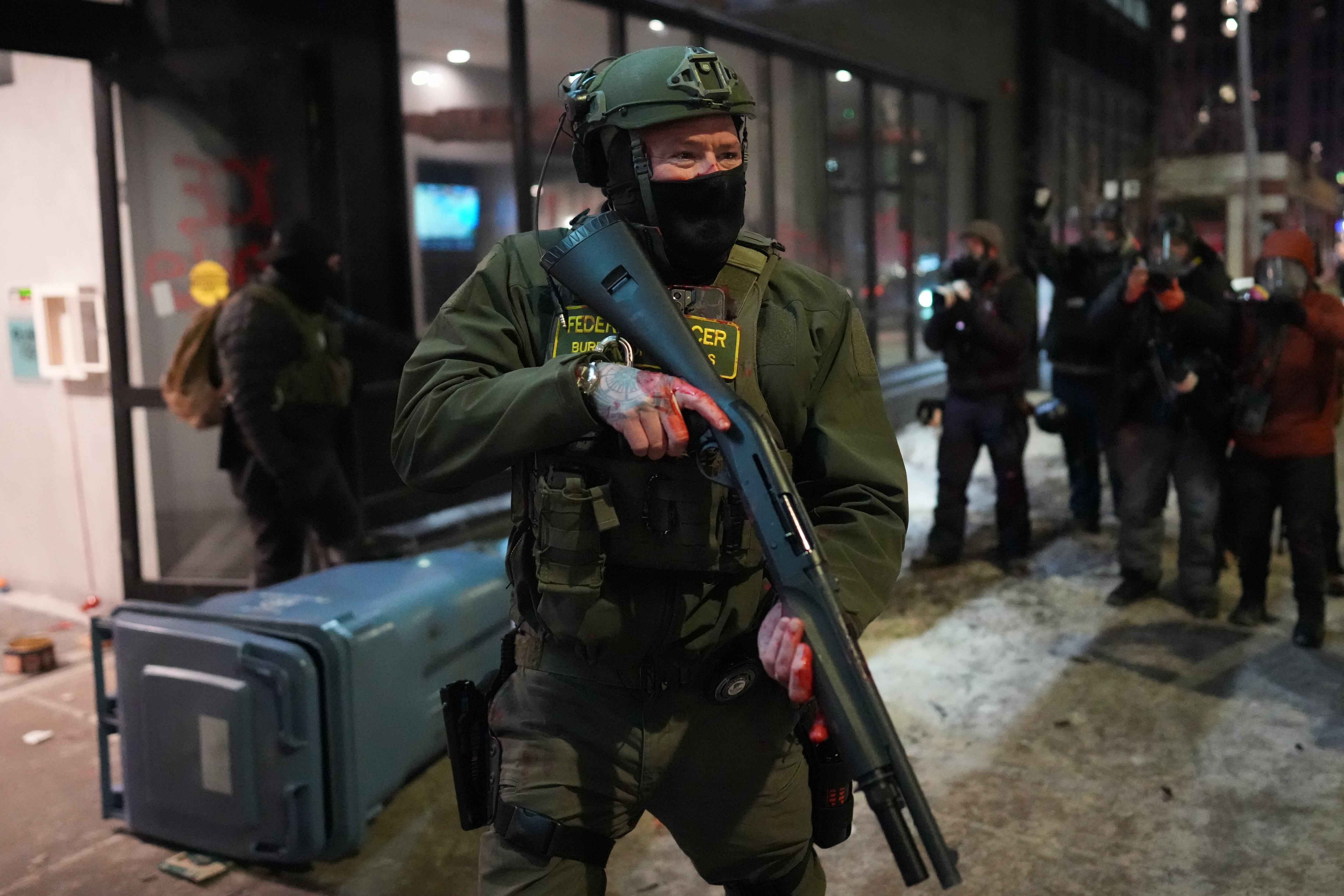
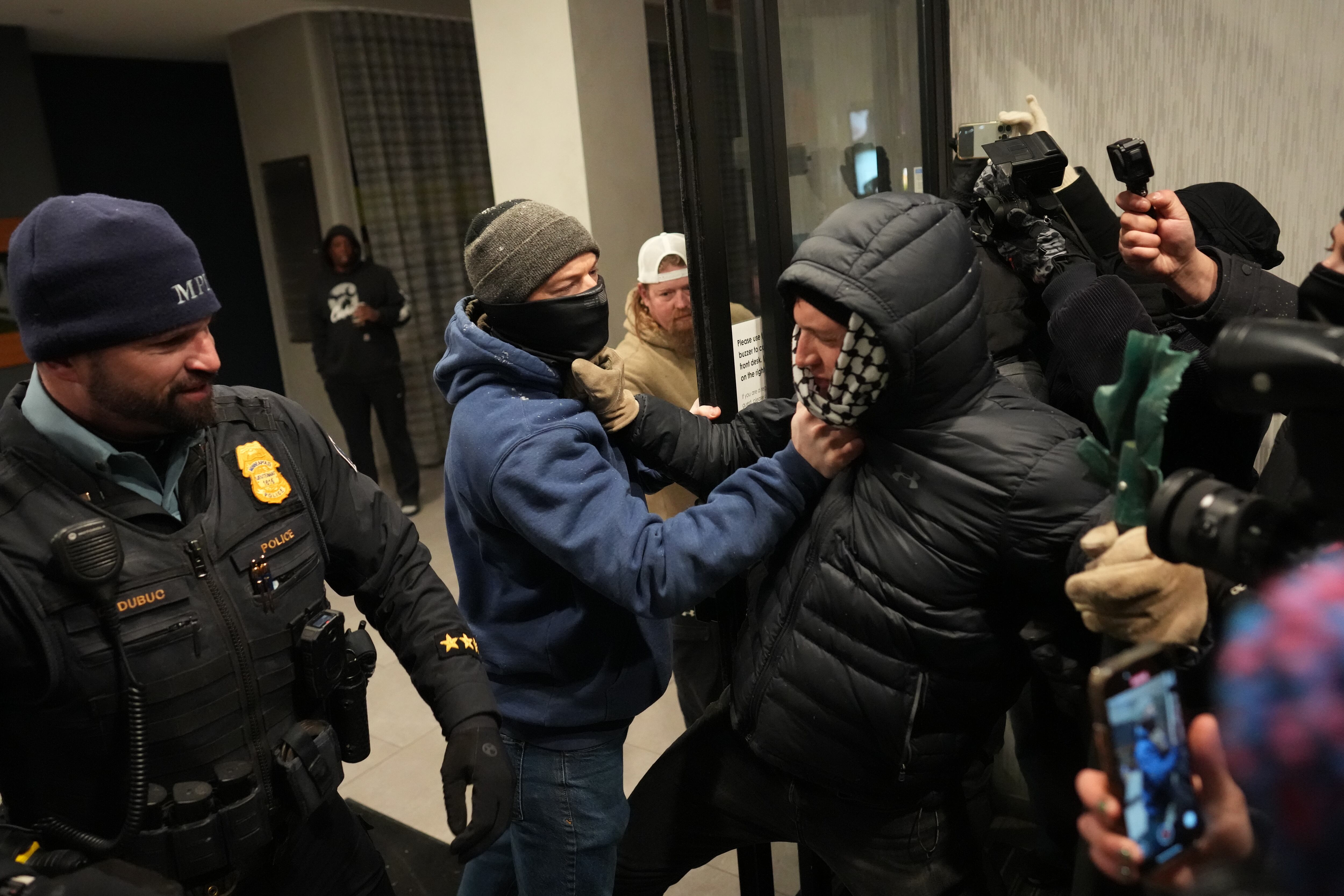
On Sunday night, protesters targeted a Minneapolis hotel where federal agents were believed to be staying, blocking a major avenue on the edge of the University of Minnesota campus.
A freelance photographer working for The Associated Press saw smashed glass in the hotel lobby, as well as graffiti with obscenities and threats directed at ICE.
A Minneapolis police officer was inside the hotel and tried to provide aid to a federal agent who was injured. More officers from local and state agencies planned to move in to “deescalate the situation, and make arrests,” Minneapolis police said Monday in a statement.
But as they began to reach the scene and arrested two people, federal agents arrived and “deployed chemical munitions,” the police statement said. A DHS spokesperson said a statement on the situation would be provided later Monday.
___
Associated Press writers Jack Brook in Minneapolis and Mike Catlaini in Trenton, New Jersey, contributed to this report.
___
This story has been corrected to show the judge’s name is Katherine Menendez, not Kathleen.
Copyright 2026 The Associated Press. All rights reserved. This material may not be published, broadcast, rewritten or redistributed without permission.