
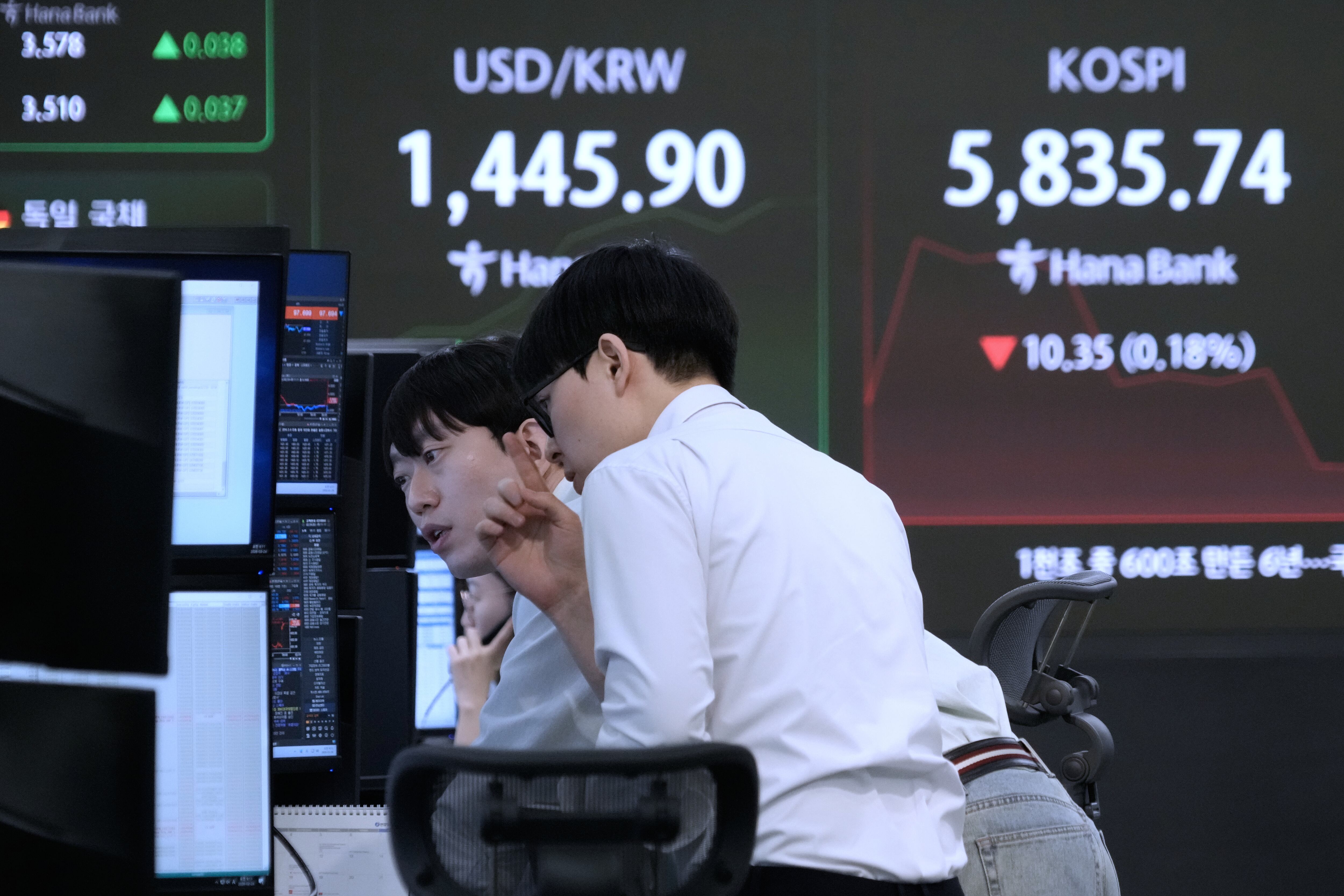


BANGKOK (AP) — Asian shares were mixed Tuesday after U.S. stocks slumped on heavy selling of shares in companies that could be losers in the artificial-intelligence boom.
U.S. futures climbed and oil prices also gained.
Tokyo’s Nikkei 225 index surged 0.9% to 57,354.14 as computer-chip related companies advanced. Chip testing equipment maker Advantest was up 4.6%, while machinery maker Disco Corp. added 2.2%.
Markets in mainland China gained more than 1% as they reopened following a weeklong holiday, but Hong Kong's Hang Seng fell as traders locked in profits from recent gains, slipping 1.9% to 26,564.01.
The Shanghai Composite index rose 1.2% to 4,129.78.
In South Korea, the Kospi picked up 1.8% to 5,951.90, setting fresh records on gains for Samsung Electronics, which jumped 3.2%. SK Hynix, another chip maker, was up 4.8%.
In Australia, the S&P/ASX 200 edged 0.1% lower to 9,014.50, while Taiwan's Taiex gained 2.4%.
India's Sensex fell 0.3%.
Tuesday will bring President Donald Trump's State of the Union address.
On Monday, U.S. stocks slumped after Trump ramped up his newest tariffs.
The S&P 500 fell 1% to 6,837.75 after Trump said he would place temporary 15% tariffs on other countries following a Supreme Court ruling that struck down his sweeping “reciprocal” taxes on imports from around the world.
The Dow Jones Industrial Average dropped 1.7% to 48,804.06. The Nasdaq composite sank 1.1% to 22,627.27.
Trump’s quick move toward more aggressive tariffs shows how much uncertainty still hangs over the global economy, even after the Supreme Court said the president lacked the legal authority to institute his sweeping “reciprocal” tariffs.
Investors may be sensing it will take a long time, as well as more court battles, before more clarity comes about how global trade will look.
On Wall Street, big losses hit companies under suspicion of getting undercut by AI-powered rivals.
CrowdStrike fell 9.8% to widen its loss for the young year so far to 25.3%. A new tool from Anthropic that scans codebases for security vulnerabilities and suggests targeted software patches for human review has been hitting stocks across the cybersecurity industry.
AppLovin sank 9.1% and took its loss for the year to date to 43.5%. It’s among the software companies hurt by worries that AI competition will steal customers and fundamentally reset their industries.
More big moves may still be ahead for Wall Street this week, particularly with a profit report from Nvidia coming on Wednesday.
Worries are rising that companies like Alphabet and Amazon may be spending so much on Nvidia’s chips that they’ll never be able to recoup their investments through higher productivity and future profits.
Elsewhere on Wall Street, stocks of airlines fell after heavy snow and high winds canceled thousands of flights across the busy Northeast.
United Airlines lost 5.2%, American Airlines fell 4.9% and Delta Air Lines sank 3.7%.
Novo Nordisk’s stock that trades in the United States tumbled 16.4% after the Danish drugmaker said a trial for its CagriSema drug showed people lost a smaller percentage of their weight after 84 weeks than with a similar one made by rival Eli Lilly. Eli Lilly rose 4.9%.
Federal Reserve Gov. Christopher Waller said Monday that it’s a “coin flip” on whether the Fed will cut its main interest rate at its next meeting in March or stand pat again.
That's a notable shift from January, when he was one of the two Fed governors to dissent against the central bank’s decision to hold its key rate steady after three rate cuts at the end of last year.
Lower rates would give the economy a boost, and Trump has been pushing hard for them. But they also could risk worsening inflation.
In other dealings early Tuesday, U.S. benchmark crude oil gained 57 cents to $66.88 per barrel. Brent crude, the international standard, was up 59 cents at $71.70 per barrel.
Crude prices have been gaining on worries that President Donald Trump might take military action against Iran.
The U.S. dollar rose to 155.16 Japanese yen from 154.66 yen. The euro fell to $1.1775 from $1.1786.
The price of bitcoin fell 2.4% to $63,330.
___
AP Business Writers Matt Ott and Stan Choe contributed.
Copyright 2026 The Associated Press. All rights reserved. This material may not be published, broadcast, rewritten or redistributed without permission.