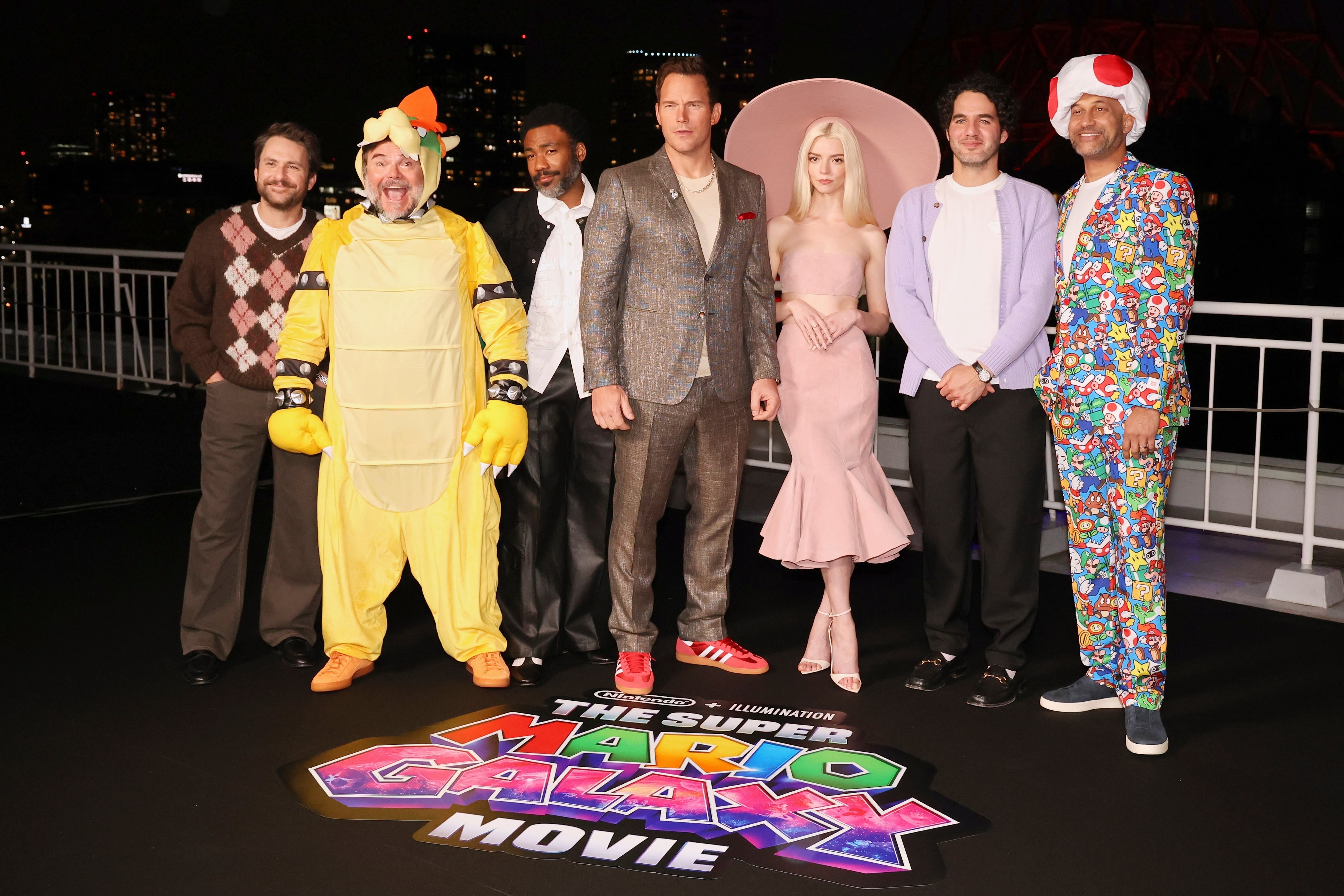


NEW YORK (AP) — As “The Super Mario Galaxy Movie” lands in theaters, coloring stations, collectible popcorn containers and mascot Marios are all in place to entice arguably the most prized moviegoers to Hollywood today: kids.
By Sunday, Universal Pictures expects the five-day opening of the “Super Mario” sequel to reach $186 million domestically, and around $350 million worldwide. That would make it easily the biggest hit of the year, surpassing a pair of successes that also launched with young moviegoers in mind: Pixar’s “Hoppers” ($297 million worldwide) and Amazon MGM’s “Project Hail Mary” ($300.8 million).
It’s not the start of a new trend but the culmination of one. In 2024, PG-rated movies outgrossed any other rating for the first time in decades, with $3.18 billion in domestic ticket sales according to Comscore. Five of the top six movies worldwide were PG movies: “Inside Out 2,” “Moana 2,” “Despicable Me 4,” “Wicked” and “Mufasa: The Lion King.”
Last year was no different. PG-rated films amassed $2.96 billion, again besting the longtime leader, PG-13. The top draws globally were “Ne Zha 2,” “Zootopia 2,” “Lilo & Stitch,” “A Minecraft Movie” and the PG-13-rated but not exactly kid-adverse “Avatar: Fire and Ash.”
Good news has been hard to come by in Hollywood. Contraction, most recently with Paramount Skydance’s planned purchase of Warner Bros. Discovery, has added to the anxieties of an already jittery industry. While ticket sales are up so far in 2026, they remain more than 20% below pre-pandemic levels. In February, AMC, the nation’s largest exhibitor, said it would continue to shutter underperforming theaters.
But despite a lot of talk about the imperiled future of moviegoing, future moviegoers — kids — are turning out in droves.
“There’s a recognition that this is an increasingly important group of movie fans and we’re doing everything we can to make sure their experience is wonderful,” says Michael O’Leary, president and chief executive of Cinema United, the trade group for theater owners.
Gen Alpha, those aged 12 or younger, may even be the movies’ best hope. A study last year by the National Research Group found that no generational group wanted to watch movies on the big screen, as opposed to at home, more than Gen Alpha.
“We’re emboldened by some of the research that indicates younger folks are the fastest growing demographic of people going to the movies,” O’Leary says. “We’re very much focused on the fact that we have to build the next generation of movie fans.”
Mario, Minions and more
In 2023, “The Super Mario Movie,” part of Universal’s collaboration with Nintendo and “Minions”-maker Illumination, grossed $1.36 billion. Its sequel is likely to get close to that, and add to a mounting string of $1 billion kids movies. The most recent was The Walt Disney Co.’s “Zootopia 2,” which became the highest-grossing Hollywood animated film of all time with a whopping $1.87 billion.
Increasingly, a generation that grew up with smartphones, iPads and Netflix is propelling today’s biggest blockbusters.
“What’s been true for a long time and is maybe even truer today: Families want to be out,” says Jim Orr, distribution chief for Universal, which recently announced the expansion of its exclusive theatrical window from three weekends to five. “They want to do things. They want to make memories.”
“No one talks about: Remember that great time when we sat on the couch?”
And this year may be the most kid-catered year at the movies yet. There are 26 wide-release PG movies slated for 2026, up from 24 in 2025 and 18 in 2024.
That includes a summer lineup that’s family friendly on a nearly week-to-week basis. Potential blockbusters lined up include “Toy Story 5” (June 19), “Minions & Monsters” (July 1) and the live-action “Moana” (July 10). Though currently unrated, “The Mandalorian and Grogu” (May 22) and “Supergirl” (June 26), not to mention “Spider-Man: Brand New Day” (July 31), will all also target young moviegoers.
A PG comeback
The PG surge comes several years after most family movies detoured to streaming during the pandemic, a shift that some, at the time, feared would become permanent.
“The family film has literally come back from near-extinction,” says Paul Dergarabedian, head of marketplace trends for Comscore. “The one genre that really took a major hit with the pandemic was the family film.”
But kids increasingly count among a key category for theaters: the habitual moviegoer. That’s considered going to six or more movies a year. And it’s not just younger kids. Last year, 41% of Gen Z moviegoers went to the movies at least six times, according to NRG, up from 31% two years earlier.
For cinephiles who have long feared movie theaters effectively turning into mini theme parks, the predominance of kid-oriented franchise blockbusters is unlikely to allay those concerns. Mid-budget, adult releases are increasingly rare. Dramas and comedies have struggled to attract audiences. Family-friendly movies occupying a bigger slice of cinemas is partially because adult moviegoing has waned.
But if older moviegoers are harder to coax away from the couch, families have been more eager. For them, the appeal of getting out of the house, despite rising ticket costs or the options on streaming services, is as strong as ever.
“In many instances, they’re going to the theater to get away from all of the other screens that inhabit their lives,” says O’Leary. “When I was a kid, you went to the movies, in part, to escape from something. So it’s a new variation on that old theme.”
Dergarabedian has taken to calling PG the new PG-13. If slightly adult-leaning movies once occupied the center of the multiplex, that territory now belongs to the PG movie.
“The kids that are going to the movies today are going to take their kids tomorrow,” Dergarabedian says. “As long as people keep making kids, the future of the movie theater experience is assured.”
Copyright 2026 The Associated Press. All rights reserved. This material may not be published, broadcast, rewritten or redistributed without permission.