

This World Cup has prompted some questions we simply can’t answer for you.
Can anyone stop Messi? Did Merlin the duck like wearing that jersey? What would have happened if the Congo’s statue fan had to sneeze?
That said, if you’re a first-time soccer watcher still confused by all this footie, we’re here to help! Free kicks, hydration breaks, stoppage time, the situation with Folarin Balogun ... there’s a lot to know. We put out a call for your burning World Cup questions — and we’ll keep answering them if you have more. We’re compiling answers to your FAQs below.
Now to some new questions...
Has what happened with Balogun ever happened before at a World Cup?
Not for 64 years. Back then, in the 1962 World Cup and at a time when there were no physical red cards in soccer, Brazil midfielder Garrincha was sent off the field by the referee in the semifinals for kicking a Chilean opponent away from the ball. However, Garrincha escaped a ban for the final — a scenario Brazil officials feared — as a result of the intervention of host nation Chile’s president, who argued that Garrincha should be allowed to play. The Balogun case differs slightly in the sense that his ban for the red card was placed on suspension for one year.
How are World Cup referees chosen and vetted?
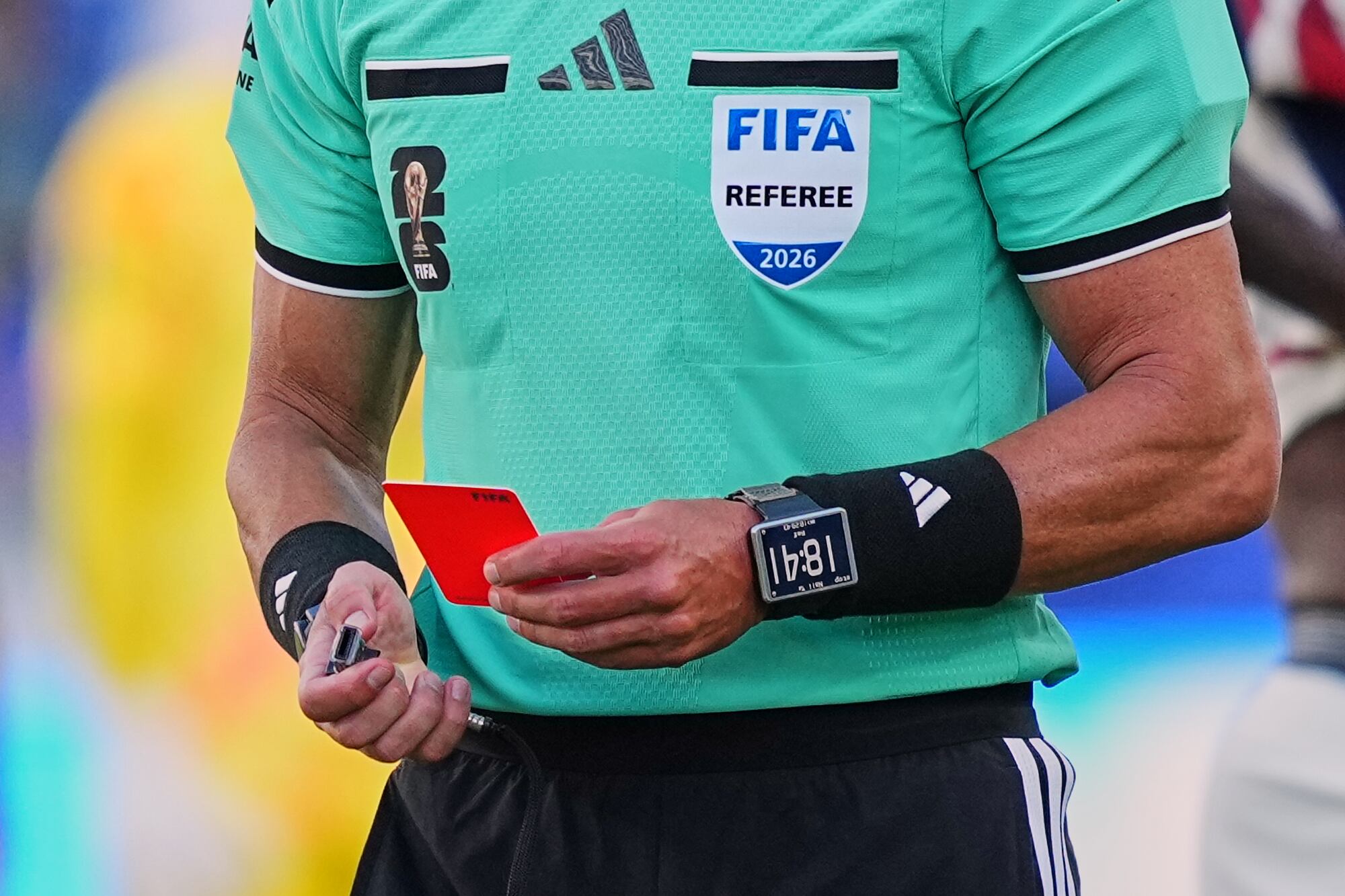
Brazilian ref Raphael Claus — the match official President Donald Trump described as “a little bit suspect” in light of the red card for Balogun — was one of 52 referees selected for the tournament based on their “quality and consistency of performances” over the previous three years in international and domestic competitions, FIFA says. They’ve been monitored, attended seminars and even received support from mental specialists. “The very best in the world,” is how FIFA referee chief Pierluigi Collina put it.
Who are the kids accompanying players at the beginning of matches?
Lucky souls, aren’t they? Those children holding hands and sometimes talking with the best soccer players in the world before games are officially called “player escorts” — even though many would describe them as “mascots.” One of FIFA’s sponsors is food company Quaker, who has teamed up with dozens of community organizations to give kids “from underserved communities” the chance to walk players onto the field.
Why do Americans call it ‘soccer’?
First of all, it’s not just Americans — looking at you, fallen brethren in Australia, New Zealand, South Africa and Canada. While all the teams that call it “soccer” and not “football” may have been knocked out, England — the birthplace of the sport — is hanging in there in the quarterfinals and still flies the “it’s called football!” flag. That’s despite the word “soccer” actually being coined in Britain, perhaps as far back as the 1880s. The exact date it was first used is not known, but it is widely believed “soccer” was derived from “association football,” which was the first official name of the sport. “Soccer” is not a commonly used term in Britain these days and some Brits often roll their eyes when they hear others use the word instead of “football.” But given the U.S. has its own version of football, surely it’s OK to use “soccer” as a differentiator, right?
What does it take to rain out or delay a game?
Soccer isn’t like cricket or tennis or baseball — it can be played through heavy rain. If it gets too heavy, though, the referee has the authority to bring a halt to, or abandon, a match owing to poor weather conditions that affect the field or the surrounding areas. Storms have been an issue at this World Cup — one caused a delay of around two hours during the group game between France and Iraq — and a rule used by FIFA pauses games for 30 minutes if lightning is detected within 8 miles (up to 13 kilometers). Each strike resets the clock. World Cup regulations state that if a match was to be abandoned after it had kicked off, it restarts “at the minute at which play was interrupted rather than being replayed in full, and with the same scoreline.”
What happens if teams are still tied after five penalty kicks?
In that case, the shootout then goes to the forebodingly named “sudden death.” That means the teams take extra rounds of penalties — one attempt each — until one scores and one doesn’t. On some occasions, even the goalkeepers end up taking a penalty. The shootout can go on for quite some time, like in the Israeli third-tier promotion playoff between F.C. Dimona and Shimshon Tel Aviv in 2024, when 56 shots were needed before Dimona prevailed 23-22.
Can you drink alcohol at the soccer games?
Yes! Unlike at the Paris Olympics venues or the Qatar World Cup stadiums, alcoholic beer is available at World Cup venues. Michelob Ultra and Budweiser are the official sponsors. Stadiums can also offer cocktails and hard seltzers for sale.
How does the size of a soccer pitch compare to an NFL field? And why is it called a pitch, anyway?
Put simply, NFL fields are longer and narrower. According to the NFL rule book, “the game shall be played upon a rectangular field, 360 feet in length and 160 feet in width.” In yards, that’s 120 x 53.3, or in meters, 110 x 49. The recommended dimensions of a soccer field in yardage, FIFA says, is 115 x 74 yards (345 x 222 feet, 105 meters x 68 meters), though they can vary slightly. As for the widely used “pitch,” that’s just a term the English use for a field. Some say it’s because goalposts were pitched into the ground for matches in the 19th century.
Here’s our previous round of No Dumb Questions...
OK, let’s start with the real basics: What does ‘offsides’ mean?
Well, first off, it’s “offside,” per the AP Stylebook. Secondly, this is a common question — and one that can make you appear a soccer aficionado if you know the answer. Essentially, a player is offside if he or she is closer to the opponent’s goal line than the ball and second-to-last opposition player (the goalkeeper is usually the last) the moment the ball is passed by a teammate. There are various caveats — for example, you cannot be offside inside your own half — but that is the gist. It can be confusing and a source of great debate.
When a team loses a player due to a red card, does it play with just 10 men the following match?
No, the team only plays short-handed for the rest of the current match.
A red card, which is handed out by an official when a player does something naughty like intentionally striking another player, means the player has been ejected and must leave the pitch. From that point on, the team would play a “man down,” meaning it can only field 10 players instead of 11. In some cases, teams have had two red cards in a single game and had to play with nine.
The player must serve a one-game suspension for the following match. However, the team itself is not penalized, and can return to its full starting strength of 11 players.
How many players are at this World Cup in total? How many of them are first timers?
Each of the 48 teams were allowed 26 players on their roster, so 1,248 players. Of those, more than half — 891 to be exact — are participating for the first time.
Why are World Cup tickets so expensive?
A lot people would like to know that. FIFA came under scrutiny about a month before the tournament for their high-price tickets and sales tactics, leaving some fans upset. That caused demand for the tickets to drop, while other fans had to make tough financial sacrifices.
Why isn’t it free to watch on TV?
They are free — if you have a subscription to Fox or Telemundo through a cable provider or streamer. Every single game of the World Cup is fully televised on Fox and FS1. Matches can also be streamed live on the FOX One app.
How are the teams selected and groups determined?
The 48 teams in this year’s World Cup qualified through regional tournaments. (Host countries — in this case the U.S., Canada and Mexico — receive automatic bids.)
As for how the 12 groups are determined, the 48 teams are divided into four, 12-team “pots” based primarily on the FIFA World Rankings. The first pot includes the host nations and then the top nine highest-ranked teams. The next 36 highest-ranked teams are divided into sequential pots of 12. Teams are then drawn at random, meaning that every group contains exactly one team from each of the four pots.
Can some qualify to play for a country without being a citizen?
A player doesn’t necessarily have to be born or raised in the country to play for the team. But there are some restrictions to prevent countries from stacking their rosters. If a player has a biological parent or grandparent who was born in the territory of the country, or if they have established residency in the country for at least five years, they would be allowed to play.
Why is there only one official on the field, given that the pitch is bigger than in American football?
There are actually four officials for every World Cup match, although they may not be as prominent as in an American football game. The head referee controls the match and enforces the rules of the game, while two assistant referees manage offside calls, throw-ins, and goal kicks. A fourth oversees substitutions, team benches, and indicates stoppage time.
How do teams decide which uniform to wear during games?
In World Cup play it’s FIFA that determines uniform combinations, not the teams. The governing body’s primary objective is to ensure strong visual contrast on the pitch so players, referees and television viewers can easily tell the teams apart. So basically, you will never see teams wearing two shades of blue in the same match.
And if you missed our first round of No Dumb Questions...
Why doesn’t the clock stop for penalties and injuries?
Unlike American football, basketball or hockey, the clock never stops in soccer. If there are delays for such things as injuries, blatant time-wasting or the aftermath of goals, those seconds or minutes are added on at the end of each half in a period called “stoppage time.” There’s an extra twist in this World Cup: hydration breaks. These three-minute stoppages in the middle of each half have been introduced to help players deal with the summer heat in the United States, Canada and Mexico (they’re also a convenient spot for extra TV ads). Those three-minute blocks must also be added to the overall stoppage time, meaning there is typically at least five minutes of extra play in each half of this World Cup.
What’s the difference between a free kick and a penalty kick?
Well, both are dead-ball situations and given after fouls. The key difference is that a penalty kick is awarded after a foul inside the penalty area — the big rectangle drawn near the opposing goal — and a free kick is awarded outside the penalty area. A penalty is a free shot at goal — from the designated spot, which is central and 12 yards (11 meters) out — with just the goalkeeper able to stop the shot. A free kick can be defended against by a whole team and is taken from where the offense occurred.
What was the tiebreaker if teams ended up with the same number of points in the group stage?
Starting from this World Cup, head-to-head results between two or more teams tied on points were the first tiebreaker — instead of overall goal difference. The second tiebreaker was goal difference in the games between the teams concerned, followed by the highest number of goals scored in those games. Only then — as a fourth tiebreaker — did overall goal difference come into play.
What’s the deal with the 5-second throw-in rule?
It’s another new measure being implemented at this World Cup with the intention of speeding up play and stopping time-wasting. If referees deem a player is taking too long on a throw-in, they can start a visual five-second countdown. If it reaches five seconds, the throw-in will be awarded to the opposing team. And it has already happened, with Bosnia-Herzegovina defender Sead Kolašinac giving up a throw-in for taking too long against Canada.
Off the pitch ... are Heinz bottles really taped over at stadiums? Why are logos being covered?
Yes, eagle-eyed reporters and fans have noted that logos on bottles of condiments — such as ketchup from Heinz — have been taped over inside stadiums. This is a directive of FIFA, the soccer governing body always very careful to protect its official partners and sponsors and give them exclusive visibility at stadiums. For the same reason, stadiums named after a sponsor — such as Gillette Stadium near Boston — have been renamed for the tournament by FIFA, which is instead using generic names.
So how much annual PTO do Europeans get anyway?
Wondering how fans of these top European soccer nations can be spending so many weeks in North America, are you? Well, the Europeans do love their soccer and this supersized tournament will have been in the diary for years. The amount of vacation days employees get vary from country to country. In the U.K, for example, most workers receive at least 28 days of paid annual leave per year. In France, they get a minimum of 30 working days. In Spain, it’s 22.
___
See more of AP’s World Cup coverage here
Copyright 2026 The Associated Press. All rights reserved. This material may not be published, broadcast, rewritten or redistributed without permission.