

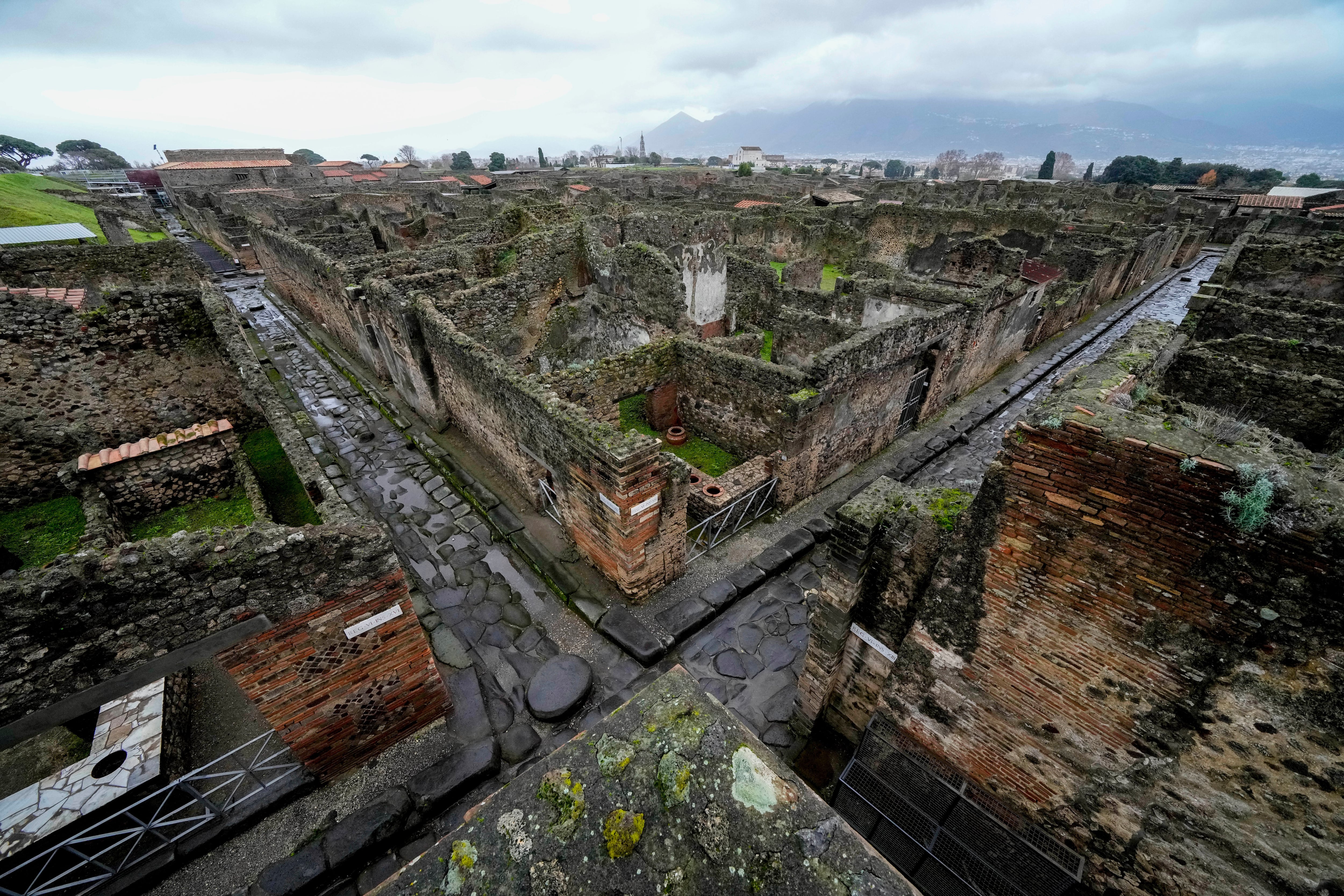
POMPEII, Italy (AP) — More than 20 plaster casts of victims who died in the catastrophic volcano eruption in Pompeii went on display for the first time Thursday in a permanent exhibition.
The casts, which scholars call “imprints of pain,” dramatically capture the position each resident was in when they died in 79 AD. The reproductions were created by pouring liquid plaster into the voids left by the decomposed bodies in the hardened ash.
Curators wanted to “give dignity to these people who are like us -- women, children, men -- who died during the eruption, but at the same time make it understandable,” said Gabriel Zuchtriegel, director of the Archaeological Park of Pompeii, adding that they want people ”to understand what really happened in Pompeii."
Invented by Giuseppe Fiorelli in 1863, the technique to create the plaster casts faithfully preserves the position, expression of pain and clothing details of the victims, making them unique testimonies. It is still used by the team of scholars conducting research at the archaeological park of Pompeii.
Pompeii is the only known site that allows the recovery of this type of evidence, enabling visitors to see the reproduction of objects that were destroyed and the people who lived and died at that moment.
The eruption of Mount Vesuvius killed an estimated 2,000 residents within the city, with total regional casualties reaching up to 16,000. The city of Pompeii was covered by ash, then later solidified by pyroclastic flows.
During the excavations in Pompeii, the remains of over a thousand victims of the eruption were found trapped in their homes or shelters, buried by a rain of pumice stones and volcanic rock, or killed by the collapse of roofs and walls under the weight of the volcanic debris, which reached a height of about three meters (about 10 feet.)
The 22 casts were chosen among the best preserved remains. The victims were found across the city, from the inner areas to the gates and roads leading out of the town, where the inhabitants fled in search of safety.
“They have a strong emotional impact on visitors and can be very moving," said Silvia Martina Bertesago, archaeologist at the Pompeii Archaeological Park.
“Through the analyses we can carry out today with increasingly advanced techniques, we can also understand their age and sex, but also whether they had particular diseases or particular types of diet,” she said.
The exhibition is housed in the porticoes of the Palestra Grande, located opposite the Amphitheatre. As well as an area dedicated to human remains, it also includes displays of findings such as plants and food that remained buried for centuries under meters of ash and lava.
Copyright 2026 The Associated Press. All rights reserved. This material may not be published, broadcast, rewritten or redistributed without permission.