

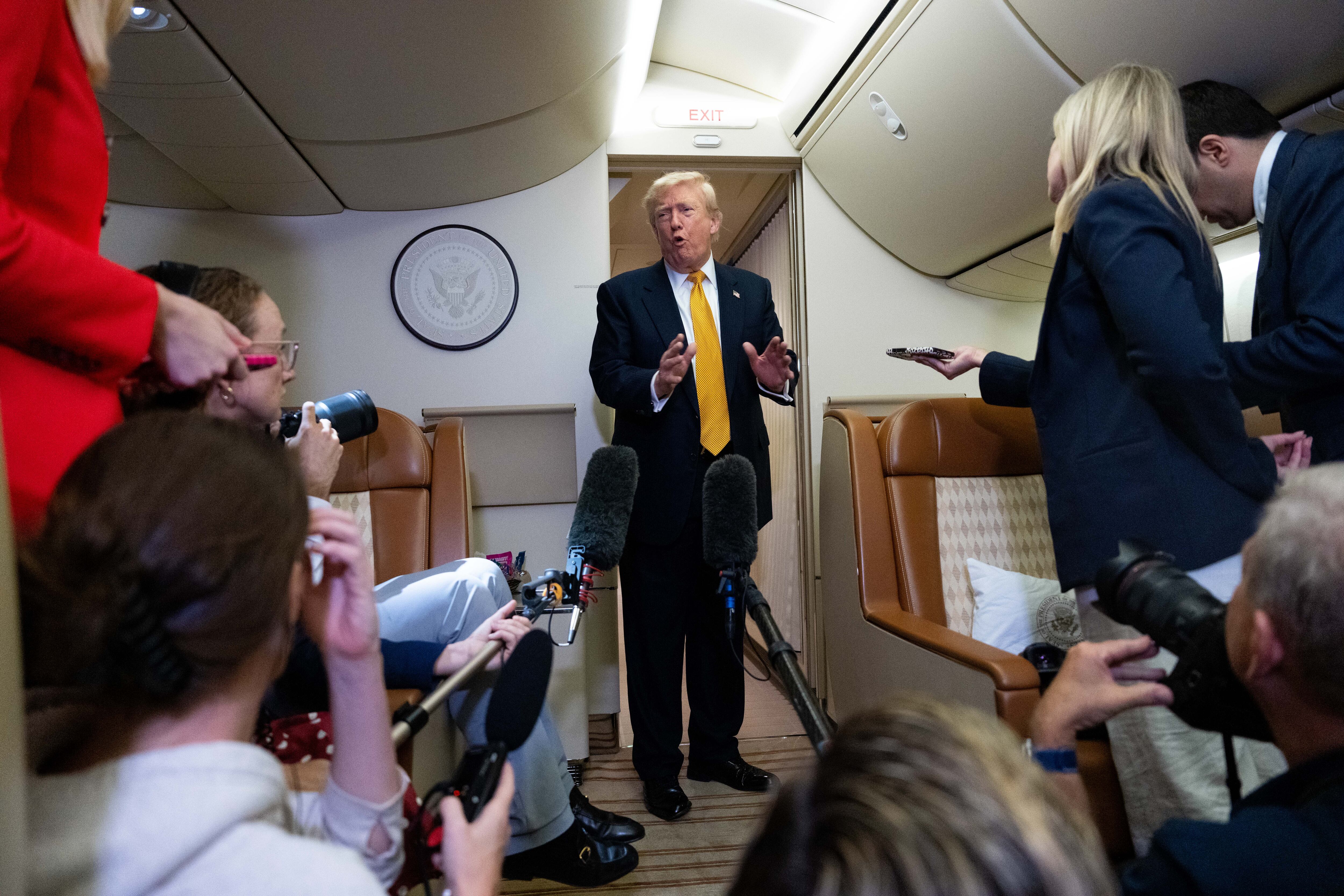
WASHINGTON (AP) — President Donald Trump's administration sought phone records of several New York Times journalists and even those of some of their relatives, according to a motion unsealed Monday — an unusually aggressive attempt to unmask the confidential sources of reporters who wrote about Trump’s Qatari-gifted Air Force One jet.
The push by the Republican president's administration to compel the identity of sources in the form of additional subpoenas comes at a time when the executive branch's relationship with the press is increasingly contentious. The efforts, described in a letter-motion filed by the Times over the weekend, were more expansive than previously known, the newspaper noted, and also covered a time frame that exceeded the news articles in question.
“Two of the subpoenas seek records beginning on January 1, 2026, long before the events that are purportedly the basis for the Department’s investigation,” lawyers for the Times wrote in the letter. “That timeframe strongly suggests that the Department is using this investigation not to focus on any purported concerns arising from the July 8 and 9 articles, but instead to forage for information about the Journalists’ source relationships more broadly.”
Government has said reporters aren't the target
The phone records subpoenas are on top of grand jury subpoenas served July 10 on three journalists that sought to compel testimony from the reporters about the identify of their sources. The Times has separately challenged those grand jury subpoenas and U.S. District Judge Arun Subramanian is scheduled to hear arguments Thursday. The judge has also frozen enforcement of the phone records subpoenas pending a ruling on the newspaper's motion to quash those.
Lawyers for the newspaper noted that some of the phone records subpoenas were issued on the same day as the grand jury ones, an additional one was issued on July 14 and another was issued on July 16 — after the Times had already moved to quash the grand jury subpoenas.
In arguing for the phone records subpoenas to be spiked, the Times said the government had acted in “bad faith” and had ignored its own protocols by not giving the journalists advance notice that records were being sought and by demanding the information “without first conducting any serious investigation.”
The newspaper’s lawyers said the additional subpoenas call “into question the accuracy” of testimony given last week by Jay Clayton, the U.S. attorney in Manhattan, where the grand jury subpoenas were issued. At his confirmation hearing to be the Trump administration's director of national intelligence, Clayton said that “we followed the protocols” and that the government had taken “the least intrusive possible” steps possible.
The Justice Department has justified the grand jury subpoenas by saying that “reporters are not the targets, those leaking classified information are.”
The additional subpoenas included a request for phone records of one reporter's mother and two of the journalists' spouses. The motion noted that the mother in question is a mental health professional with confidential client relationships and that one of the two spouses is the general counsel of a law firm.
"The disclosure of additional subpoenas for confidential newsgathering information of the Journalists is deeply concerning, revealing yet another instance of the alarming pattern of conduct detailed in the Motion to Quash,” the news organization’s lawyers wrote.
“These actions demonstrate abuse of the grand jury process, continued bad faith attacks on the Journalists, violations of the Department’s own internal regulations and disregard for the law in this Circuit intended to protect critical First Amendment interests," the motion stated.
In a response posted Tuesday morning, the Justice Department said that it had complied with its own regulations in issuing the subpoenas and that it had taken investigative steps before seeking them. The department said it was authorized to delay disclosure of the subpoenas but had decided to alert lawyers for the journalists to give them an opportunity to challenge.
“Any subpoenas served for a phone number not used by one of the movants was a result of information in a law enforcement database indicating that the phone number was associated with the movant,” lawyers for the department said, “If the Government determines that these phone numbers were not used by the movants, the Government will not pursue the corresponding subpoena(s).”
It's part of an ongoing legal challenge
The grand jury subpoenas, delivered to reporters at their homes, marked a dramatic escalation of the Trump administration’s crackdown on media leaks that free press advocates swiftly condemned as a government effort to intimidate news organizations. It followed an FBI search earlier this year of a Washington Post reporter’s home and the seizure of her electronic devices.
The new jet in question, a present from Qatar that Trump’s administration spent $400 million to retrofit and upgrade, recently entered service. But Trump used an older model Air Force One jet to leave a NATO summit in Turkey earlier this month.
The Times, citing anonymous sources, reported that the switch had come at the urging of the Secret Service and that the newer plane lacked some of the advanced security features of the older Air Force One aircraft, including antimissile capabilities. On social media, Trump denied security concerns.
Trump's administration has clashed with the press, from newspapers to TV networks to the Voice of America, on multiple fronts since he returned to office last year. The methods include lawsuits, administrative actions and public threats.
The First Amendment of the U.S. Constitution guarantees the press' ability to operate free of governmental restrictions.
The Associated Press is currently battling the Trump administration in court over the White House's decision last year to bar AP journalists from the president's press pool after the news organization refused to rename the Gulf of Mexico to the “Gulf of America” as Trump demanded. AP style is to acknowledge the president's renaming but retain the term “Gulf of Mexico" because parts of it lie outside U.S. jurisdiction.
Copyright 2026 The Associated Press. All rights reserved. This material may not be published, broadcast, rewritten or redistributed without permission.