


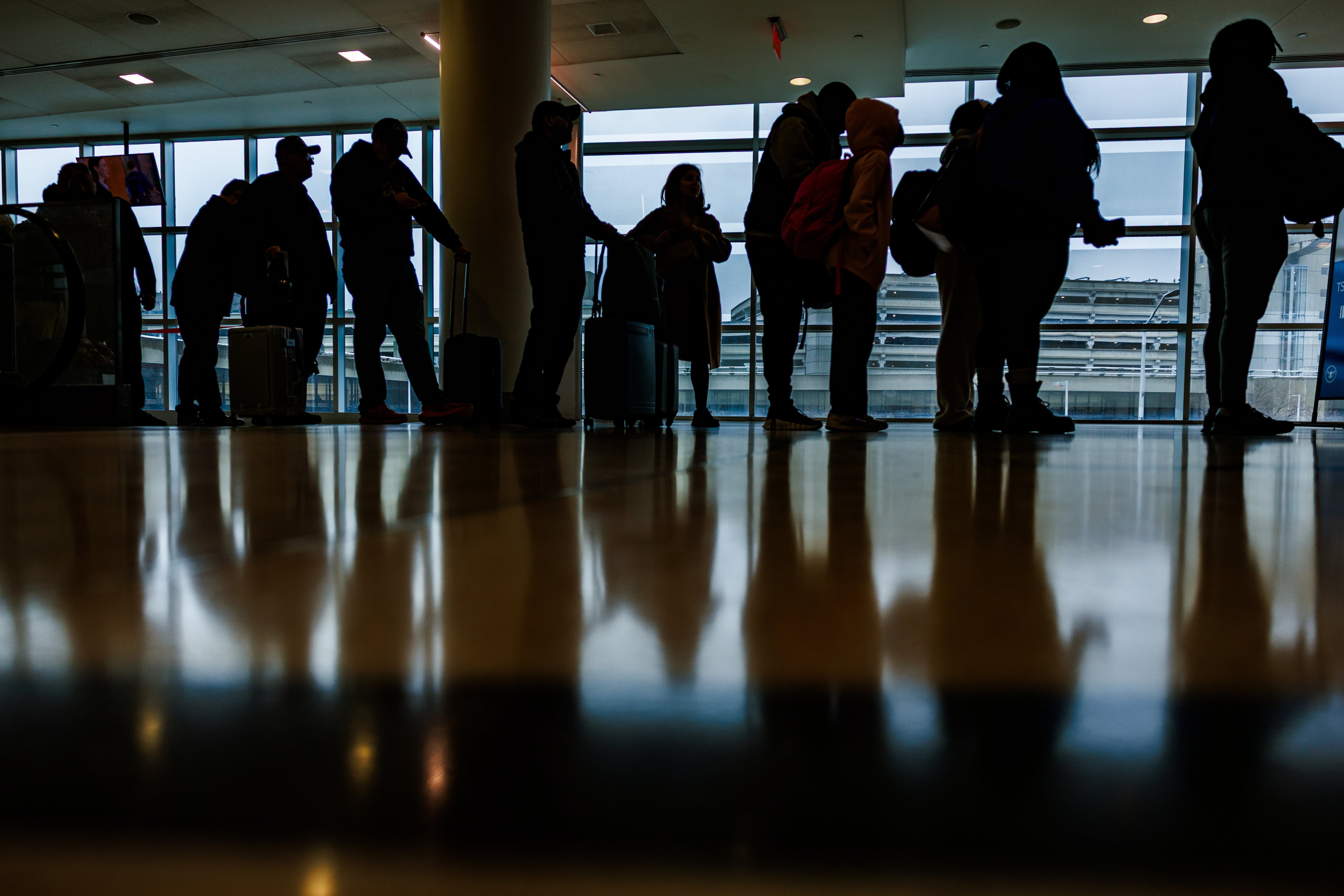

NEW YORK (AP) — Armed federal immigration officers in tactical gear moved through terminals at some of the busiest U.S. airports Monday, standing near security lines and checkpoints after President Donald Trump ordered their deployment during a partial government shutdown that has disrupted air travel nationwide.
The officers have not screened passengers or made arrests so far. The Trump administration said they would supplement Transportation Security Administration staffing at certain airports but provided few details about exactly what they would be doing.
After intensified immigration enforcement and protests in cities across the country over the past year, their presence has unsettled some travelers and raised new questions.
On Monday, Associated Press journalists observed Immigration and Customs Enforcement officers and agents patrolling terminals and lingering near long lines of passengers at Hartsfield–Jackson Atlanta International, John F. Kennedy International in New York, Newark Liberty International in New Jersey, George Bush Intercontinental in Houston and Louis Armstrong International outside New Orleans. A handful of other airports — including Phoenix's Sky Harbor International — also confirmed ICE would be on-site. Chicago Mayor Brandon Johnson said his office was monitoring the deployment of federal officers at O’Hare International.
Federal law enforcement officers are a routine presence at international airports. Customs and Border Protection officers screen arriving passengers, and Homeland Security Investigations agents conduct criminal inquiries tied to cross-border activity. But immigration agents are rarely visible at TSA checkpoints, the front line of domestic air travel.
ICE deployments arrive amid ongoing Washington impasse
Monday’s deployments came as hundreds of thousands of Homeland Security workers, including from the TSA, have worked without pay since Congress failed to renew DHS funding last month.
Funding for the department lapsed Feb. 14, when Democrats refused to fund ICE as well as Customs and Border Protection without changes to their operations after federal officers shot and killed Alex Pretti and Renee Good in Minneapolis. But, while routine funding used to pay TSA agents has lapsed, ICE and other immigration enforcement personnel are still receiving paychecks amid the shutdown — a result of Trump’s big tax cuts bill that became law last year.
Meanwhile, the budget stalemate impacting TSA only deepened as Trump rejected the latest offer, this one from his own Republican Party, after a weekend of negotiations.
White House staff pitched Trump on the idea of funding DHS, except for immigration operations that have been central to the dispute, according to a person a familiar with the situation who spoke on the condition of anonymity to discuss private talks. Still, Trump rejected that plan and later escalated his demands that senators also approve the so-called SAVE America Act, a strict proof-of-citizenship voting bill that has essentially no chance in the Congress.
On Monday, the White House also turned down a request from top Democratic negotiator, Sen. Patty Murray of Washington, to meet and continue talks, according to another person granted anonymity to discuss the private conversations.
Democrats are continuing to demand major changes to federal immigration operations — including policy changes that would require ICE officers to get a warrant from a judge before forcefully entering homes, to no longer allow officers to wear masks and to require that they provide clear identifying information on uniforms.
Unlike many recent immigration operations in U.S. cities, where federal agents have often worn face coverings, ICE officers at airports appeared to be largely not masked Monday, following an earlier direction by Trump.
Fears that the deployments will heighten tension
Some fear that positioning federal immigration officers at security checkpoints will only escalate tensions. Union leaders representing aviation workers stressed that ICE officers don’t have the same training and expertise as TSA workers.
Everett Kelley, national president of the American Federation of Government Employees — which represents TSA officers — said in a statement that his members “deserve to be paid, not replaced by untrained, armed agents who have shown how dangerous they can be.”
Whether ICE will have a more sweeping role beyond watching long lines and patrolling terminals has yet to be seen. On Sunday, Trump said federal immigration officers could guard exit lanes or check passenger IDs. The president has since suggested he could deploy the National Guard at airports too.
ICE and TSA have been “working together so far very well,” Trump said at Monday in Memphis. Still, he said he would “bring out the National Guard” if more personnel is needed.
Long wait times persisted at some major hubs Monday.
Atlanta’s Hartsfield–Jackson, for example, is still urging passengers to allow at least four hours for both domestic and international screenings. The check-in line for departing passengers was so long Monday that it snaked from the TSA screening area to the atrium, through the baggage claim and out the entrance doors with people in back of the line waiting outside. ICE officers were patrolling the terminal area, but not seen checking IDs or otherwise interacting with passengers.
Donna Troupe, who was flying from Atlanta to Miami, said she didn’t take issue with ICE’s presence at the airport — but also wasn’t sure how much they were needed. “When I’ve seen them, they’ve just been standing around talking,” she said.
Meanwhile, Daniela Dominguez, another traveler in Atlanta who was headed to Miami, said she was concerned that for some seeing ICE would be unnerving.
“I bet a lot of people have a lot of anxiety coming to the airport,” Dominguez said.
In New Orleans, John Hoffman arrived to the airport five hours before his flight to Spokane, Washington, after missing his trip the day before. He said security lines seemed to be moving quicker Monday as federal officers monitored lines — still, he questioned whether was worth the travel and lodging expenses to deploy ICE officers to various airports.
Beyond TSA operations, many travelers on the East Coast faced additional disruptions after a Sunday night collision that killed two people and injured dozens of others on the runway of New York’s LaGuardia Airport. LaGuardia was temporarily shut down as air traffic was diverted.
TSA workers have been going without pay
After weeks of missed paychecks, many TSA agents have called in sick — or even quit their jobs — as financial strains pile up. The staffing shortages have forced some airports to close checkpoints at times, with wait times swinging dramatically for travelers.
TSA call-out rates climbed over the weekend. Nationwide on Sunday, 11.8% of TSA agents missed work — the highest rate of the shutdown so far — with over 3,450 officers calling out, according to DHS. More than 400 officers have quit during the shutdown, the department said.
Some have accused the government of using TSA workers as pawns in the ongoing budget fight. And aviation unions have raised additional safety concerns in light of the Trump administration’s deployment of ICE officers.
“This latest threat of ICE invasion at the airports is another distraction from solutions that protect Americans,” a coalition of unions representing aviation workers — including the Association of Flight Attendants-CWA and International Association of Machinists and Aerospace Workers — said Sunday. TSA work “can’t simply be replaced” by federal immigration officers, they noted, adding that ICE’s presence and potential attempts to question passengers about immigration status may also “distract them from ensuring airport security.”
The unions called for TSA workers to be paid immediately.
___
Associated Press journalists Lisa Mascaro, Seung Min Kim and Tia Goldenberg in Washington; Emilie Megnien and Mike Stewart in Atlanta; Stephen Smith in New Orleans; Russ Bynum in Savannah, Georgia, and Rio Yamat in Las Vegas contributed to this report.
Copyright 2026 The Associated Press. All rights reserved. This material may not be published, broadcast, rewritten or redistributed without permission.