


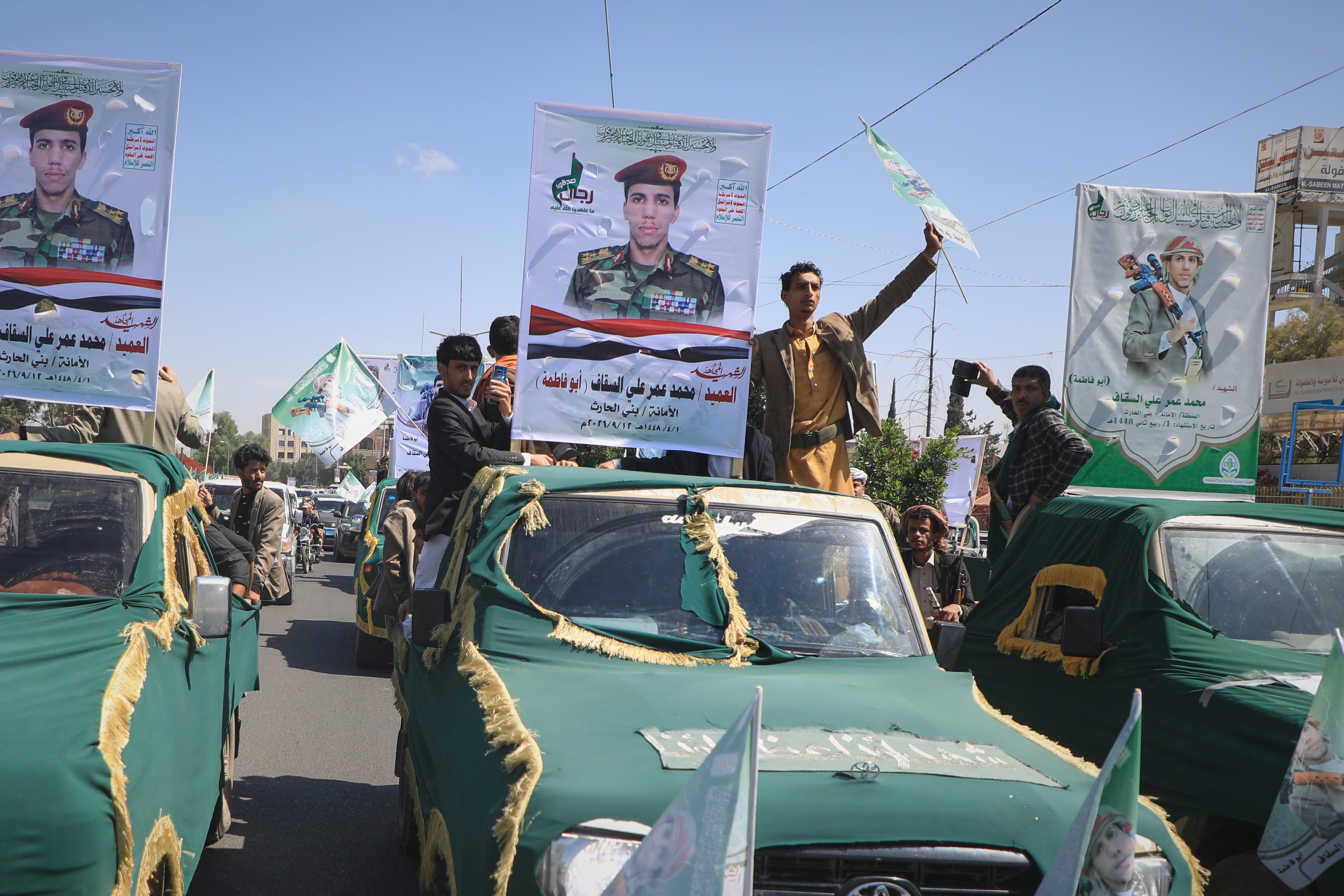

CAIRO (AP) — Saudi Arabia accused Yemen’s Iran-backed Houthi rebels of trying to attack Islam’s holiest city, as the region responded with condemnation Wednesday but no sign of military support. The kingdom, a key U.S. ally, declared Mecca a “red line” as it slid deeper into the new front of the Iran war.
With the world’s biggest oil exporter under fire from the rebels backed by the Saudis' regional adversary, the kingdom needs a safe outlet for its crude as well as military assistance. There's no clear path to either.
A crucial Saudi pipeline has been shut down, reportedly for weeks, after an attack by Iranian-backed militias in Iraq. The Houthis have been targeting infrastructure in the kingdom and its shipping on the Red Sea, where they have seized several islands in the Bab el-Mandeb Strait. And Iran is still targeting ships in the Strait of Hormuz. Oil prices remain above $100 a barrel.
The Houthis denied firing drones toward Mecca, about 1,100 kilometers (680 miles) from Yemen’s border. The Saudis said they intercepted and destroyed the drone before it entered the airspace over the birthplace of the Prophet Muhammad.
Turkey and Pakistan say the Saudis haven't asked for help
The attacks are the first test of a new defense pact among Saudi Arabia, NATO member Turkey and nuclear power Pakistan. But officials from Turkey and Pakistan told The Associated Press they have not received a Saudi request for support in response to the Houthis' escalation.
The Turkish official said efforts to “institutionalize” the alliance need to be completed before the pact becomes operational. The officials spoke on condition of anonymity because they were not authorized to speak publicly on the issue.
Amid the condemnation of the attempted attack on Mecca, Pakistani Prime Minister Shehbaz Sharif said his country and the Saudis stand “unwaveringly, shoulder to shoulder.” Turkey's foreign minister expressed solidarity and said no country can “remain indifferent,” state-run Anadolu Agency reported.
Criticism also came from the Organization of Islamic Cooperation, representing over 57 Muslim states, which said the attempt violates the “sanctity of holy sites.”
This was the second attempted attack by the Houthis against Mecca after the rebels fired a ballistic missile toward the city in 2017, according to Col. Turki al-Maliki, spokesperson for the Saudi-led military coalition fighting the rebels.
Houthis claim shooting down an F-15 fighter jet
Later Wednesday, the rebels claimed, without offering evidence, that they shot down an F-15 fighter jet operated by the Saudi-led coalition over Yemen's central province of Marib.
Houthi military spokesperson Brig. Gen. Yahya Saree didn’t say when it occurred, and The Associated Press could not independently verify the claim. The rebels at times take days to claim attacks.
Spokespeople for the Saudi-led coalition and the Saudi government didn’t immediately respond to a request for comment.
For now, the US is staying out of the fight
The United States has sold billions of dollars in weapons to Saudi Arabia and has committed to providing training and other support to protect the kingdom, but top U.S. officials in recent days have indicated a lack of desire to get involved in the conflict.
“The Houthis called us, and they don’t want to fight with us,” U.S. President Donald Trump said Saturday, adding that the rebels appear focused on the Saudis.
Vice President JD Vance on Monday said Washington had been in “constant contact” with the Saudis and had been “engaged in direct conversations with the Houthis themselves,” calling it “a very fluid and dynamic thing” to be monitored.
On the ground, forces with Yemen's internationally recognized government have said they are regrouping to combat the Houthis after fleeing the rebels' advance. But those forces are a collection of armed groups with varying aims.
The number of Yemeni civilians fleeing the fighting in the Arab world’s poorest country soared once again to over 100,000 people, the International Organization for Migration said, as fears grow over a return to civil war.
Iran's top diplomat is in China
While Saudi Arabia appeared to face the choice of pursuing diplomacy or taking the fight to the Houthis, the top diplomat for rival Iran was in China, the biggest buyer of Iranian oil.
Chinese Foreign Minister Wang Yi called on the U.S. and Iran to exercise restraint and reopen the Strait of Hormuz as soon as possible, and expressed China’s concern about the spread of the fighting to Yemen and the Red Sea, according to China’s Foreign Ministry.
Iran's Foreign Minister Abbas Araghchi said in a statement after the meeting that Tehran seeks “the restoration of calm to the region and friendly and peaceful relations with our neighbors."
“In this regard we have begun dialogue with the countries of the region,” he added.
China has avoided direct involvement in the war, but President Xi Jinping at the BRICS summit in New Delhi over the weekend again offered Beijing's help in ending it.
Oil flows through the Strait of Hormuz have recovered somewhat as tankers risk using a route near Oman on the other side of the waterway, with guidance from U.S. forces. Estimates vary because ships can turn off location systems but range from 5 million to 7 million barrels per day on average.
That's less than half the amount before the war began with U.S. and Israeli strikes on Iran on Feb. 28.
___
Fraser reported from Ankara, Turkey, Ahmed from Islamabad and Anna from Jerusalem. Associated Press writers Abby Sewell in Beirut, Ken Moritsugu in Beijing and David McHugh in Frankfurt contributed to this report.
Copyright 2026 The Associated Press. All rights reserved. This material may not be published, broadcast, rewritten or redistributed without permission.