
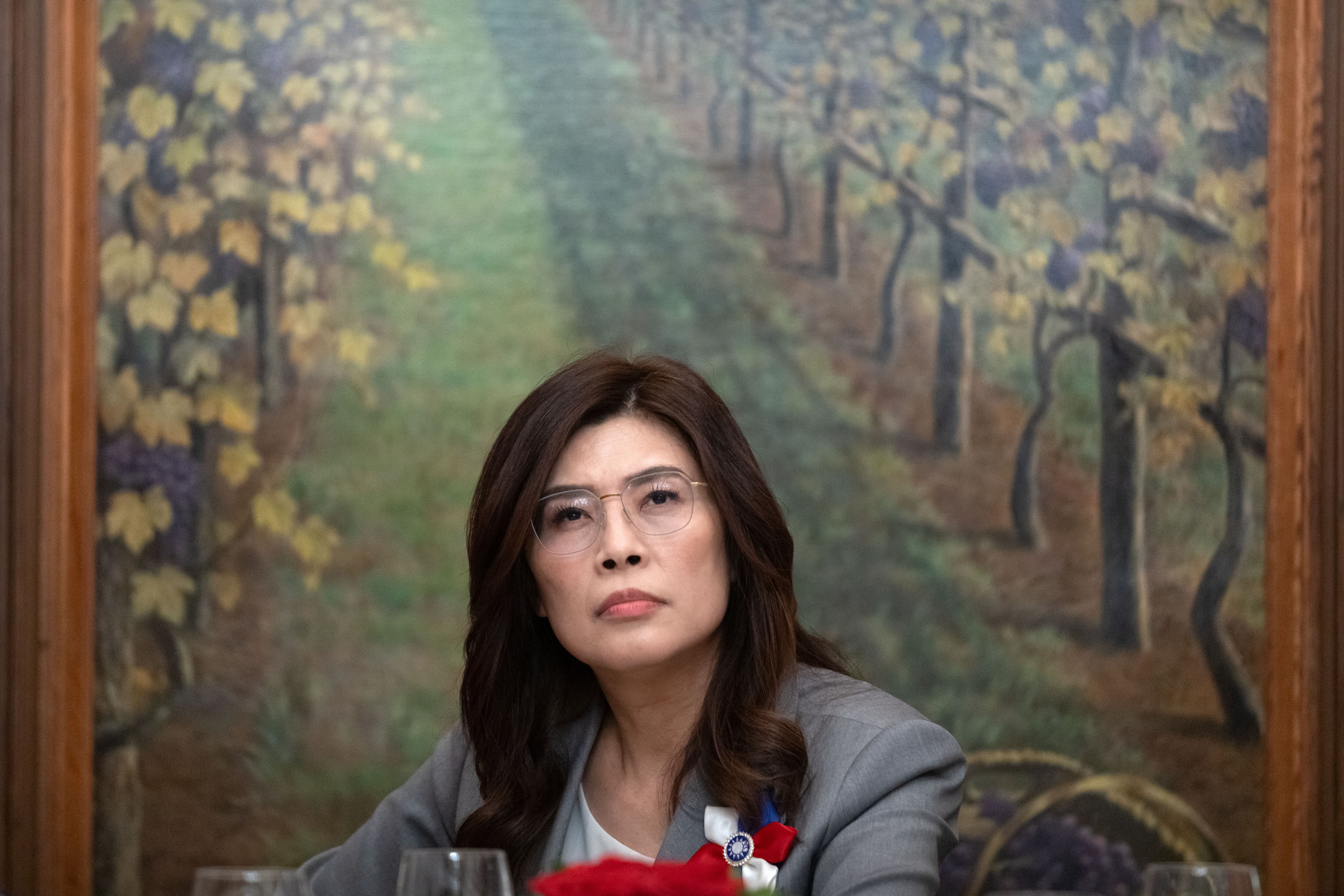




WASHINGTON (AP) — Taiwan’s Beijing-friendly opposition leader said Friday that her party is committed to the defense of the self-ruled island that China views as its own but that peace is possible by taking permanent secession off the table.
Cheng Li-wun told reporters during a trip to Washington that the Kuomintang Party she chairs shares common ground with President Donald Trump, who said after his May trip to Beijing that he was not “looking to have somebody go independent” or fight a war thousands of miles away.
“I think our basic stances are the same — that is peace and stability in the Taiwan Strait and to avoid any unnecessary war,” Cheng said after a three-day visit to the nation's capital, where she met American lawmakers and scholars.
Cheng said she also met Trump administration representatives but would not offer more information.
The visit, as part of her two-week trip to the U.S. to promote her party's approach to the Taiwan Strait, has come at a time of rising uncertainty in U.S.-Taiwan relations. Chinese leader Xi Jinping has warned of a possible clash if the U.S. does not properly handle the issue of Taiwan, a self-governing island that Beijing has vowed to seize by force if necessary to achieve what it considers reunification.
Congress has pledged to better arm Taiwan, giving preliminary approval to a $14 billion arms sales package. The Trump administration has yet to greenlight it.
Cheng, who met Xi in Beijing in April and whose party agrees that both sides of the strait belong to the same Chinese nation, has been promoting dialogue with Beijing. She said it is necessary for peace, stability and prosperity in the region.
Beijing has cut off official contact with Taipei's government for the past decade, because Taiwan’s ruling party does not recognize the “One China” principle.
“To initiate the dialogue cross-strait with Xi Jinping doesn’t mean that we will give up the deterrence strength in Taiwan, and, of course, it doesn’t mean that we will compromise or give up our democracy and freedom,” Cheng said, dismissing accusations that she was doing Beijing's bidding.
Asked about her meeting with Xi, Cheng described the Chinese leader as “very gentle and very nice and very real” and said she believed Xi wanted to address the Taiwan issue “with peaceful means and avoid war.”
But the Taiwanese government has pointed out Beijing’s increasingly bellicose behavior in the Taiwan Strait, including regular military operations around Taiwan in the past several years.
While the U.S. recognizes Beijing's position that Taiwan is part of China, it opposes any use of force in altering the status quo. It also is obligated by a U. S. law to provide the island with sufficient hardware to deter any invasion. In December, the Trump administration approved an $11 billion arms sales package to Taiwan.
Trump has indicated that he may still speak with Taiwan President Lai Ching-te even after China has publicly urged him not to do so.
Washington has been disappointed that Taiwan’s opposition-controlled legislature last month passed a $25 billion special defense budget to fund major U.S. arms purchases, down from the original $40 billion proposed by Lai.
On Friday, Cheng said her party objected to the initial proposal because it couldn't write a “blank check” for a proposal lacking details but put forward an interim measure to prioritize purchases of U.S. weapons.
Sen. Dan Sullivan, R-Alaska, met Cheng on Thursday and wrote on social media that Cheng's party needs to join with Taiwan's ruling Democratic Progressive Party to “finish the defense budget and support the Alaska LNG project.”
Rep. Tom Suozzi, D-N.Y., met her Wednesday and said in a statement that the opposition party's “resistance to a robust defense budget raises concerns for me that the party is drifting closer" to the ruling Chinese party and “weakening deterrence.”
Rep. John Rose, R-Tenn., who met Cheng on Wednesday, said in a statement that he is willing to engage with leaders from all parties and pledged his commitment to “supporting Taiwan's sovereignty and expanding the U.S.-Taiwan relations."
Copyright 2026 The Associated Press. All rights reserved. This material may not be published, broadcast, rewritten or redistributed without permission.