


WASHINGTON (AP) — Utah voters will nominate candidates for Congress Tuesday using a new map that created a Democratic-friendly district in Salt Lake City and scrambled the reelection plans of the state’s all-Republican delegation.
The new congressional boundaries could result in an additional Democratic seat, as Republicans try to retain a slim U.S. House majority in a midterm election environment where the president’s party typically loses seats in Congress.
The state adopted the new map over the objections of the Republican-controlled Legislature after a Utah court invalidated lawmakers’ 2021 plan, which divided the Democratic stronghold of Salt Lake City among four Republican-dominated congressional districts. The court ruled that the Republican lawmakers’ map violated a voter-backed 2018 measure designed to reduce partisanship in redistricting.
The Utah Supreme Court upheld the lower court ruling in February, and a Republican measure backed by President Donald Trump to repeal the 2018 anti-gerrymandering law failed to make the November ballot. The reshuffling of seats in Utah comes as Republicans are set to make gains from mid-decade redistricting efforts in several states at Trump’s urging.
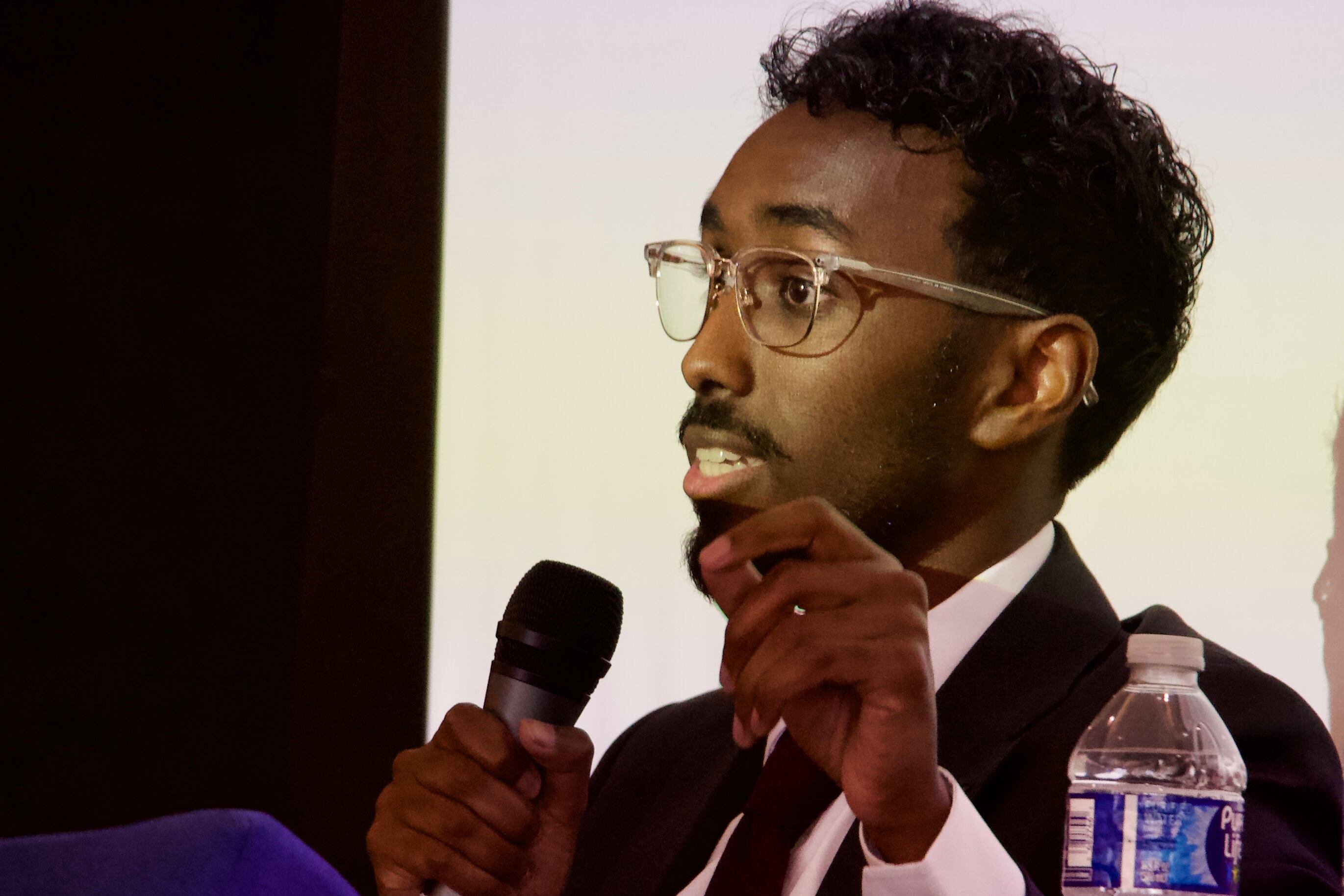
In the newly drawn Salt Lake City-based 1st Congressional District, former Salt Lake City mayor and former Democratic U.S. Rep. Ben McAdams looks to return to Congress in a district more favorable than the one he represented for one term at the end of the last decade. He faces state Sen. Nate Blouin, tax attorney Michael Farrell and former American Heart Association lobbyist and former TikTok and Meta policy analyst Liban Mohamed. At the start of June, McAdams had almost triple Blouin’s overall fundraising haul and dwarfed the rest of the field combined in cash available.
Republican Riley Owen is running unopposed. Had this district been in effect in the 2024 presidential election, former Vice President Kamala Harris would have carried it with 60% of the vote.
The new 2nd Congressional District in northwest Utah is the least changed of the state’s four districts. It tracks closely with the current 1st Congressional District. Republican U.S. Rep. Blake Moore, who currently represents the 1st District, is running for a fourth term, but he faces a tough primary against state Rep. Karianne Lisonbee. At the April state party convention, Lisonbee defeated Moore by an almost two-to-one margin in a nomination vote among delegates, but Moore secured a spot in the primary through a signature petition. Lisonbee has criticized Moore for co-chairing the “Better Boundaries” committee that helped pass the 2018 redistricting law that many state Republicans blame for costing them a seat in Congress.
In the massive new 3rd Congressional District spanning southern and eastern Utah, Republican U.S. Rep. Celeste Maloy faces a primary challenge from former state Rep. Phil Lyman in her bid for a second full term. Maloy currently represents the 2nd Congressional District, which overlaps with the new 3rd District in southwest Utah, but the bulk of the new district along the Colorado border will be new territory. Maloy narrowly won the nomination vote at the April state convention over Lyman after two rounds of voting, but not by enough to keep Lyman off the primary ballot.
In the new 4th Congressional District, Republican U.S. Rep. Mike Kennedy is unopposed for renomination. The district overlaps mostly with Maloy’s current 2nd District on the western side of the state, not the eastern half that he’s represented since 2025.
Republican U.S. Rep. Burgess Owens of the current 4th District in the heart of Utah opted not to seek reelection.
Trump has endorsed all three incumbents seeking reelection.
About half of Utah’s 29 state Senate seats and all 75 state House seats are up for election in 2026. Republicans hold overwhelming supermajorities in both chambers.
Here are some of the key facts about the election and data points the AP Decision Team will monitor as the votes are tallied:
When do polls close?
Polls close at 8 p.m. MT, which is 10 p.m. ET.
What’s on the ballot?
The Associated Press will provide vote results and declare winners in contested primaries for U.S. House, state Senate, state House and state Board of Education.
Who gets to vote?
Any registered voter may participate in the Democratic primary regardless of party registration. Only registered Republicans may vote in the Republican primary. Eligible voters may register in-person at the polls during the early voting period or on Election Day. Voters who are not affiliated with any political party may affiliate with the Republican Party at the polls on Election Day and vote in the Republican primary.
How many voters are there?
As of June 16, there were about 2.1 million registered voters in Utah, including about 1 million registered Republicans, about 297,000 registered Democrats and about 622,000 voters not affiliated with any party.
How many people actually vote?
Roughly 427,000 votes were cast in the 2024 Republican state primary. Total votes in Democratic primaries ranged from about 68,000 in the 2024 presidential primary to about 221,000 in the 2020 presidential primary.
How much of the vote is cast early or by absentee ballot?
Elections in Utah are conducted predominantly by mail.
As of Thursday, about 163,000 ballots had already been cast in Tuesday’s primaries, including about 127,000 from Republicans, about 32,000 from Democrats and about 2,900 from unaffiliated voters.
When are early and absentee votes released?
Most counties tend to release a significant amount of early in-person and mail results in the 1st vote update of the night. But in about two-thirds of counties, advance voting results are released along with results from in-person Election Day voting.
How long does vote-counting usually take?
In the 2024 state primary, the AP first reported results at 10:03 p.m. ET, or three minutes after polls closed. The last vote update of the night was at 2:07 a.m. ET with about 74% of total votes counted. The tally surpassed 90% of the vote counted by June 27 at 6:32 p.m. ET, two days after Election Day.
When will the AP declare a winner?
The AP does not make projections and will declare a winner only when it’s determined there is no scenario that would allow a trailing candidate to close the gap. If a race has not been called, the AP will continue to cover any newsworthy developments, such as candidate concessions or declarations of victory. In doing so, the AP will make clear that it has not yet declared a winner and explain why.
How do recounts work?
Recounts are automatic in Utah only in the event of a tie vote. A losing candidate may request a recount if the vote margin is 0.25% of the total vote or less. In elections with fewer than 400 total votes cast, recounts may be requested if the winning margin is one vote. The AP may declare a winner in a race that is subject to a recount if it can determine the lead is too large for a recount or legal challenge to change the outcome.
Are we there yet?
As of Tuesday, there will be 133 days until the 2026 midterm elections.
___
Follow the AP’s coverage of the 2026 election at https://apnews.com/projects/elections-2026/.
Copyright 2026 The Associated Press. All rights reserved. This material may not be published, broadcast, rewritten or redistributed without permission.