


DUBAI, United Arab Emirates (AP) — Mojtaba Khamenei, a son of Iran's late supreme leader, has been named as the Islamic Republic's next ruler, authorities announced Monday, as Tehran widened its attacks across the Mideast to strike oil and water facilities crucial to its desert sheikdoms.
With Iran's theocracy under assault by the U.S. and Israel for more than a week, the country's Assembly of Experts chose as the next supreme leader a secretive, 56-year-old cleric who maintains close ties to the country's paramilitary Revolutionary Guard. The Guard has been firing missiles and drones at Israel and Gulf Arab states since the younger Khamenei's father, Ayatollah Ali Khamenei, was killed Feb. 28 during the war's opening salvo.
The war has shaken global energy markets, pushing oil prices above $100 a barrel and leading to tighter supplies of natural gas after Qatar turned off its production.
The younger Khamenei, who had not been seen or heard from publicly since the war started, had long been considered a contender for the post. That was even before the Israeli strike killed his father, and despite never being elected or appointed to a government position.
There appeared to be some dissension over his selection. Political figures within Iran criticized the idea of handing over the supreme leader's title based on heredity and thereby creating a clerical version of the rule of the shah, who was toppled during the 1979 Islamic Revolution. But top clerics in the Assembly of Experts likely wanted Khamenei to prosecute the war.
Khamenei, who is believed to hold views that are even more hard-line than his late father, now will be in charge of Iran's armed forces and any decision regarding Tehran's nuclear program.
While the country's key nuclear sites are in tatters after the United States bombed them during the 12-day Israel-Iran war in June, there's still highly enriched uranium in Iran that's a technical step away from weapons-grade levels. Khamenei could choose to do what his father never did — pursue the bomb.
Israel has already described him as a potential target, while U.S. President Donald Trump criticized the idea of Khamenei taking power.
“Khamenei’s son is unacceptable to me,” Trump has said. “We want someone that will bring harmony and peace to Iran.”
The White House did not immediately respond to a request for comment. Trump told ABC News on Sunday he wants a say in who comes to power once the war is over; a new leader “is not going to last long” without his approval.
Iran's Revolutionary Guard issued a statement expressing support, as did the Iran-backed Lebanese militant group Hezbollah.
Top Iranian security official Ali Larijani, speaking to Iranian state television, praised the Assembly of Experts for “courageously” convening even as airstrikes continued in Tehran. He said the younger Khamenei had been trained by his father and “can handle this situation.”
Regional anger grows and oil rises above $100 a barrel
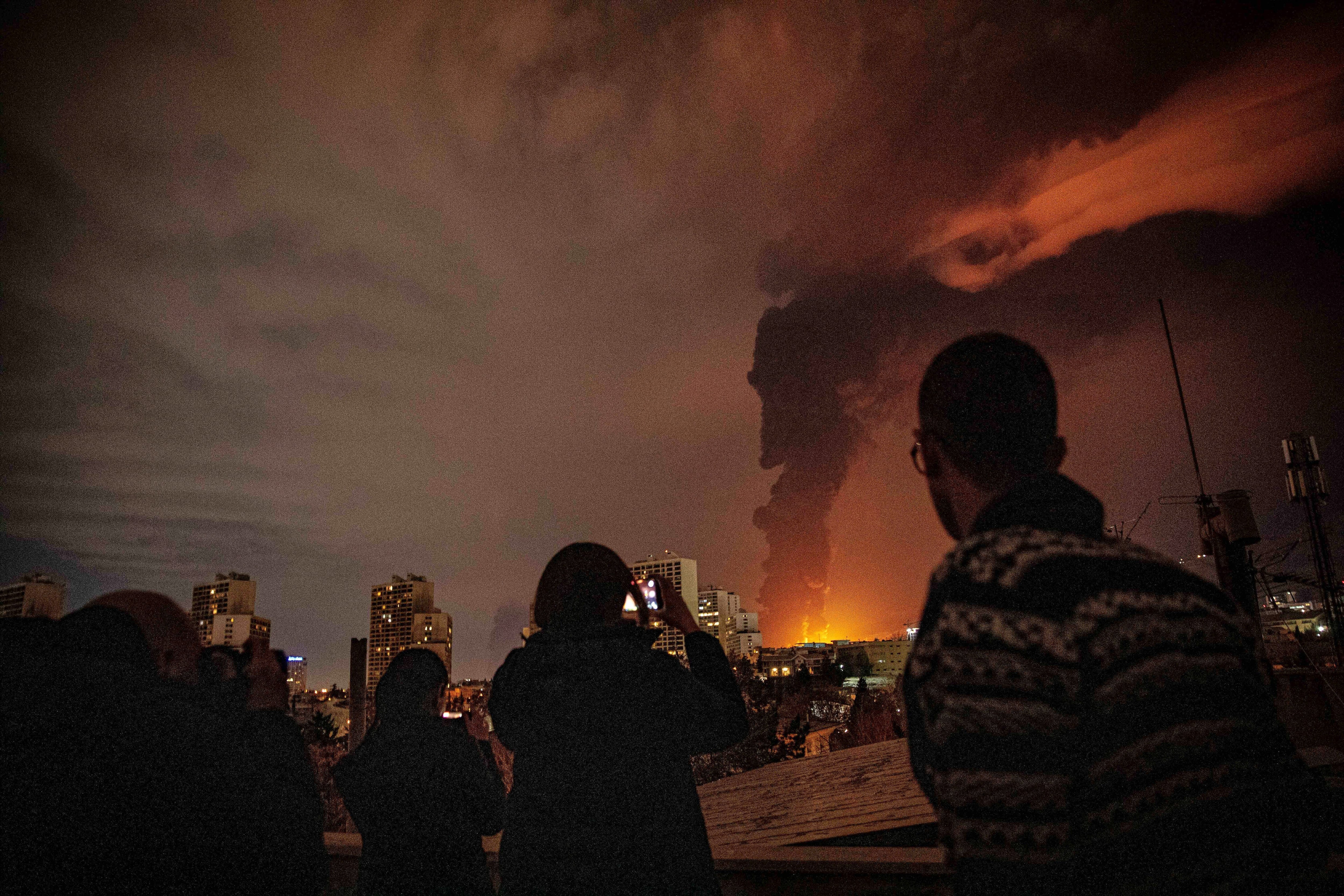
Oil depots in Tehran smoldered following overnight Israeli strikes.
In a sign of rising regional anger, the Arab League chief lashed out at Iran for its “reckless policy” of attacking neighbors, including ones that host U.S. forces.
The U.S. military said a service member died of injuries from an Iranian attack on troops in Saudi Arabia on March 1. Seven U.S. soldiers have now been killed.
Saudi Arabia’s Defense Ministry said Monday it intercepted a drone attacking the country’s massive Shaybah oil field. The kingdom followed the alleged drone attack with sharper warnings to Iran that it would be the “biggest loser” if it continued to attack Arab states.
It dismissed comments by Iranian President Masoud Pezeshkian on Saturday that Iran had halted its attacks on Gulf Arab states.
“The kingdom affirms that the Iranian side has not implemented this statement in practice, neither during the Iranian president’s speech nor afterward,” Saudi Arabia’s Foreign Ministry said in a statement. “Iran has continued its aggression based on flimsy pretexts devoid of any factual basis.”
It added the Iranian attacks mean “further escalation which will have grave impact on the relations, currently and in the future.”
Two U.S. officials say the State Department will order nonessential personnel and families of all staff to leave Saudi Arabia as Iran escalates its attacks. The officials spoke on condition of anonymity pending a formal announcement. Eight other U.S. diplomatic missions have ordered all but key staff to leave: Bahrain, Iraq, Jordan, Kuwait, Lebanon, Qatar, the United Arab Emirates and the consulate in Karachi, Pakistan.
The war has killed at least 1,230 people in Iran, at least 397 in Lebanon and at least 11 in Israel, according to officials. Israel reported its first soldier deaths Sunday, saying two were killed in southern Lebanon, where its military is fighting Hezbollah.
Desalination and oil facilities attacked
Bahrain accused Iran of indiscriminately attacking civilian targets and damaging one of its desalination plants, though its electricity and water authority said supplies remained online.
Desalination plants supply water to millions of residents in the region and thousands of stranded travelers, raising new fears of catastrophic risks in parched desert nations.
The strike came after Iran claimed a U.S. airstrike damaged a desalination plant there. Foreign Minister Abbas Araghchi said the strike on Qeshm Island in the Strait of Hormuz had cut into the water supply to 30 villages.
He warned that in doing so “the U.S. set this precedent, not Iran.”
In response, U.S. Central Command spokesperson Navy Capt. Tim Hawkins said that "U.S. forces do not target civilians – period.”
The Iranian Red Crescent Society warned Tehran residents to take precautions against toxic air pollution and the risk of acid rain from the oil depot attack. It also said about 10,000 civilian structures across the country had been damaged, including homes, schools and almost three dozen health facilities.
Lebanon says a half-million people displaced
Lebanon said over a half-million people have been displaced in the week of fighting between Israel and Hezbollah.
The actual number is likely higher. Lebanon’s count of 517,000 refers to those who registered on the government’s online portal. Israel over the past week has called on residents in dozens of villages across southern Lebanon and the entirety of Beirut’s southern suburbs to evacuate.
In Beirut, sheltering families crammed into schools, slept in cars or in open areas near the Mediterranean Sea, where some burned firewood to keep warm.
Israel’s renewed offensive began last week after Hezbollah launched rockets toward northern Israel during the Iran war's opening days.
___
Metz reported from Ramallah, West Bank, Chehayeb from Beirut and Magdy from Cairo. Associated Press journalists Melanie Lidman in Tel Aviv, Israel; Matthew Lee in Washington; Christopher Weber in Los Angeles; and Aamer Madhani in Doral, Florida, contributed reporting.
Copyright 2026 The Associated Press. All rights reserved. This material may not be published, broadcast, rewritten or redistributed without permission.