



LOS ANGELES (AP) — When Matthew Smith took his five-year-old son to a World Cup game in the Los Angeles area earlier this month, they opted to take public transit instead of driving from their nearby coastal city.
It was Smith's first time on the LA Metro in a decade, and the experience exceeded his expectations.
“Seems like a very functioning transit system, which is somewhat surprising given its reputation,” he said.
That is the reaction Metro officials were hoping for as they used the 2026 FIFA World Cup's eight LA games to introduce — or reintroduce — people to the region's public transit system, often an afterthought in car-centric Los Angeles. It is an early test run of sorts for the 2028 Olympics, which organizers have billed as a “no car” Games where there will be no parking for attendees at any of the venues. Spectators will have to rely on transit and shuttles to get to events.
Nearly 50,000 rides were taken on rail lines for the July 2 Spain-Austria game that Smith and his son attended. There is no train that runs directly to SoFi Stadium in the LA suburb of Inglewood, but Metro has added 15 shuttle lines to transport people there from major rail stations and transit centers — the farthest route taking one hour and 15 minutes. More than 30,000 rides were taken on those shuttles for that game alone, the agency said.
The Metro will take a similar approach for the Olympics because many venues don't connect directly to the system. For the World Cup, the agency borrowed about 200 buses to meet the increased demand. Officials have said they will need to borrow 3,000 buses for the Olympics.
Officials work to overcome safety fears
For many residents, public transit isn't baked into everyday life in Los Angeles, the nation's second most-populous city, quite the same way it is in other major urban centers like New York and Chicago. LA Metro estimates the system provides about 1 million rides each day — roughly the same as Chicago, a smaller city. In New York, meanwhile, it is well over 3 million on the average weekday.
Many view LA's rail and bus system as unreliable at best and unsafe at worse. Certain high-profile violent incidents, such as a 67-year-old woman who died from being stabbed on a Metro train in 2024, have driven those perceptions. Some riders are also concerned about drug use, cleanliness and the presence of homeless people.
In June, Metro opened applications for its police force, which it hopes to have fully deployed by 2029 to replace the LAPD. The agency hopes having its own sworn officers working along with homeless outreach and crisis response teams will help riders feel safer on its trains and buses.
Metro has also touted data that showed a decline in violent crime over the past two years, with a 13.6% decrease in overall crime in March 2026 compared to a year before.
Martha Banuelos used the transit system sporadically before but generally preferred to “avoid it like the plague.” She started riding the trains again recently to get into the city from North Hollywood for World Cup watch parties.
“It’s a lot cleaner and smells way better,” she said.
Officials see World Cup as an opportunity
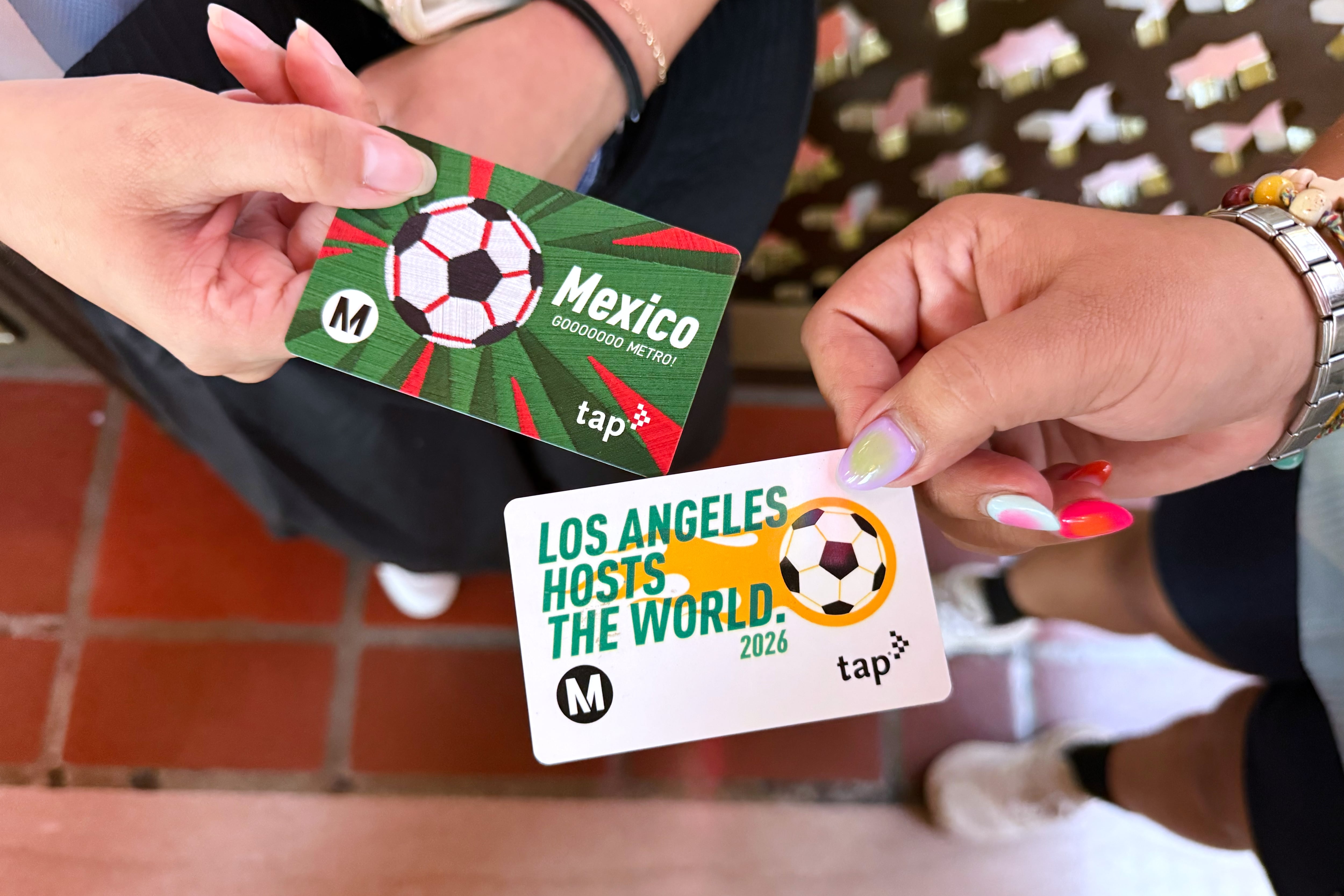
Metro has partnered with FIFA to host fan zones and watch parties at key transit hubs — where thousands of fans from around the region gathered to drink, dance to DJ sets, and cheer for their favorite teams. Metro has advertised limited edition tap cards for different countries and leaned into social media to promote public transit during the games.
The system also upgraded its payment options before the World Cup to allow riders to pay directly with a credit card like other cities that have done away with tap cards.
Those efforts worked to draw in new riders like Yasmin Cortez, a 32-year-old who took the train for the first time ever to attend the official FIFA Fan Festival at the LA Memorial Coliseum to watch matches, volunteer for FIFA, and soak in the World Cup spirit. A week later, she took the rail again to root for Uruguay at the Union Station Fan Zone, from Cerritos about 16 miles (26 kilometers) southwest of LA.
“Especially with gas prices now, yeah I should be taking the Metro,” she said. “There’s a lot to explore, and I bought some new walking shoes.”
Looking ahead to 2028 Olympics
During the last Summer Games, Paris was lauded for how accessible the Games were, with nearly every venue reachable by Metro, commuter train, tram or bus.
LA, long known for congested roadways, is hard at work to expand its own transit options as the Games quickly approach.
Transit enthusiasts rejoiced at the long-awaited extension of the D line in May, which runs east-west connecting downtown LA to Koreatown, and now further west, where popular tourist attractions like the Grove shopping mall, Los Angeles County Museum of Art and the La Brea Tar Pits are.
It marked the first opening of a heavy rail expansion project in the U.S. since 2020. Four more stations are under construction to extend the line to the University of California, Los Angeles campus, which will serve as the official Athlete Village for the 2028 games.
“LA is a transit city,” said Jennifer Vides, Metro's chief customer experience officer. “People want to try to say that it’s not. Obviously we have a lot more expansion to do and we’re working on it. But people really want transit.”
Copyright 2026 The Associated Press. All rights reserved. This material may not be published, broadcast, rewritten or redistributed without permission.