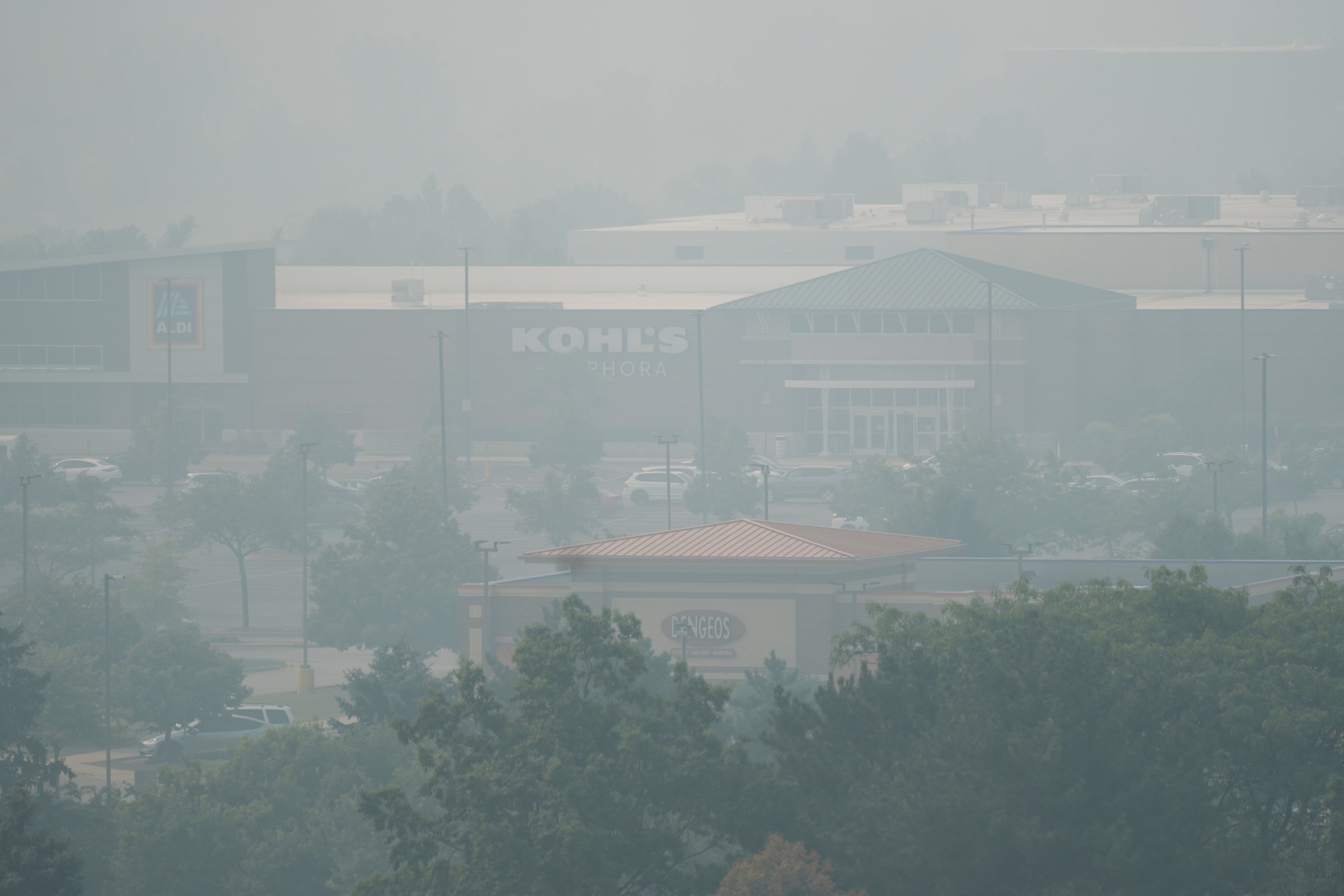


NEW YORK (AP) — Heavy, pungent smoke from Canadian wildfires darkened skies in the U.S. on Thursday from the Great Lakes to parts of the East Coast, reducing visibility for commuters and prompting warnings that air quality could make being outside dangerous.
Detroit's air quality was among the worst in the world for major cities, as a lingering high pressure system trapped smoke from dozens of fires in Canada and northern Minnesota, said Steven Freitag, a National Weather Service meteorologist in Pontiac, Michigan.
“Sure enough, it arrived in force here and it's really pretty extreme levels,” said Freitag, who noted that visibility in some areas was reduced to a half mile.
Omar Mitchell wore a mask as he walked to his restaurant in Detroit. He said he urged his employees to do the same.
“It’s scary,” Mitchell, 50, said as he looked at the sky. “You don’t know necessarily what the side effects may be. That’s days or months later.”
Cities across the Great Lakes states registered air quality ranging from unhealthy to hazardous — which means it’s unhealthy for anyone, regardless of health conditions. Microscopic particles can lodge deep in the lungs and enter the bloodstream, leading to heart and lung problems and contributing to other long-term health issues.
All of Michigan and much of Minnesota were under a hazardous air quality alert. In the Chicago area, air quality ranged from very unhealthy to hazardous.
National Weather Service meteorologist Jake Petr said even if winds from the northwest clear skies as expected later this week, the smoky air could keep returning until the fires are out. That could take weeks or longer.
“Anytime we have something that could bring air from that region until the fires are over, it could conceivably dip back into the area,” Petr said.
In St. Paul, Minnesota, the air was “glowing yellow,” said Brent Williams, head of the soil, water and climate department at the University of Minnesota, who said the area “could be looking at weeks to months of continued smoke and flare-ups off and on as the winds blow in different directions.”
A study published this year found that long-term exposure to tiny particles from wildfire smoke contributed to an average of 24,100 deaths a year in the lower 48 states. Long-term exposure can make existing health problems worse and lead to a range of chronic and deadly health issues, including respiratory illness, cardiovascular and neurological diseases, and premature death.
In the New York City area, a thick, gloomy haze tinged the morning sky in orange-and-yellow, reducing visibility so dramatically that it partly obscured Manhattan’s prominent skyline.
Smoke eased a bit in the metropolitan area but was expected to thicken again by late afternoon or evening, possibly lasting overnight, weather service meteorologist Maureen Hastings said.
City officials opened cooling centers as health officials urged New Yorkers to limit strenuous and prolonged outdoor activities and to stick to air-conditioned spaces as much as possible. State officials distributed tens of thousands of face masks at transit hubs and other major locations.
Mayor Zohran Mamdani said public schools, parks and other city agencies were moving activities indoors, rescheduling events and adjusting operations as air quality was expected to worsen as the day progressed.
The state Department of Environmental Conservation warned that there was a potential for temporary spikes of “very unhealthy” air quality from Buffalo in the state's western corner to Rochester by Lake Ontario, Syracuse in the central region, down to the greater New York City area.
Philadelphia officials urged people to avoid strenuous activity and stay inside or wear N95 or KN95 masks outside.
“Today is not the day to start your marathon training plan,” said Dr. Palak Raval-Nelson, the city's public health commissioner.
___
Webber reported from Fenton, Michigan. Associated Press reporters Ed White in Detroit, Jacqueline GaNun in Lansing, Michigan, and
___
The Associated Press’ climate and environmental coverage receives financial support from multiple private foundations. AP is solely responsible for all content. Find AP’s standards for working with philanthropies, a list of supporters and funded coverage areas at AP.org.
Copyright 2026 The Associated Press. All rights reserved. This material may not be published, broadcast, rewritten or redistributed without permission.