

BREVARD COUNTY, Fla. — Early risers across the East Coast may get a special pre-dawn show Friday morning as NASA and SpaceX prepare to launch the Crew-12 mission to the International Space Station.
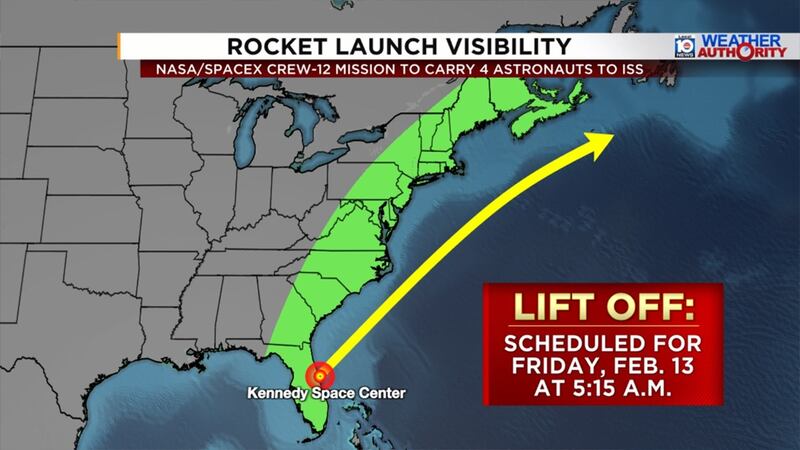
If weather conditions cooperate, the rocket could be visible along the East Coast from Florida all the way to Maine, lighting up the sky shortly before sunrise.
Pre-sunrise launches like this often produce some of the most impressive views, as sunlight illuminates the rocket’s exhaust high in the atmosphere while the ground below remains dark.
Who’s launching?
Crew-12 will lift off from Kennedy Space Center aboard a SpaceX Falcon 9 rocket, carrying four astronauts toward the International Space Station.
The astronauts aboard are:
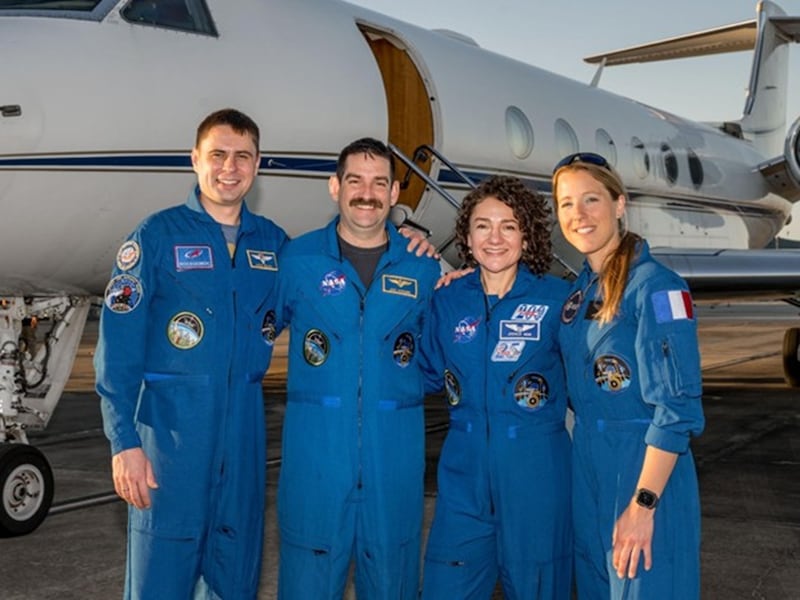
- NASA astronaut Jessica Meir — mission commander for Crew-12
- NASA astronaut Jack Hathaway — pilot
- European Space Agency (ESA) astronaut Sophie Adenot — mission specialist
- Russian cosmonaut Andrey Fedyaev — mission specialist
This group represents a mix of experienced flyers and first-time station visitors. Both Meir and Fedyaev have flown in space before, while Hathaway and Adenot are making their first trips to the ISS.
Once in orbit, the crew will dock with the station and begin a months-long mission conducting scientific research, technology demonstrations, and station maintenance while orbiting Earth every 90 minutes.
This launch is part of NASA’s routine crew rotation schedule — but the timing of Crew-12 has become especially important in recent weeks.
Why this mission was moved up
Crew-12’s launch was moved up on the calendar following the early departure of a prior ISS crew member due to a medical evacuation.
As a result, the ISS has been operating with a skeleton crew of just three astronauts for several weeks while science and station maintenance continued.
Under normal operations, the station typically hosts about seven crew members at a time — the standard long-duration crew size maintained during most expeditions.
NASA officials determined that accelerating the arrival of the next crew would help maintain full operational status aboard the ISS, ensuring that ongoing experiments, maintenance tasks, and daily station operations could continue without disruption.
In other words, Crew-12 isn’t just another routine launch — it’s helping fill an unexpected gap and keep the space station running smoothly after an unforeseen medical situation.
How to watch the launch
Unlike launches that fly due east over the Atlantic, Crew-12 will take a northeast trajectory along the East Coast. That path significantly expands the potential viewing area.
If skies are clear, the rocket could be visible from Florida all the way to Maine. Viewers should look toward the east or northeast shortly after liftoff.
The rocket may first appear as a bright, fast-moving point of light, followed by a glowing exhaust plume as it climbs higher and catches the sun. The best views typically occur within the first few minutes after launch.
What Florida viewers van expect
The Sunshine State often gets the best seats in the house, and this launch should be no exception.
Because the rocket launches from Central Florida and travels northeast:
- Much of the Florida Peninsula may be able to see it
- Visibility is possible from South Florida through Central Florida and into Northeast Florida, including the Miami, Tampa, Orlando, and Jacksonville metro areas
- Viewers should face east-northeast shortly after liftoff — from seconds to a couple of minutes after launch
Coastal areas generally have the clearest views, but inland locations may still see the rocket if skies are unobstructed. Under the right conditions, the exhaust plume can appear wider and brighter than expected as the rocket climbs into thinner air.
One of the most visible launches of the year
The Crew-12 launch is scheduled for 5:15 a.m. Friday, meaning early alarms may be necessary — but for skywatchers, it could be well worth it.
As with any skywatching event, weather will ultimately determine how good the view is. Low clouds, haze, or thick high clouds can block visibility even if the launch itself goes on as scheduled.
Clear or mostly clear skies will offer the best chance to see the rocket’s ascent and illuminated plume. If conditions cooperate, this mission has the potential to deliver one of the most impressive rocket launch views of the year for Florida and much of the East Coast.
Copyright 2026 by WPLG Local10.com - All rights reserved.
