
MIAMI — If the background of Cuban President Miguel Díaz-Canel’s news conference on Friday was any indication, the island’s leaders weren’t sending the message that they are interested in giving up on the ruling party’s dominion over the island if there is a deal with the U.S.
With an image of the late Fidel Castro, as the revolutionary who led the 1959 uprising, to his right, Díaz-Canel confirmed for the first time what President Donald Trump had said were talks led by State Secretary Marco Rubio after stopping the Venezuelan oil lifeline.
“These talks have aimed to find solutions, through dialogue, to the bilateral differences between our two nations. International factors have facilitated these exchanges.” Díaz-Canel said in Spanish.
Díaz-Canel stood defiant in front of a famous quote from “Our América” by José Martí: “There is no prow that can cut through a cloudbank of ideas.” Still, former Venezuelan President Nicolás Maduro remained at the Metropolitan Detention Center in New York, and a more flexible Delcy Rodríguez stood in his place.
Local 10 News This Week In South Florida Anchor Glenna Milberg said Trump’s military actions in Venezuela and Iran are indicative of his approach during negotiations with Cuba.
“If President Trump does not get what he wants in these talks with Cuba, what is that pattern there,” Milberg told Local 10 World News Anchor Louis Aguirre.
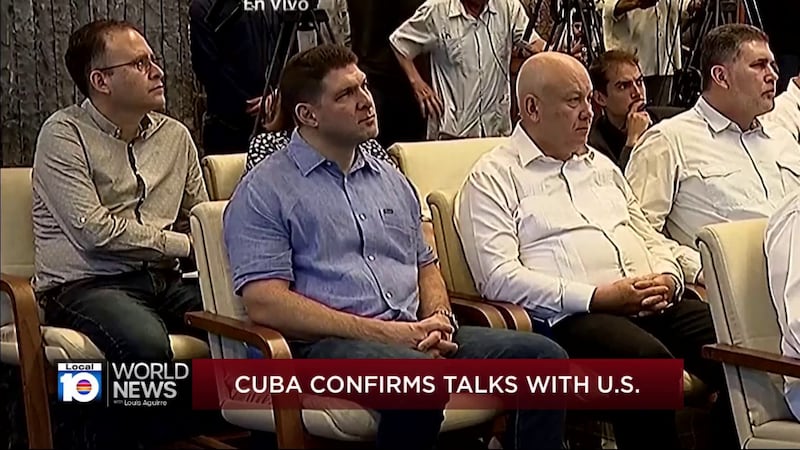
Raúl Castro’s grandson Raúl “Raulito” Guillermo Rodríguez Castro, also known as “El Cangrejo” or “The Crab” because of a deformed finger, was in the conference room watching Díaz-Canel’s announcement.
Milberg described Castro as “the head of The Revolution” despite his retirement, and Díaz-Canel as “a bureaucrat in place.” Rodríguez Castro, 41, doesn’t have a clear government role.
Rubio met secretly with Rodríguez Castro during the CARICOM conference on Feb. 25 in St. Kitts and Nevis, according to U.S. officials who talked to The Associated Press on condition of anonymity.
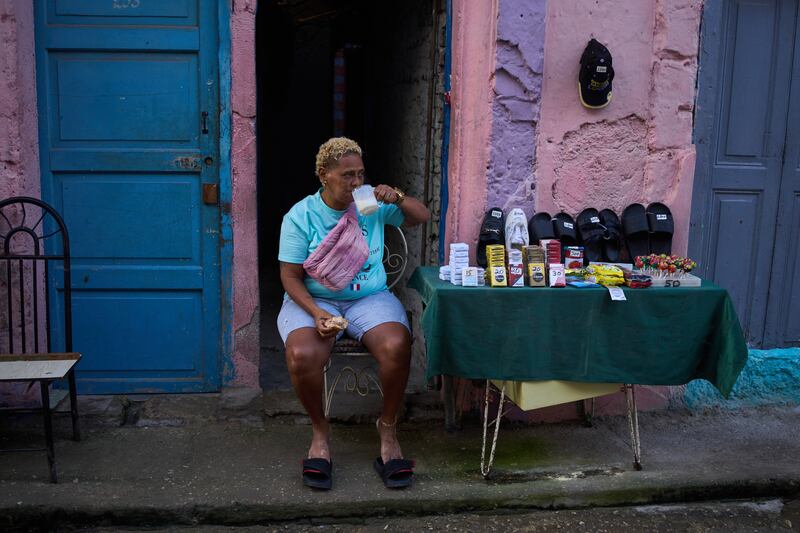
Last week in Doral, Trump said Cuba was “very much at the end of the line.” Cubans on the island are struggling with power outages, water service disruptions, and shortages of basics.
Díaz-Canel said two power plants were out of service, bakeries were using coal and wood, surgeries were being postponed, schools were closed, and unemployment had increased.
Cuban-American Republican lawmakers who have asked Trump for Castro’s indictment want definitive political change.
“The investment necessary to actually restore the Cuban economy, I don’t think it’s going to come unless there is a political change in Cuba,” Rep. Carlos Giménez told Local 10 News.
On Friday, Díaz-Canel didn’t talk about political change. Instead, he announced that the release of 51 prisoners for good behavior was a sovereign decision. He also said there will be another public announcement on Monday.
“Look for some tinkering with the economic rules, possibly foreign investment, possibly privatizing, allowing some more private business on the island,” Milberg said.
More on U.S.-Cuba talks
- Miami’s Calle Ocho entrepreneurs prepare for U.S.-Cuba talks to maybe open island for business
- In Miami’s Little Havana, Versailles colada drinkers support U.S. military intervention in Cuba
- Democratic senators file war powers resolution to check Trump on Cuba
- Cuban president says talks were recently held with the US to resolve differences
- Cuba will release 51 people from prison in an unexpected move
- South Florida Cuban exiles say democracy must come before US engagement with Cuba
Interactive graphic for history buffs
Copyright 2026 by WPLG Local10.com - All rights reserved.
