

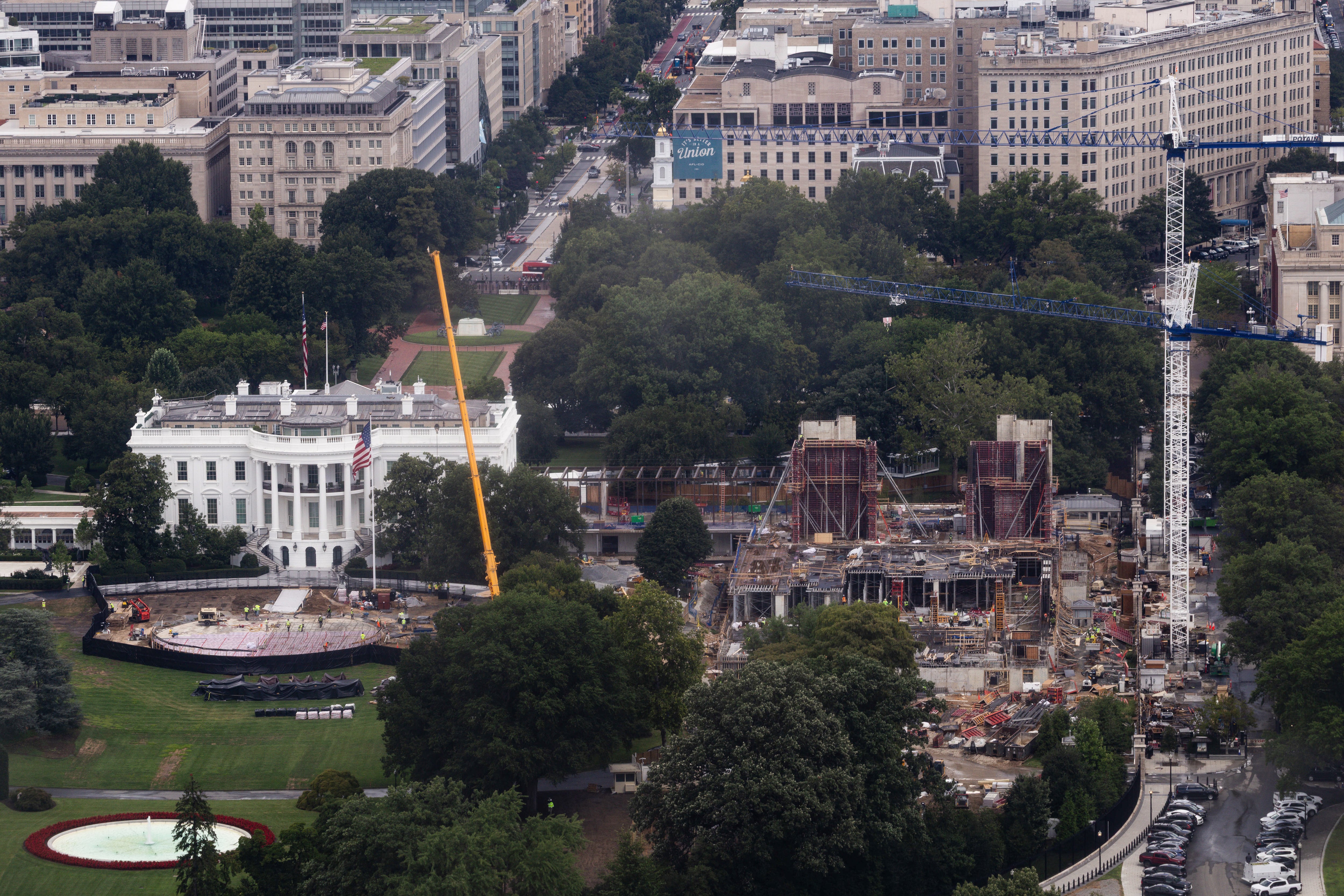
WASHINGTON (AP) — President Donald Trump’s administration on Friday asked the U.S. Supreme Court to allow the White House to continue construction on its $400 million ballroom project while it appeals a lower court’s order to halt the work.
Trump’s solicitor general petitioned the high court to suspend last week’s decision by a three-judge panel from the U.S. Court of Appeals for the District of Columbia Circuit.
The divided panel ruled last week Trump must stop the White House ballroom’s construction because Congress has not approved the project. The panel’s majority said Trump doesn’t have the unilateral authority to build a 90,000-square-foot (8,400-square-meter) ballroom where the White House’s East Wing stood before he ordered its demolition last fall.
The lower court suspended its own ruling for two weeks to give Trump's Republican administration time to appeal to the Supreme Court. Solicitor General D. John Sauer asked the Supreme Court to rule on its stay petition before the appeals court panel’s decision takes effect on Aug. 21.
"This case involves an extraordinary and unlawful injunction that will halt the ongoing construction of the integrated military complex, including a totally secure ballroom space, at the East Wing of the White House, which is vitally required by national security,” Sauer wrote.
The lower court’s 2-1 decision upheld an order to pause aboveground construction on the project, siding with historic preservationists who sued to stop construction of the ballroom.
“Whether or not a massive ballroom should be constructed is for Congress to decide and is not a matter for Executive self-help,” wrote the majority's two judges, both appointed by Democratic presidents.
A third judge disagreed, finding that the preservationist group that challenged the project had no legal right to sue.
“The district court elevated the aesthetic displeasure of a single passerby over the government’s security interests in the ballroom,” wrote Judge Neomi Rao, who was appointed by Trump.
The Trump administration argues that the president, not Congress or the courts, has unimpeded authority to renovate the White House. The current state of the project, essentially an open construction site, makes it harder to protect the White House, the Justice Department contends.
The administration also says the National Trust for Historic Preservation does not have the legal right, or standing, to sue over the ballroom, which is part of Trump’s plans to quickly remake Washington. The solicitor general said the ballroom project “should be a matter for the President and the political process, not construction-by-injunction.”
During an appeals court hearing in early June, an administration lawyer defended a broad view of presidential control over iconic public facilities. The government could bulldoze the Statue of Liberty and the White House, Justice Department lawyer Yaakov Roth said in response to a hypothetical question, and the descendants of immigrants who came through Ellis Island and the enslaved people who built the White House would not have standing to sue.
The D.C. Circuit panel upheld a ruling by U.S. District Judge Richard Leon, who was nominated by Republican President George W. Bush. Leon concluded that a pause wouldn’t jeopardize national security. He also exempted any construction work that is necessary for the safety and security of the White House.
The ballroom has been under construction for 10 months. The administration says the work is roughly 65% finished.
“Given those developments, the injunction promises chaos in service of nothing,” Sauer wrote.
Copyright 2026 The Associated Press. All rights reserved. This material may not be published, broadcast, rewritten or redistributed without permission.