
MIAMI — After the U.S. government moved forward with the capture and prosecution of Nicolás Maduro and Cilia Flores, the world was waiting for President Donald Trump’s next move.
On Monday, Trump told NBC News that U.S. oil companies will be able to invest in rebuilding the infrastructure needed to increase and maintain oil production in Venezuela.
“It’ll be a lot of money -- a tremendous amount of money will have to be spent, and the oil companies will spend it, and then they’ll get reimbursed by us or through revenue,” Trump told NBC News and suggested that rebuilding the infrastructure could happen in 18 months or less.
On Sunday night, while aboard Air Force One, Trump talked to reporters about his plans in Venezuela, Colombia, Cuba, Mexico, and Greenland.
“American dominance in the Western Hemisphere will never be questioned again,” Trump said.
VENEZUELA: Trump said the U.S. is working with the current administration in Venezuela and there will be elections “at the right time.”
Trump said the priority was to increase Venezuela’s oil supply, and the U.S. military was prepared to do a second strike.
“The oil companies are ready to go,” Trump said. “They are going to go in. They are going to rebuild the infrastructure ... We built it, to start off, many years ago. They took it away. You can’t do that.”
Trump said he was considering reopening a U.S. Embassy in Caracas, and Delcy Rodríguez, the Venezuelan interim president, was cooperating.
“We don’t expect direct involvement in any other way beyond just coercing the new interim government to get that going,” House Speaker Mike Johnson told reporters on Monday after a briefing with State Secretary Marco Rubio and Defense Secretary Pete Hegseth.
Related story: Venezuelan UF graduate reacts to Trump sharing his message of gratitude after Maduro’s capture
COLOMBIA: Trump described Colombian President Gustavo Petro as a “sick man who likes making cocaine” and said his days were counted.
Petro accused Trump of the death of Yohana Rodríguez Sierra, 45, who was born in Cartagena, Colombia and lived in Venezuela for more than 12 years before she died during U.S. military actions early Saturday morning in Hatillo, a town in southeastern Caracas.
“They are killing us; they killed my mother,” Ana Corina Morales, Rodríguez Sierra’s 22-year-old daughter, told relatives in Cartagena during a phone call, according to Colombian newspaper El Tiempo’s report.
Petro will not be running for reelection during the presidential election on May 31.
CUBA: Trump said Cuban “bodyguards” died trying to protect Maduro. Cuban President Miguel Díaz-Canel declared two days of mourning after the 32 deaths in Caracas.
Related story: US control of Venezuelan oil flow to weaken Cuban communists’ grasp on power
MEXICO: Trump said Mexico is going to have to “get their act together” or “we are going to have to do something” because “the cartels are running Mexico.”
Trump said he has offered Mexican President Claudia Sheinbaum help, and she said the U.S. has to focus on reducing demand.
“We categorically reject the intervention in the internal affairs of other countries. Latin American history is clear and overwhelming. Intervention has never brought democracy, never has generated wellbeing, nor lasting stability,” Sheinbaum said during an address on Monday.
GREENLAND: “We need Greenland from the standpoint of national security,” Trump said about his reasons for wanting to annex the territory to the U.S.
Greenland Prime Minister Jens Frederik Nielsen and Danish Prime Minister Mette Frederiksen criticized Trump over his willingness to end the NATO alliance.
Maduro in New York City
Also on Monday, Maduro and Flores arrived at federal court in Manhattan and pleaded not guilty to narco-terrorism charges. The U.S. didn’t recognise Maduro as the legitimate president of Venezuela.
U.S. District Judge Alvin Hellerstein is presiding over the case. Attorney Barry J. Pollack, based in Washington, D.C., represented Maduro. Attorney Mark Donnelly, based in Houston, represented Flores. Their next court hearing is on March 17.
United Nations
Nearby, during the United Nations Security Council’s emergency meeting, Samuel Moncada, Venezuela’s UN ambassador, said Rodríguez had been sworn into office as the new acting Venezuelan president.
Mike Waltz, the U.S. ambassador to the UN, posed a question during his statement: “If the United Nations in this body confers legitimacy on an illegitimate narco-terrorist with the same treatment in this charter of a democratically elected president or head of state, what kind of organization is this?”
Timelines
Here is a timeline of events during Operation Absolute Resolute:
At about 10:45 p.m. on Jan. 2: President Donald Trump issued the order to move forward with Maduro’s capture. U.S. Air Force Lt. Gen. Dan “Razin” Caine said every branch of the U.S. military worked with the CIA, the National Security Agency, and the National Geospatial-Intelligence Agency before Trump moved forward with the mission.
At about 1 a.m. on Jan. 3: A U.S. military team captured Maduro and Flores, according to Cain.
At about 3:30 a.m. on Jan. 3: The team, Maduro, and Flores were over the water and landed on the USS Iwo Jima (LHD-7), a Wasp-class amphibious assault ship.
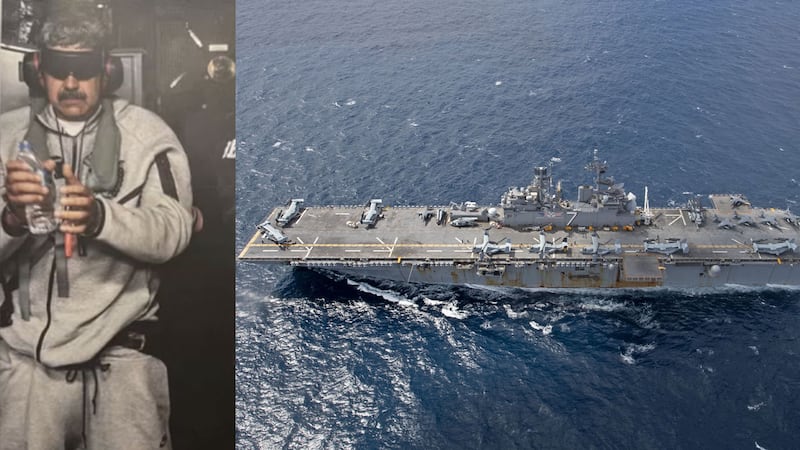
At about 4:25 a.m. on Jan. 3: Trump announced the capture and extraction from Venezuela after “a large-scale strike.”
At about 7:25 a.m. on Jan. 3: U.S. Attorney General Pamela Bondi announced the cases against Maduro and Flores, “two alleged international narco traffickers,” were in the Southern District of New York. Maduro faced charges of narco-terrorism conspiracy, cocaine importation conspiracy, possession of machine guns and destructive devices, and conspiracy to possess machine guns and destructive devices against the United States.
At about 11:30 a.m. on Jan. 3: Federal agents officially took custody of Maduro and Flores, according to federal prosecutors.
At about 4:30 p.m. on Jan. 3: Maduro and Flores arrived at the Stewart Air National Guard base in Windsor, New York.
Here is a timeline of some of U.S. actions before Maduro’s capture:
Nov. 18, 2013: The U.S. Justice Department announced that a senior official with the Banco de Desarrollo Económico y Social de Venezuela, or BANDES, a state-run economic development bank in Venezuela, admitted to corruption involving accounts in Switzerland.
Feb. 13, 2017: The U.S. Treasury announced sanctions against Tareck Zaidan El Aissami Maddah, who Maduro had appointed as the Venezuelan vice president on Jan. 4, 2017.
May 29, 2019: The State Department announced that a Venezuelan-American businessman based in Miami admitted to his role in a bribery scheme involving Petroleos de Venezuela S.A. and the Citgo Petroleum Corporation.
July 25, 2019: The U.S. Justice Department indicted Alex Nain Saab Moran, a close associate of Maduro, for money laundering related to foreign corruption.
Aug. 5, 2019: The U.S. Embassy in Venezuela reported that nearly 90% of hospitals in Venezuela reported shortages of medicine and inconsistent water supplies.
Sept. 17, 2019: The U.S. Treasury announced new sanctions related to Saab’s network.
March 26, 2020: The Justice Department announced the filing of federal charges against Maduro and 14 current and former Venezuelan officials in New York City, Washington, DC, and Miami.
The State Department announced there was a $15 million reward for Maduro’s capture and a $10 million reward for El Aissami Maddah, the former Venezuelan vice president.
Sept. 29, 2020: The State Department announced there was a $10 million reward for Pedro Luis Martin-Olivares, the former chief of the Venezuelan intelligence service. There were also announcements about a $5 million reward for Jesus Alfredo Itriago, the former chief of Venezuela’s counter-narcotics agency, and a $5 million reward for Rodolfo McTurk-Mora, the former head of Interpol in Venezuela.
Jan. 19, 2021: The State Department announced that the U.S. Treasury’s Office of Foreign Assets Control had designated and blocked three companies in Russia, Ukraine, and Venezuela and identified six vessels allegedly “involved in the lifting and transport of Venezuelan oil” in an effort to “limit” Maduro’s options.
Nov. 9, 2023: U.S. Department of Agriculture releases the Analysis of the 2022 Venezuela Food Security Situation reporting that the economy had declined 88% from 2012 to 2020, and the food supply growth did not fully meet the needs of Venezuelans.
Aug. 1, 2024: The State Department announced the U.S. did not recognise Maduro as the winner of the presidential election on July 28, 2024, in Venezuela.
Jan. 10, 2025: The U.S. offers a $25 million reward for the capture of Diosdado Cabello Rondón, a Venezuelan minister, and a $15 million reward for the capture of Vladimir Padrino López, a Venezuelan four-star general.
Jan. 20, 2025: Trump expands foreign terrorist organizations’ designation.
Feb. 20, 2025: The Trump administration designates Venezuelan gang Tren de Aragua as a foreign terrorist organization.
July 25, 2025: The U.S. Treasury announced the Cartel de Los Soles was to be treated as a “specially designated global terrorist.”
Aug. 7, 2025: State Secretary Marco Rubio announced that the reward for Maduro’s capture had increased to $50 million under the U.S. Narcotics Rewards Program.
Aug. 19, 2025: The U.S. Navy deploys three guided-missile destroyers to the southern Caribbean near Venezuela.
Sept. 2, 2025: The U.S. military reported killing 11 drug trafficking suspects during a strike in the Caribbean. After a controversial strike killed the two survivors of an initial strike, more followed on Sept. 15 and 19.
Oct. 2, 2025: Trump declared drug trafficking suspects as “unlawful combatants.”
Oct. 3, 2025: The U.S. military carried out a fourth fatal strike in the Caribbean, a fifth on Oct. 14, a sixth on Oct. 16, a seventh on Oct. 17, an eighth on Oct. 21, a ninth on Oct. 22, and a tenth on Oct. 24.
Oct. 15, 2025: Trump announced that he had authorized the CIA to conduct covert operations in Venezuela.

Oct. 24, 2025: The Pentagon deploys the USS Gerald R. Ford to the southern Caribbean.
Nov. 10, 2025: After several fatal strikes in the Pacific, the Pentagon announced there was a fatal strike in the Caribbean.
Nov. 16, 2025: The USS Gerald R. Ford arrives in the Caribbean.
Nov. 24, 2025: Rubio announced that the Cartel De Los Soles was a foreign terrorist organization headed by “Maduro and other high-ranking individuals of the illegitimate Maduro regime who have corrupted Venezuela’s military, intelligence, legislature, and judiciary.”
Dec. 1, 2025: The USS Gerald R. Ford arrives in St. Thomas.
Dec. 10, 2025: The U.S. seized an oil tanker with Venezuelan oil off the coast of Venezuela.
Dec. 16, 2025: Trump announced a blockade on all “sanctioned oil tankers” going to and leaving Venezuela.
Dec. 20, 2025: The U.S. seized a second tanker off the coast of Venezuela.
Dec. 30, 2025: The U.S. Treasury announced sanctions related to Iran-Venezuela trade in Mohajer-6, a combat drone with intelligence, surveillance, and reconnaissance capabilities. The Associated Press reported the CIA was behind a drone strike at a docking area in Venezuela.
Copyright 2026 by WPLG Local10.com - All rights reserved.

