




NUEVA VENECIA, Colombia (AP) — Leaning over the side of a small speedboat, Jhon Cantillo scoops up a thick clump of bright green vegetation, holding it up before gesturing toward the horizon, where the plant spreads across the waters as far as the eye can see.
From above, the plant forms dense, almost carpet-like mats that stretch across the surface. Up close, its long strands extend deep below the water, with roots reaching toward the lagoon bed, making it difficult to remove completely.
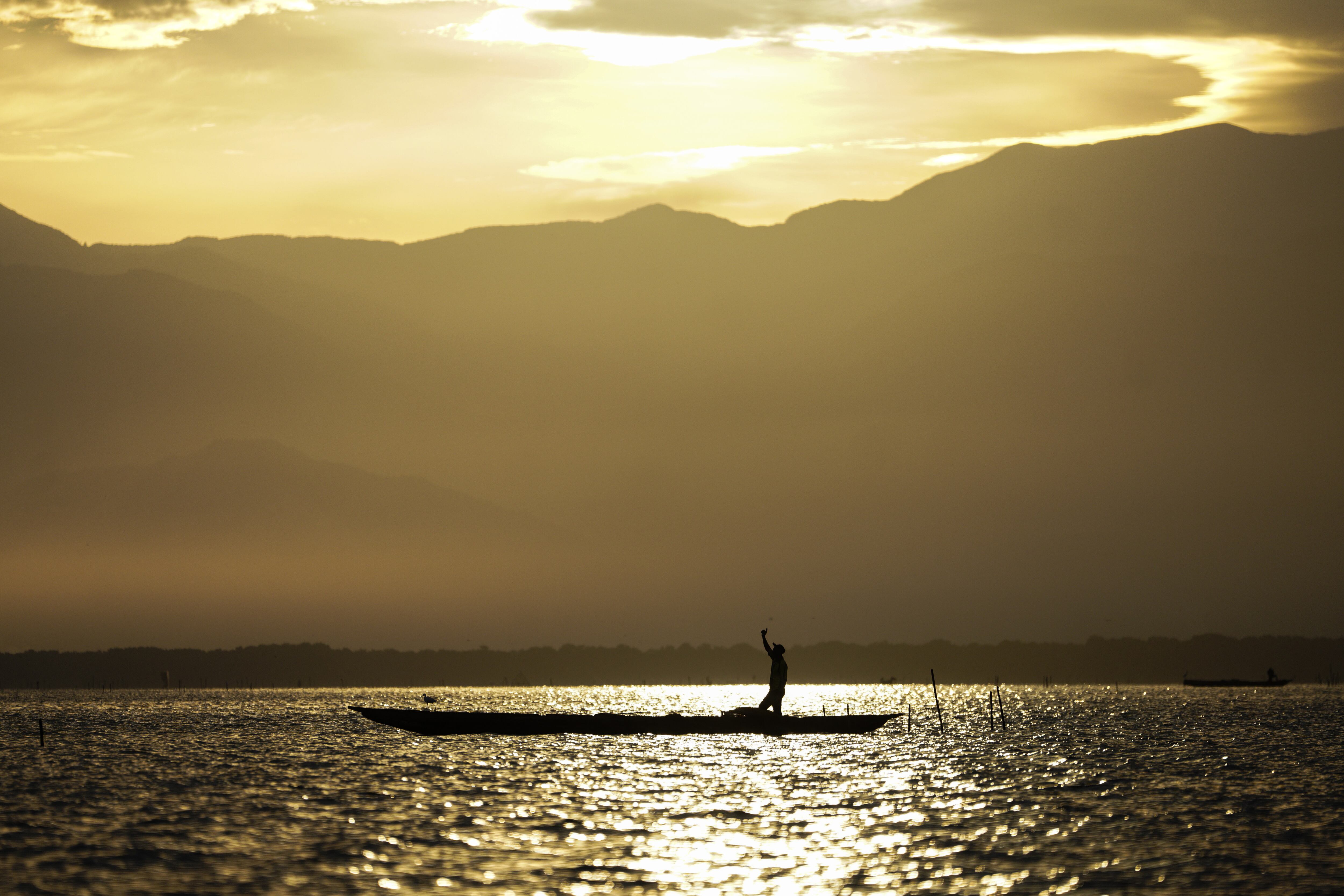
The scenes are unfolding in Colombia’s Cienaga Grande de Santa Marta, a vast coastal wetland on the Caribbean coast about 30 kilometers (19 miles) from the city of Santa Marta. What was until recently a lifeline for fishing and transport is now being choked by dense vegetation, turning it into what he describes as an unfolding environmental crisis.
“What we’re seeing here today is a problem. One that affects not only movement or fishing, but the community as a whole,” said 32-year-old Cantillo, a local environmental and social leader from Cienaga Grande de Santa Marta.
Over the past year, residents say the fast-growing invasive plant native to Asia — Hydrilla verticillata — has spread rapidly across the wetland after first appearing around mid-2025. The dense vegetation, which some locals refer to as “horse tail,” is choking fishing routes, clogging waterways and restricting access to areas where residents collect water, while driving up costs in communities that rely almost entirely on the lagoon for their livelihoods.
The Cienaga Grande de Santa Marta is one of Colombia’s most important fishing ecosystems, serving as a nursery for many species.
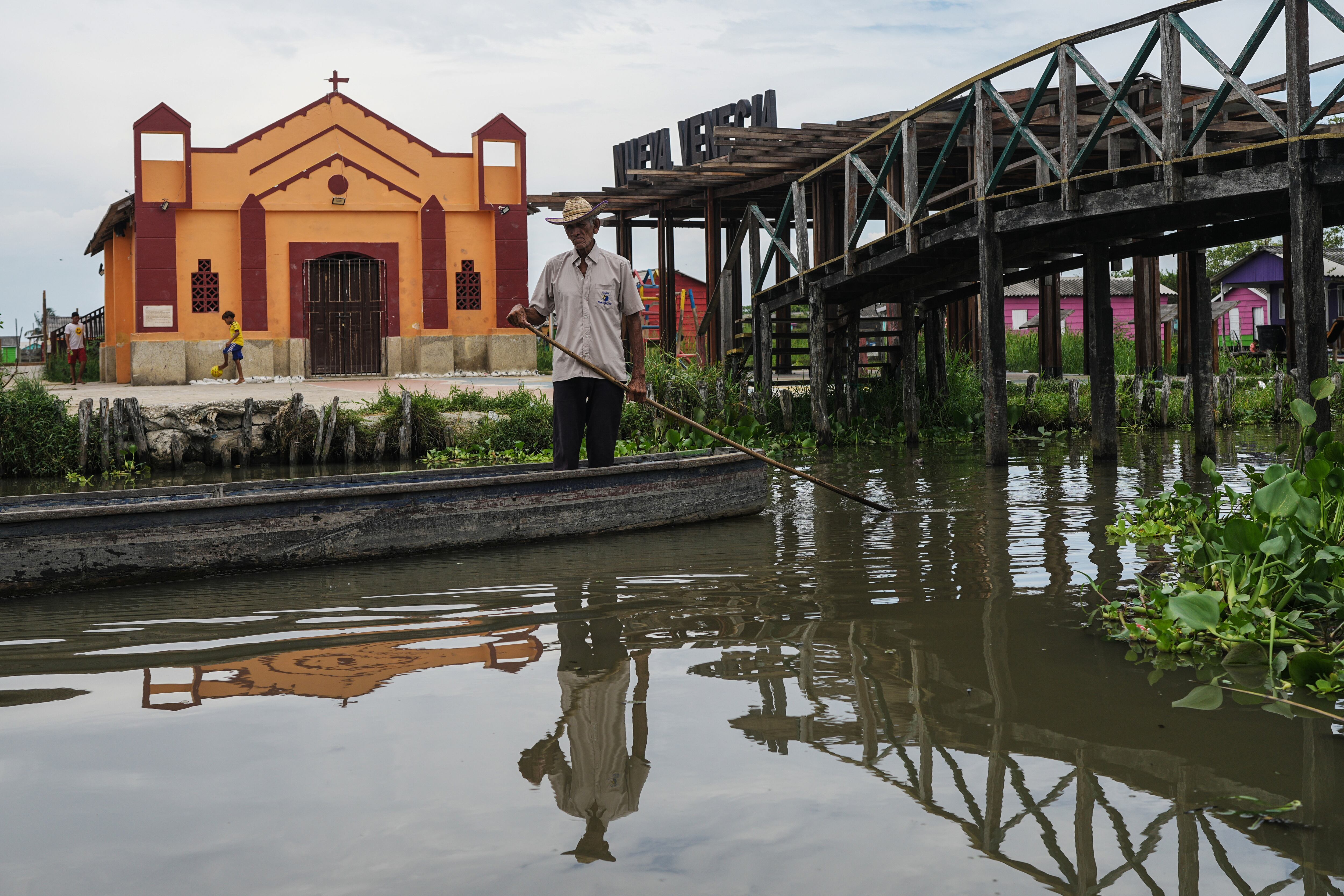
In Nueva Venecia and Buenavista — two isolated fishing communities built almost entirely on wooden stilts over the water — large swaths of open water are now covered by the invasive plant. The communities themselves are largely informal and exist outside many basic state services.
Nueva Venecia — the older of the two, founded in 1847 as a fishing settlement — is home to roughly 4,500 people living in about 500 colorful houses. Buenavista, which emerged in the 1950s, has around 1,150 residents and 163 similarly vibrant homes, where residents travel between houses, shops and schools by small boats or canoes.
"A year ago, there were canoes fishing here. Teachers and students crossing the lagoon. Today, what we see is a problem,” Cantillo said.
A growing crisis for fishing communities
The impact is rippling through already vulnerable communities. Fish catches have dropped, transport has become more difficult and families are facing rising costs as they are forced to buy potable water.
In Nueva Venecia, one small-scale fisherman stood shirtless in the midday heat, pulling brittle strands of dried vegetation from his fishing nets, which he had laid out in the sun to make them easier to clean.
“We can’t work because of this plant,” said 61-year-old Santander Cueto. “It doesn’t let us cast our nets — everything gets tangled.”
What was once a routine task now takes significantly longer.
“The lagoon's completely covered. There’s nowhere left to fish,” said Demóstenes Guerrero, 58, a fisherman and representative of a fishing association in Buenavista.
In some areas, groups of residents head out in wooden boats to cut narrow “lifeline” passages through the thickest vegetation, allowing canoes to pass without getting their propellers tangled. These efforts are labor-intensive and largely driven by the community itself, and must be repeated every few days as the fast-growing plant quickly closes the routes again.
The wetland spans about 428,000 hectares (1,600 square miles) of lagoons, mangroves and marshes — roughly the size of Los Angeles — and has been a UNESCO biosphere reserve since 2000.
Pollution and changing water flows fuel the spread
The Cienaga Grande de Santa Marta is fed by the Magdalena River — one of Colombia’s main waterways — which carries untreated wastewater from across much of the country, said Julián Arbelaez, a water and sanitation engineer working in the region.
That influx of nutrients, including nitrogen and phosphorus, creates ideal conditions for invasive species when water slows in wetlands like this one.
“That load causes the river to enter a state of eutrophication,” Arbelaez said, referring to a process in which excess nutrients fuel rapid plant growth.
The vegetation is also cutting off access to cleaner water sources. Residents typically travel by boat to collect freshwater from channels connected to the Magdalena River, but many of those routes are now blocked. As a result, Arbelaez said, people are increasingly collecting water closer to their homes — often in areas contaminated by untreated sewage.
Residents say another invasive plant, Eichhornia crassipes, which floats on the water’s surface, has long been present in the lagoon and also disrupts fishing and transport, though its impact has been less sudden.
Local leaders say changes in water flow have also contributed to the crisis, with freshwater now dominating areas where saltwater once helped suppress or kill Hydrilla verticillata.
Sandra Vilardy, a professor at Universidad de los Andes who has a doctorate in ecology and who has worked in the region for about 20 years, said there is still limited research on how the plant arrived and that current explanations remain hypotheses.
She said one of the most likely pathways is maritime transport, with the plant potentially entering through major river systems before spreading into wetlands through smaller vessels and dredging activity. A second possibility, she said, is the release of aquarium plants into waterways, a common cause of biological invasions globally, though she noted that explanation appears less likely in this case given the region’s environmental conditions.
Communities say response has been slow and insufficient
“This is a monster in terms of growth,” Cantillo said, describing how it spread from a limited presence early last year to surrounding entire communities within months.
Even attempts to remove it can make the situation worse, as fragments can break off and spread further. Residents say efforts to remove the plant have largely been limited to small-scale manual clearing by fishermen and sporadic pilot efforts by authorities, with no effective large-scale solution in place.
The crisis is now pushing some residents to consider leaving altogether.
“We now face a risk that we didn’t have 20 or 25 years ago — the risk of mass displacement,” Cantillo said.
Protests and road blockades have already taken place as frustration grows over what locals describe as a slow and insufficient government response.
Alfredo Martínez, director of CORPAMAG, the regional environmental authority, said Hydrilla verticillata is not officially classified as an invasive species in Colombia and that national guidelines for its control are still pending. He said monitoring and removal efforts are underway with local community involvement, adding that no further expansion has been observed since March and that lower water levels may be slowing its spread.
César Rodríguez Ayala, a community leader in Nueva Venecia, said the crisis is affecting nearly every aspect of life.
“If the fisherman can’t work, the shop doesn’t sell,” he said. “We are living a very difficult situation, economically and environmentally.”
While mechanical removal methods exist, complete eradication is unlikely in the short term due to high costs and limited capacity, according to Cantillo.
“We are part of Colombia too,” Rodríguez said. “We live on the water, but we also deserve to be seen — and helped — in a moment like this.”
___
The Associated Press’ climate and environmental coverage receives financial support from multiple private foundations. AP is solely responsible for all content. Find AP’s standards for working with philanthropies, a list of supporters and funded coverage areas at AP.org.
Copyright 2026 The Associated Press. All rights reserved. This material may not be published, broadcast, rewritten or redistributed without permission.