
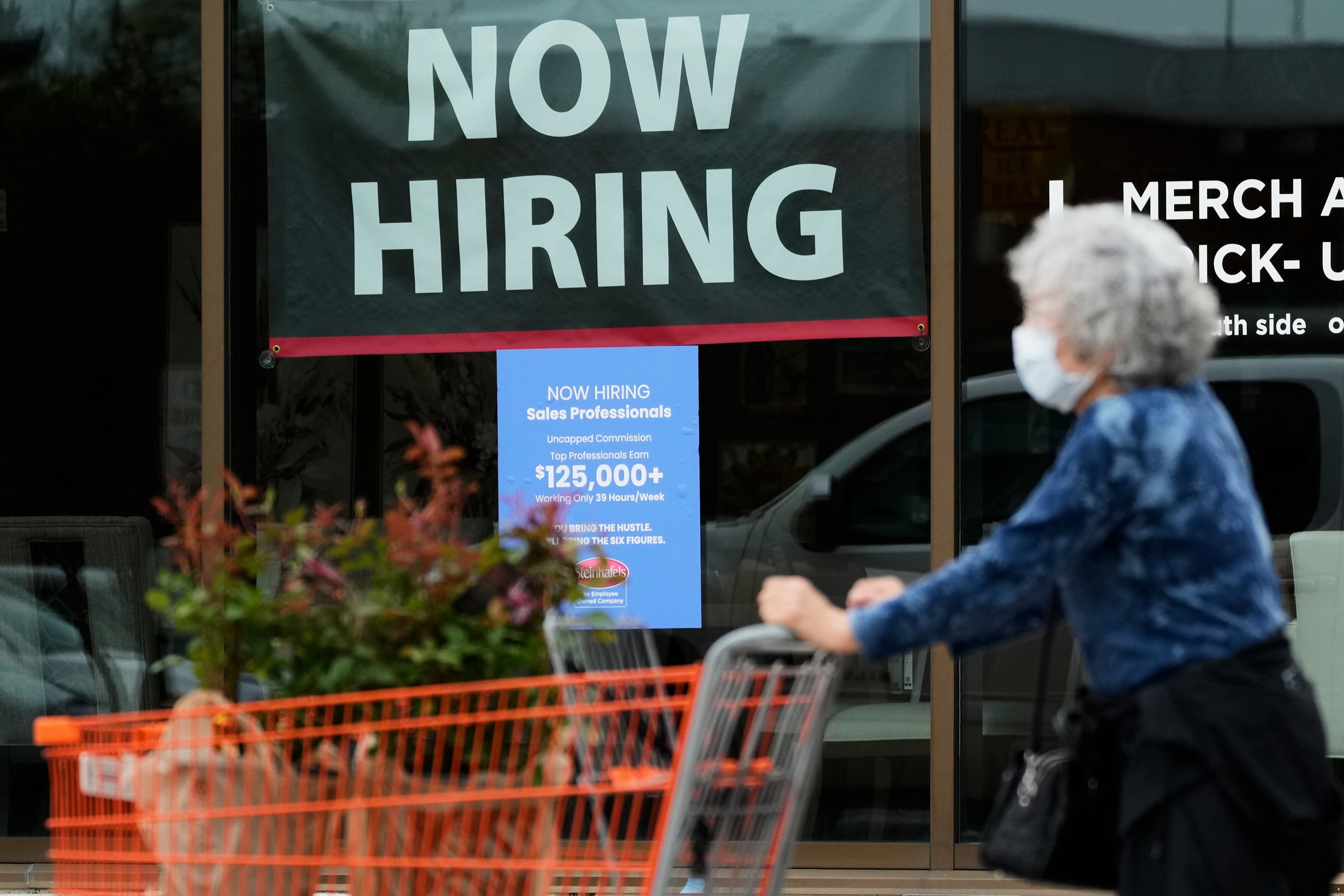

WASHINGTON (AP) — The U.S. job market stalled unexpectedly last month, delivering a political blow to President Donald Trump three months ahead of midterm elections and complicating decision-making for the inflation fighters at the Federal Reserve.
Employers cut 23,000 jobs in July. And Labor Department revisions slashed 103,000 jobs from May and June payrolls.
The unemployment rate fell but for the wrong reason: Thousands of people dropped out of the labor market so fewer people were competing for work.
The July jobs numbers from the Labor Department Friday marked a sharp setback for the American labor market and for Trump less than three months before his Republican party seeks to keep full control of Congress in the midterm election.
Forecasters had expected job creation to approach 100,000 last month.
Local public schools cut 50,000 jobs in July, restaurants and bars 26,000, retailers 19,000.
The 4.1% unemployment rate was the lowest since June 2025 – but it only fell because 264,000 people dropped out of the labor market last month. The share of those working or looking for work fell to 61.4%, the lowest since February 2021.
“We can't really put lipstick on a pig here,'' said Daniel Zhao, chief economist at the jobs website Glassdoor. ”This is not a great report for July.''
Manufacturing up, but public schools down
The Trump administration, which has imposed massive tariffs in an attempt to protect American industry and create manufacturing jobs, noted that jobs were up 22,000 at construction companies and 5,000 at factories.
“The Trump industrial resurgence is on schedule," said White House spokesman Kush Desai. "Manufacturing and factory construction jobs grew again in July even as government payrolls continued to significantly shrink.’’
Trump has long bragged that jobs have been increasing for native-born citizens in his economy, but that talking point was undermined by the July numbers. The White House declined to comment on why Friday's report showed that employment for native-born Americans dropped by 720,000 over the past 12 months. Those numbers can be quirky. They’re not adjusted for seasonal changes and are not seen as a reliable measure of total native-born employment. But the administration had latched onto them as evidence that Trump's immigration crackdown was benefiting people born in the United States.
To raise or not to raise
Policymakers at the Federal Reserve have been divided over whether to start raising interest to combat inflation that has exceeded their 2% target for more than five years. The Fed kept rates unchanged at its meeting last week — but three officials dissented from that decision in favor of a rate hike. Wall Street traders were expecting rate hikes later this year. Friday’s report may at least delay higher rates.
“The Fed has to consider the health of the job market as they debate whether a hike is justified,″ said Glassdoor’s Zhao. ”The softness in today’s report is going to have to give the Fed a little bit of pause.″
July wage gains were modest. Average hourly pay was up 3.2% last month from July 2025, the smallest year-over-year increase since May 2021. The smaller wage gains are coming at a time when American families are squeezed by the high cost of living.
“This is a bleak jobs report," said Heather Long, chief economist at Navy Federal Credit Union. "The U.S. labor market is stalling again and that is going to make the Federal Reserve’s job harder and life for job seekers rough.''
Women lost 32,000 jobs last month, the Labor Department reports, accounting for all the job losses in July. But that marked a reversal in women’s fortunes: They still gained 321,000 jobs over the past 12 months; men lost 5,000 over that period.
Economists noted that private payrolls continued to grow in July and that the big drop in public school payrolls might have been a statistical glitch caused by seasonal adjustments.
Rebounding from a miserable 2025
Hiring had rebounded this year from a lackluster 2025 in the face of the conflict in the Persian Gulf that has sent energy prices surging and put a strain on family budgets. Job growth had been solid, if unspectacular. Some businesses are having trouble filling vacancies. Others are using technology to do the work humans used to do.
Americans who have jobs are enjoying unusual job security. Layoffs are low by historical standards. Companies, scarred by the surprise labor shortages that followed COVID-19 lockdowns a few years ago, don’t want to risk giving up the staff they have.
One week in July the number of Americans filing for unemployment benefits dropped to the lowest level in more than 50 years. The jobless rate tumbled to 4.2% in June, the lowest in a year, and is expected to have stayed there last month, according to a survey of forecasters by the data firm FactSet.
But Americans who have lost their jobs – or are seeking to bust into the job market for the first time – are struggling to catch a break.
Economists have used the term "no hire, no fire'' to describe the unusual job market conditions.
Hiring in the year to date remains weak
So far this year, employers are adding 61,000 jobs a month, up from 9,700 in 2025, the weakest hiring outside a recession since 2002. But job creation this year is well below the 2023-2024 average of 166,000 jobs a month — and it had been even higher during the 2021-2022 hiring boom that followed the end of COVID-19 lockdowns.
At least the United States doesn’t need as many jobs as it used to to keep the unemployment rate from rising. Trump’s immigration crackdown and the ongoing retirement of baby boomers mean fewer people are competing for work. So the “break-even’’ rate of monthly hiring, 155,000 in 2023-2024, has dropped, perhaps to nearly zero, according to a Federal Reserve study.
The jobs outlook is clouded by the ongoing fighting in the Persian Gulf, which has pushed up energy prices and squeezed family budgets, and by the rise of artificial intelligence, which could either make workers more efficient and better-paid -- or take their jobs.
In a report out this week, researchers Ingrid Chen, Marianna Kudlyak and Riva Mikhlin of the Federal Reserve Bank of San Francisco found that landing a job has gotten tougher in the past couple of years – surprisingly so.
Normally, this deep into an economic expansion – it's been more than six years since the last recession – employers would need workers so badly that they’d be taking chances on young people and on those with less education. Not this time. “Instead of being pulled in, the pipeline into employment is shrinking such that the recovery is no longer reaching workers at the margins,’’ Chen, Kudlyak and Mikhlin write.
Moreover, the unemployed people who normally get back to work the fastest – those in their prime working years (25 to 54) and with college educations – are struggling to find new jobs. The San Francisco Fed researchers aren’t sure what’s making the job search so tough. They suspect it might have to do with the immigration crackdown, hiring slowdowns specifically at tech companies and government contractors, uncertainty over the direction of government policy or “early signals of broader labor market deterioration.’’
____
AP Business Writer Claire Savage in Chicago contributed to this story.
Copyright 2026 The Associated Press. All rights reserved. This material may not be published, broadcast, rewritten or redistributed without permission.