MIAMI — The fully autonomous ride-sharing service Waymo is now available to select members of the public in South Florida.
The company announced Thursday that it’s now accepting rides in and around Miami for the “nearly 10,000 residents already signed up” for the service.
Scroll down to read about Local 10’s test ride
It “will be inviting new riders on a rolling basis to ensure a seamless experience across our initial 60-square-mile service area,” according to its website.
Waymo released a map accompanying the announcement showing its initial service area.
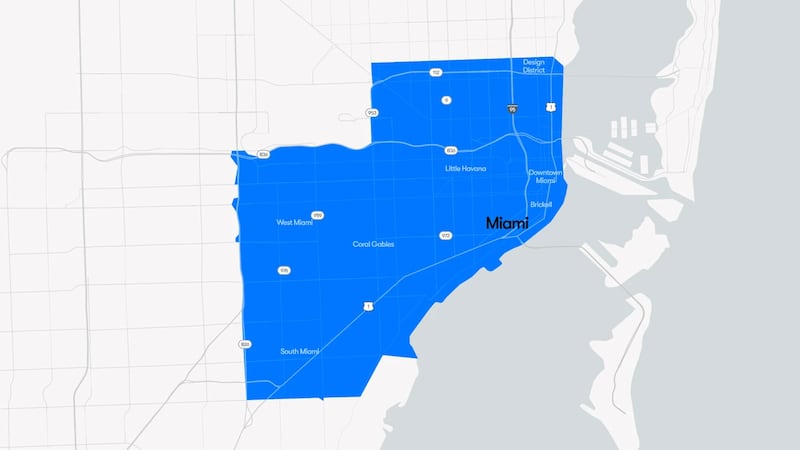
Rides are available in several Miami neighborhoods, including the Brickell and downtown areas, Little Havana, Flagami, Coconut Grove, Allapattah, Wynwood and the Design District.
Waymo’s service area also includes the cities of South Miami and West Miami, as well as most of Coral Gables and portions of unincorporated Miami-Dade roughly bounded by the Palmetto and Dolphin expressways to the west and north and Kendall Drive to the south.
The company says it “plans to expand to Miami International Airport soon.”
Waymo already serves the Atlanta, Austin, Los Angeles, Phoenix and San Francisco areas, according to its website. Several other cities, including Orlando, are listed as being “up next.”
Local 10 News takes test ride
Waymo provided Local 10 News with a test ride on the rain-soaked streets of Miami on Thursday.
Riders hail the technology like a typical ride-sharing app, but it comes customized with riders’ preferences, from climate control to language to music, on the desired settings. Riders unlock the vehicles from their phones and the vehicles automatically lock once the rider is inside. They can add stops mid-trip.
During the test ride, the vehicle recognized a group of teenagers stepping off a curb to jaywalk and adjusted accordingly.
The ride was, by and large, smooth. There was one hiccup: the vehicle stopped for an abnormally long time at a four-way stop ― a little more than 50 seconds.
Waymo spokesperson Mark Lewis, who accompanied Local 10, explained what was happening.
“It is deciding what to do next,” Lewis said. “We are at an all-way stop; it should be observing that it is able to proceed.”
Just before the driver behind Local 10’s Waymo moved to pass, the Waymo vehicle started moving again.
“It made the decision (that) whatever it was taking caution on, it decided it was ready to go,” Lewis said. “In these, if you feel like your vehicle is stopped more than it should be, we have the support button where there is always a human at the other end.
“We have gone through this intersection many times today and so if it continues to maybe be confused or (needs) clarity on how to proceed, it will reach out to its fleet support and keep on going.”
The company’s vehicles have had high-profile malfunctions in other cities, including an instance where one ended up on light rail tracks in Arizona.
In December, federal regulators announced that they were probing “the performance of the Waymo ADS (Automated Driving Systems) around stopped school buses” after reports of a Waymo vehicles in Austin failing to stop for school buses with their stop arms deployed and red lights flashing.
As far as crashes, though, the company touts a federal analysis showing that injury crashes were reduced by 80% on a per-mile basis compared to human drivers.
According to a law firm tracking Waymo crashes, Waymo vehicles have only been involved in two deadly crashes. In both instances, the wrecks involved a human driver crashing into a stationary or slowing vehicle.
Lewis said the company is confident its vehicles can handle South Florida streets.
“We’re always learning, but we have the confidence in our driver that’s had over 127 million autonomous miles driven with no one in the driver’s seat across the cities where we’ve already opened service and across the cities where we’ve tested actively,” he said. “We’ve already been testing here (for months), so we really believe it has the experience to work here.”
Copyright 2026 by WPLG Local10.com - All rights reserved.

