


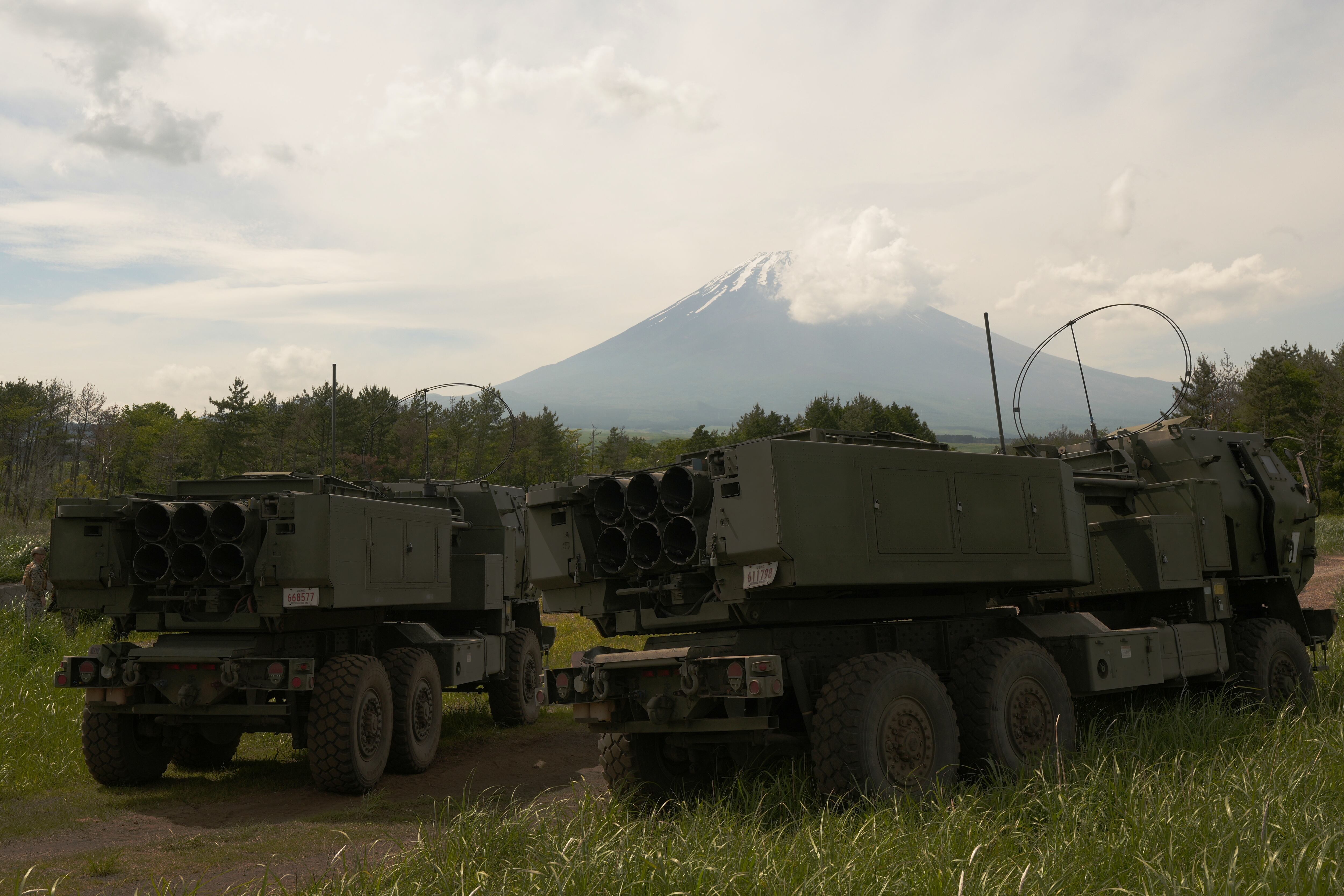

GOTEMBA, Japan (AP) — With a burst of flame, followed by a thunderclap boom that broke the bucolic serenity of the training area in the foothills of Japan’s Mount Fuji, the first rocket fired by the U.S. Marines from their mobile launcher screamed toward its target, the orange burn of its engine painting a streak across the blue sky.
Another five rockets followed in rapid succession, before a second HIMARS truck drove out of its concealed position in a copse of evergreens, fired its salvo of six rockets, then retreated back to cover.
The live-fire exercise this week at the U.S. military’s Camp Fuji east maneuver area lasted only a few minutes, but was a significant demonstration to Pacific allies of American capabilities as Washington seeks to deter possible Chinese aggression against Taiwan, the self-governing democracy that Beijing claims as its own and hasn't ruled out taking by force.
Deterrence through strength, not confrontation
It was also a demonstration of how the U.S. has been shifting tactics in the Pacific, made necessary by the rapid modernization and improvement of China’s military in recent years.
“The U.S. does not want China to invade Taiwan, but it would not be relying on the traditional aircraft carrier-based attack wings of the past,” said Euan Graham, a senior defense analyst with the Australian Strategic Policy Institute.
“In Iran, with the U.S. conflict there, there were over 40 U.S. aircraft, manned and unmanned, either destroyed or damaged against a much less capable adversary, so in the case of conflict with China that vulnerability would be much greater," he said. "That’s why we’re seeing the U.S. emphasizing ... these smaller units.”
According to the Pentagon's latest annual report to Congress, the goal is to “deny the ability of any country in the Indo-Pacific to dominate us or our allies." It said the priority was on bolstering deterrence “through strength, not confrontation.”
Recent wars and proliferation of drones underscore need for mobility
The function of the HIMARS is implicit in its full name, “High Mobility Artillery Rocket System." It's a truck-mounted pod of rockets that can be hidden from drone or satellite surveillance, driven out to fire its GPS-guided missiles, then quickly back to a new hidden position using what the military commonly calls “shoot-and-scoot” tactics.
“It depends on the crew, but it can get as fast as four minutes, (even) two minutes sometimes,” said Sgt. Kevin Alvarez, section chief of one of the two Fox Battery, 3rd Battalion, 12th Marines, 3rd Marine Division HIMARS involved in the Camp Fuji exercise.
Introduced about 20 years ago, the HIMARS has been used in Iraq and Afghanistan, but was largely unknown to the general public until Ukraine was able to use it with great success in its fight against Russia.
Those conflicts, especially with the proliferation of drones on the battlefield that can quickly identify static artillery positions, have underscored the value of mobility, said Lt. Col. Ryan Anness, commander of the 3rd Battalion.
“They’re much quicker, much faster, and much easier to hide than, say, traditional cannon artillery, and obviously having the precision fire weapons and having the ability to hide easier is why so many countries, and why it’s important for us, to have the HIMARS,” he said.
HIMARS can now hit targets at more than 300 miles
The HIMARS can fire a variety of missiles, and initially only shorter-range munitions were provided to Ukraine until the U.S. decided to allow Kyiv to have the ATACMS, or Army Tactical Missile System, that can hit targets at about 300 kilometers (180 miles) away.
In the first days of the war against Iran after the U.S. and Israel attacked on Feb. 28, the HIMARS was used to fire both ATACMS and, for the first time in combat, the even longer-range Precision Strike Missiles, sinking “multiple” Iranian surface ships and a submarine in port, Air Force Gen. Dan Caine, chairman of the Joint Chiefs of Staff, has said.
The so-called PrSM can reach targets at ranges greater than 500 kilometers (310 miles,) according to manufacturer Lockheed Martin.
Together with the Army’s Typhon — another truck-based launching system that shoots longer-range Tomahawk missiles and others, but is less maneuverable than the HIMARS — the two systems could easily cover the Taiwan Strait between Taiwan and China, and the strategically important Luzon Strait, between the Philippines and Taiwan, if deployed on Taiwan and the Philippine and Japanese islands nearby, Graham said.
Both waterways would be critical to any sort of Chinese invasion or blockade plan.
“In advance of a conflict around Taiwan, there would likely be a large-scale outflux of U.S. assets within the envelope of China’s missile capabilities,” Graham said. "All that would be left is submarines, which are more survivable, and small units based on rugged survivability — mobile systems like the HIMARS.”
Exercises demonstrate capabilities, and partnership
The maneuvers carried out at Camp Fuji on Wednesday used dummy rockets — concrete-filled tubes with no explosives — and were carried out under strict safety guidelines and observed by Japanese military officials, who shut down a local road during the exercise just in case one of the projectiles fell short.
Even though the precautions meant carrying out the live-fire exercise somewhat slower than the HIMARS would be used in combat, Lt. Col. Anness stressed the value of it both for his Marines and for ties with U.S. allies.
“Being able to have long-range precision-fire weapons provides deterrence here in the Pacific, and we train with our Japanese partners as much as we can to make sure we’re ready,” he said.
Copyright 2026 The Associated Press. All rights reserved. This material may not be published, broadcast, rewritten or redistributed without permission.