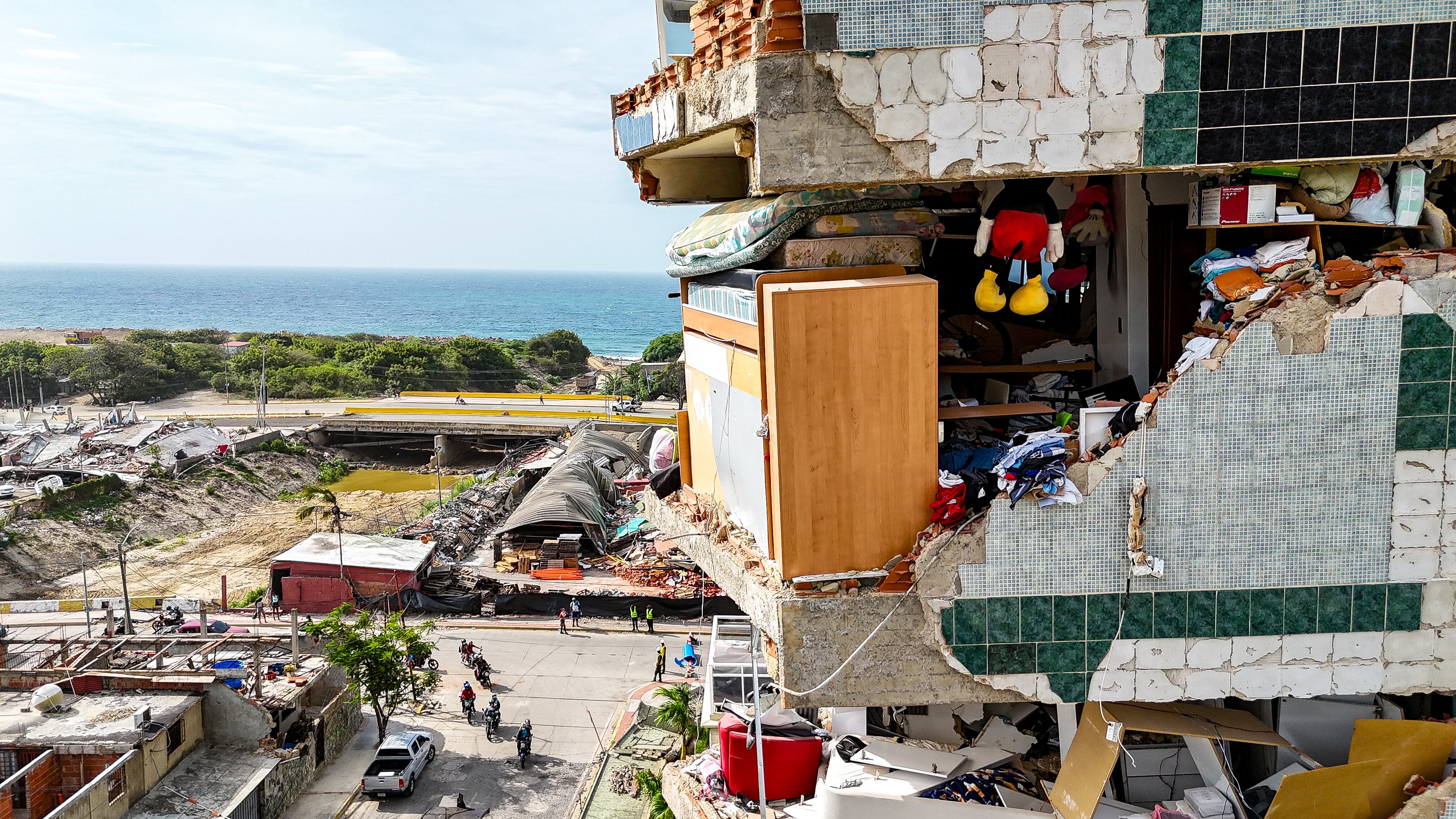


CATIA LA MAR, Venezuela (AP) — Venezuela's U.S.-backed acting President Delcy Rodríguez on Thursday issued a fiery defense of her government's response to last week's devastating earthquakes, lashing out at critics who say authorities reacted too slowly, pushing back on suggestions that the true death toll is far higher than the government has acknowledged and rejecting accusations that the nation's shoddily constructed social housing exacerbated the disaster.
The self-described socialist government of Rodríguez, striving for legitimacy months after the United States removed former President Nicolás Maduro from power in January, has come under fire for what residents have described as a sluggish and haphazard response to the quakes.
Residents of the hardest-hit state, La Guaira, have complained that the initial absence of a serious government search-and-rescue operation left them alone to scour for neighbors and loved ones with their bare hands. Rescuers have lamented the country's shortages of specialized equipment. Experts have warned that substandard construction of social housing projects — a hallmark policy of former President Hugo Chávez — left neighborhoods vulnerable to quakes.
At a press conference for foreign journalists in the capital of Caracas late Thursday, Rodríguez, wearing a black ribbon as a symbol of mourning, refused to accept the criticism.
“We did not wait one day, two days or three days. We activated immediately,” she said, lacing into media outlets that she accused of spreading misinformation. “To politicize a humanitarian tragedy like this — when the Venezuelan government and its authorities have spared no effort, public, private, national, or international — is disgraceful."
Authorities have counted at least 2,295 people killed by the earthquake as of Wednesday — a number that’s expected to rise. They did not offer an updated death toll on Thursday, and have maintained tight control over public communications and relief efforts.
A rare bright spot in the misery
The stench of decomposition hung heavy over streets of flattened buildings as rescue missions to find survivors of Venezuela’s devastating earthquakes increasingly turned to the recovery of corpses.
Desperate for good news, Venezuelan and international emergency workers celebrated the near-miraculous rescue of a 43-year-old security guard found alive after nearly eight days under the rubble — five days beyond the critical 72-hour mark following a quake when experts say finding survivors is most likely.
National broadcasters reran footage of the exuberant moment he was pried free from the collapsed mall and lifted onto a stretcher as crowds cheered. Trapped in an air pocket beneath the concrete, Hernán Alberto Gil Flores survived on the food and water that rescuers managed to pass him through crevices.
Elsewhere across La Guaira, an air of hopelessness was setting in. The port city of Catia La Mar teemed with officials carrying body bags and stacking wooden coffins.
More than 38,000 reports of missing people — many of them likely buried beneath the rubble — have been sent to a website set up by the Venezuelan opposition, as the government has not given official figures for those missing.
When one journalist asked Rodríguez about the true, still-unknown toll of the disaster, citing reports that the United Nations is procuring 10,000 body bags, Rodríguez defended the government's tally.
“We do not want to speculate," she said. “The numbers we provide are rigorously verified.”
In La Guaira, several of Chávez's signature social housing projects were razed by the earthquakes, prompting suspicions of flawed construction. Rodriguez deflected the accusations, claiming on Thursday that about 80% of the collapsed buildings were privately developed. She did not offer evidence.
Rodríguez’s denies a slow government response
Pressed on reports that residents were on their own in the first 48 hours after the quakes, with heavy machinery and official aid scarce, Rodríguez acknowledged that “naturally, at the sites where the building collapsed, the first people to arrive were survivors of the collapse itself, relatives and neighbors."
But she railed against what she called “narratives manufactured in propaganda laboratories" and claimed that a day after the quakes, “We had already mobilized the full capacity of the Venezuelan state together with the private sector.”
The disaster has evolved into the biggest test of competence yet for Rodríguez, who served as deputy to Maduro until his ouster and became interim leader with the backing of the Trump administration.
Her comments Thursday came a day before the extension of her 180-day mandate as acting leader was set to expire. It was unclear what would happen once the deadline passes Friday.
Under Venezuela’s constitution, temporary absences are to be filled by the vice president — which was Rodríguez’s former role — for up to 90 days. These interim appointments can be extended by the national assembly for an additional 90 days. The National Assembly, controlled by Rodríguez’s party, can trigger a snap election if lawmakers declare the post permanently vacant.
U.S. support of a government under fire
In contrast to the aftermath of Venezuela's catastrophic 1999 landslides, when then-President Chávez rejected offers of assistance from an adversarial U.S., Rodríguez has publicly welcomed aid and rescue teams from governments across the political spectrum — including the Trump administration and its regional allies.
In expressing thanks for the foreign help, Rodríguez singled out Israel, which has no diplomatic relations with Venezuela. She praised President Donald Trump and Secretary State of Marco Rubio, saying they “remained constantly attentive and offered support.”
Washington has thrown its support behind Rodríguez in its bid to open up Venezuela’s lucrative energy industry and largely turned its back on opposition leader and Nobel Peace Prize winner María Corina Machado, who this week accused Rodríguez’s government of blocking her return to the country.
The U.S. has committed over $300 million and deployed some 900 military personnel to support rescue operations. On top of that, John M. Barrett, the U.S. chargé d’affaires to Venezuela, said the U.S. would make revenue from Venezuelan oil production, controlled by the U.S. Treasury since Maduro’s seizure, available for relief efforts. That promise has made demands for more transparency in U.S. management of Venezuelan oil sales all the more urgent, analysts say.
“Venezuelans really need that money to be used for the protection of Venezuelans,” said Laura Cristina Dib, Venezuela program director at the independent human rights organization Washington Office on Latin America.
___
DeBre reported from Buenos Aires, Argentina. Associated Press journalists Ben Finley in Washington, Gabriela Aoun Angueira in San Diego, Gisela Salomon in Miami and Megan Janetsky in Mexico City contributed to this report.
___
Corrects that the deadline for the acting president expires on Friday, not Thursday.
Copyright 2026 The Associated Press. All rights reserved. This material may not be published, broadcast, rewritten or redistributed without permission.