
June is historically the least active month of the hurricane season, but that doesn’t mean the first month of the season can’t bring its fair share of issues. Most commonly, it’s the weak and sloppy systems – waterlogged disturbances that may not even muster up a name – that wreak the most havoc in June. Short-timer Arthur last week punctuated this truth, and even though it did briefly get a name, the widespread and locally catastrophic flooding that followed came after it had already unraveled into a remnant low.

Mercifully for areas in Texas, Louisiana, and coastal Mississippi saturated with tropical rains last week, Mother Nature will turn off the tropical spigot this week, as high pressure takes over and ushers in the hottest temperatures of the year so far. Already heat advisories are in effect today across parts of southern Louisiana in anticipation of feels-like temperatures approaching 110 degrees, with additional heat advisories expected this week across the Deep South.
The one-two punch that’ll shut down the Atlantic to close out June
We started reading the stormy tea leaves of mid-June – brought on by the active phase of the Madden-Julian Oscillation or MJO – way back on the second day of the hurricane season. While El Niño was heating up in the eastern Pacific, the Gulf and western Caribbean showed signs of punching through – at least briefly – as the upper-level wind configuration opened a narrow lane for tropical mischief.
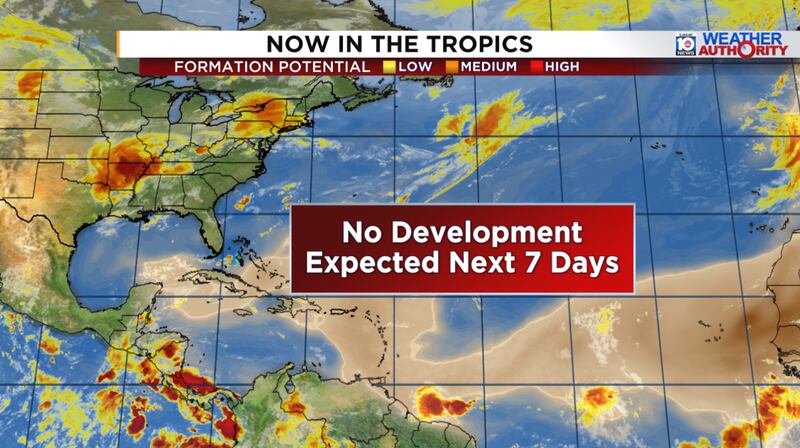
Now that we’re on the other side of Arthur and its remnants, the tropical Atlantic is about to get pummeled by the one-two punch of El Niño and continent-sized plumes of Saharan dust, coming as dust season peaks for the end of June and beginning of July.
The warming of the ocean waters in the eastern equatorial Pacific that define El Niño takes time to link up with the atmosphere and begin affecting the circulation patterns that ultimately dampen Atlantic tropical activity. We’re seeing that atmospheric coupling beginning now, with rising air dominating the Pacific and sinking air over the North Indian Ocean torpedoing development odds through the tropical Atlantic.

A ribbon of exceptionally strong wind shear stretching clear through the tropical belt of the Atlantic basin will mean tropical tumbleweeds for the foreseeable future.

Even into July, any tropical threats will probably originate closer to the U.S. and around the southeastern U.S. coastline where the effects of El Niño are less noticeable. But for now, the triggers we’d look to closer to home – like unusually strong cold fronts or large thunderstorm complexes moving off the mainland – aren’t in the cards, and June should close with little fanfare across the Atlantic.
Copyright 2026 by WPLG Local10.com - All rights reserved.
