
Though El Niño is responsible for intensifying many extreme weather patterns associated with climate change – worsening extreme drought, heavy rainfall, and heatwaves globally – its impact on the Atlantic hurricane season is generally welcome news to those of us living along hurricane alley.
Overall hurricane activity across the Gulf, Caribbean, and tropical Atlantic is typically softened during El Niño events – particularly during moderate to strong El Niños like the one that’s gearing up and expected to peak later this year. The warming of the eastern equatorial Pacific that defines El Niño shifts large-scale atmospheric circulations, which in turn ramps up storm-busting wind shear and dries out parts of the tropical Atlantic.

Not only are the number of Atlantic storms reduced during El Niño years but the risk of a U.S. hurricane strike typically falls in tandem. But a reduced risk isn’t zero risk, and when a hurricane threatens the U.S. during an El Niño year, some states see their relative risk increase.
Florida still the undisputed hurricane heavyweight, but Louisiana and South Carolina see shifting risks
In terms of hurricane strikes in the U.S., Florida has recorded more than any other state. In any given year, the highest odds of a hurricane strike on the U.S. is in Florida (typically about 50-60% odds of a Florida hurricane strike in any given year). While the overall odds of a U.S. hurricane strike may fall during El Niño years like 2026, it’s still Florida that holds the highest risk.
But for other states, the relative risk changes when El Niño comes to town. For example, Texas is the second most likely state for a hurricane strike during any given year, but when considering only El Niño years, Texas falls behind Louisiana in terms of hurricane strikes. Additionally, South Carolina jumps from the 6th most at-risk state to tied with Texas for 3rd most at-risk state when El Niño conditions are present.
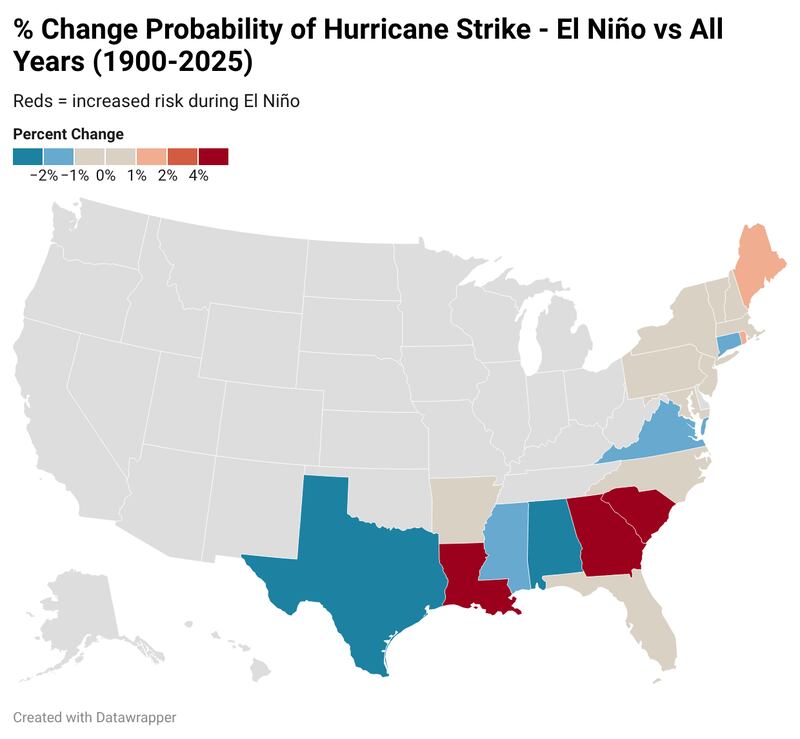
It’s worth noting that a hurricane landfall on the U.S. only happens once to twice a year on average. Years like 2004, 2005 and 2024 – which each saw 5 U.S. mainland hurricane landfalls – are the exception rather than the rule (the most hurricanes to hit the U.S. in a single season is 6, which happened in 1886, 1985, and 2020). So when we say the odds of a U.S. hurricane strike are reduced during El Niño years, it means we might expect one hurricane hit rather than two for an average year. While one less hurricane strike on the U.S. is meaningful, El Niño certainly doesn’t eliminate the risk.
No major hurricane landfalls recorded from Georgia to Maine during El Nino years
Although so-called “major” (Category 3 or stronger) hurricanes have struck the U.S. during El Niño years – including infamous hurricanes like Betsy in 1965 which hit during a strong El Niño – no Category 3 or stronger hurricane landfall has been recorded north of Florida and along the east coast from Georgia to Maine during an El Niño year.
In addition to a reduction in major hurricane activity during El Niño years, the North Atlantic subtropical high pressure (also known as the Bermuda or Azores High) that steers Atlantic hurricanes is also weaker, which leads to more recurving storms over the open ocean and before reaching the U.S. east coast, a factor also contributing to the dearth of major landfalls north of Florida.
No development expected this week in the Atlantic
As we discussed in yesterday’s newsletter, the remnants of now Tropical Storm Cristina in the eastern Pacific will slip into the southern reaches of the Gulf by late this week. Forecast models last week that hinted at a small development window by the weekend have backed off due to the proximity to land of the disturbance and less conducive upper-level conditions.
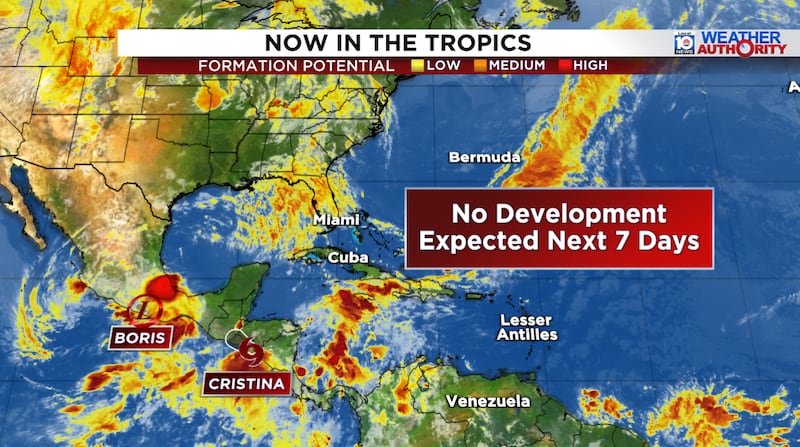
The Atlantic basin will remain dormant through the second full week of the hurricane season.
Copyright 2026 by WPLG Local10.com - All rights reserved.
