

The National Hurricane Center late Wednesday morning upgraded Potential Tropical Cyclone One to Tropical Storm Arthur, the first named storm of the 2026 Atlantic hurricane season.
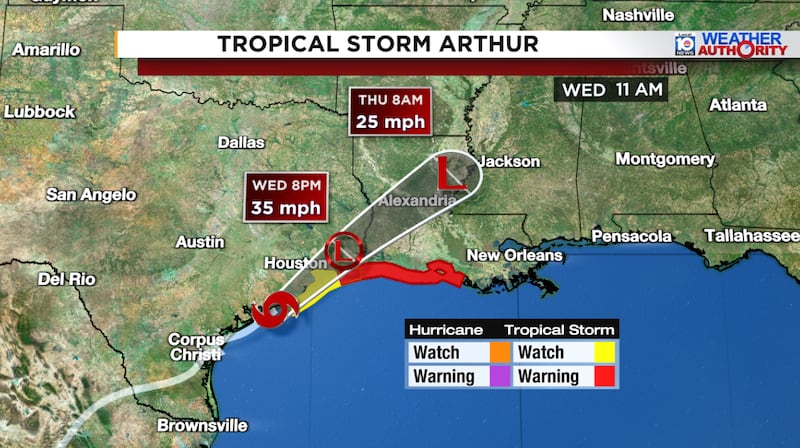
As of 11 AM ET Wednesday, the center of Arthur was located along the middle Texas coast roughly 90 miles south of Galveston. Maximum sustained winds were estimated at 40 mph – the threshold for a tropical storm – and little change in strength is expected before it moves fully inland over parts of southeast Texas and Louisiana later today.
A NOAA-owned and operated station at the entrance of Galveston Bay reported sustained winds of around 40-45 mph with gusts to 50 mph around 10 AM local time Wednesday.
It’s worth noting that nearly all thunderstorm activity and heavy rain associated with Arthur is displaced well east of its circulation due to a firehose of nearby westerly wind shear. As a result, Arthur has a very unconventional appearance for a tropical storm, with persistent, deep convection absent over its circulation center. The shear will accompany Arthur inland and keep the wet weather to the south and east side of its sprawling circulation center.
Big rains and widespread flood threat across the Deep South
While Arthur will bring blustery weather to the coast today, its winds will be a secondary hazard to the multi-day flood threat it poses to a large stretch of the Deep South. Hefty rainfall totals since the start of the week approaching double digits have already fallen across central Louisiana, with another 5 to 10 inches of rainfall expected for parts of southern and central Louisiana, lower Alabama, southeastern Mississippi, western Georgia, and the western Florida panhandle through Thursday.
The National Weather Service Weather Prediction Center is advertising a moderate risk (threat level 3 of 4) of excessive rainfall for these areas, including cities like New Orleans and Mobile, which could lead to significant life-threatening flooding over the next few days.

Those in the highest-risk flood zone should closely monitor local alerts from the National Weather Service, as extreme rainfall rates exceeding 3 inches an hour could lead to rapid water rises.
Blustery onshore winds could also produce minor or moderate coastal flooding for parts of the upper Texas and Louisiana coastlines today.
Exiting into the western Atlantic this weekend
As we’ve discussed in previous newsletters, Arthur will get quickly mixed up with an advancing cold front on Friday as its remnant circulation zips eastward through Georgia and the Carolinas and into the western Atlantic.
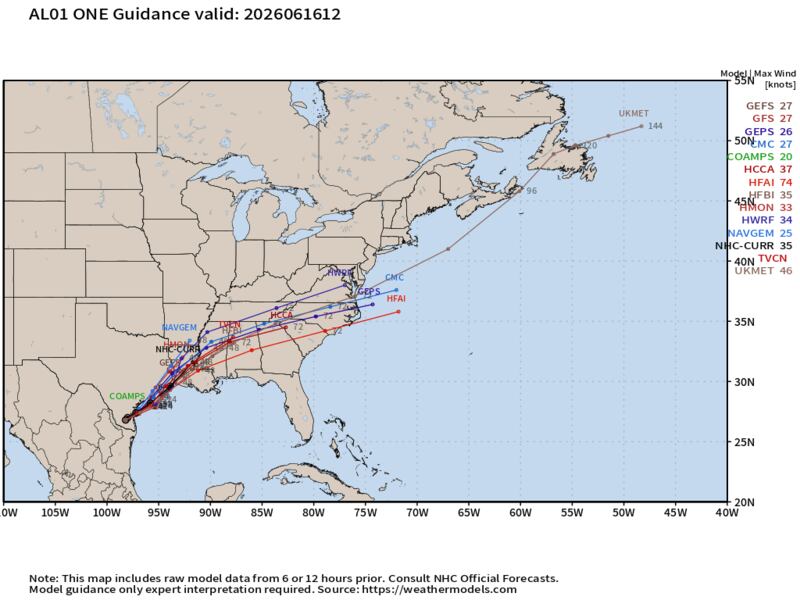
Once it emerges off the Carolina coast late Friday into early Saturday, it could try to redevelop over the western Atlantic, but it’ll be quickly flushed out to sea by jet stream winds on Sunday, which will likely curtail any attempt at a second act.
Otherwise the Atlantic basin looks to settle down to round out the last few weeks of June, with no development expected elsewhere at least into the middle to latter part of next week.
Copyright 2026 by WPLG Local10.com - All rights reserved.
