
Tropical Storm Arthur lasted only 12 hours as a named storm on Wednesday – one of the shortest-lived named storms in Atlantic basin records – but its stormy, water-logged remnants dragged a slug of torrential rains and severe weather through parts of the Deep South on Thursday, leading to widespread, devastating flooding from south and central Louisiana to southeastern Mississippi and lower Alabama.
Many of the hardest hit areas saw rainfall rates top 3 inches an hour, an incredible rate that triggered rapid water rises, spawning numerous flash flood emergencies yesterday, with floodwaters overrunning roads and pouring into homes, launching dozens of high-water rescues along parts of the Gulf Coast.
The New Orleans National Weather Service Office, which covers southeastern Louisiana and coastal Mississippi, issued 18 flash flood warnings on Thursday across their parish and county warning area, the second most issued of any calendar day for the office going back nearly 40 years, and second only to Aug. 12, 2016, during one of Louisiana’s worst floods in recent memory.

According to the Associated Press, nearly 200 homes were flooded in rural Avoyelles Parish in east-central Louisiana, about 30 miles southeast of Alexandria. A privately-owned rain gauge at nearby Plaucheville, Louisiana – part of the Citizen Weather Observing Program (CWOP) volunteer-based weather observing network – reported a whopping 23.35 inches of rain in 24 hours, with nearly all of it falling in a 6-hour period between 6 AM and noon local on Thursday. If verified by the National Weather Service, this would set a record for the most rainfall in a 24-hour period ever observed in the state of Louisiana, according to records maintained by NOAA (the current 24-hour rainfall record for Louisiana is 22 inches in Hackberry, Louisiana, from Aug. 28-29, 1962).
Over a foot of rain was also recorded on Thursday just inland of Gulfport-Biloxi along the Mississippi Gulf Coast. Meanwhile, 4.49 inches of rain fell to the east at Mobile Regional Airport, nearly doubling the previous record for the day set in 2004, though higher totals nearing double-digits were reported along I-65 just north of Mobile near Saraland.
Nearly 100 reports of damage from high winds associated with Arthur’s remnants were confirmed across the southeast U.S., with the bulk of wind damage focused over western and central Georgia. A few tornadoes across southern Louisiana and Mississippi have also been confirmed so far from Thursday.
Flooding lingers in post-Arthur’s wake
Moderate to major river flooding will persist along the I-10 corridor across the central Gulf Coast in the wake of Thursday’s intense rainfall.
Although rainfall totals will be generally lower today than Thursday, due to saturated soils and the possibility of locally high rainfall rates from slow-moving storms, a moderate risk (threat level 3 of 4) remains for parts of the central Gulf Coast through Saturday morning, which could lead to additional scattered flash flooding.

Arthur’s remnants bailing into the western Atlantic, re-development unlikely
The remnant low-pressure that was once Tropical Storm Arthur was being swept eastward through the Carolinas Friday morning ahead of an advancing cold front.
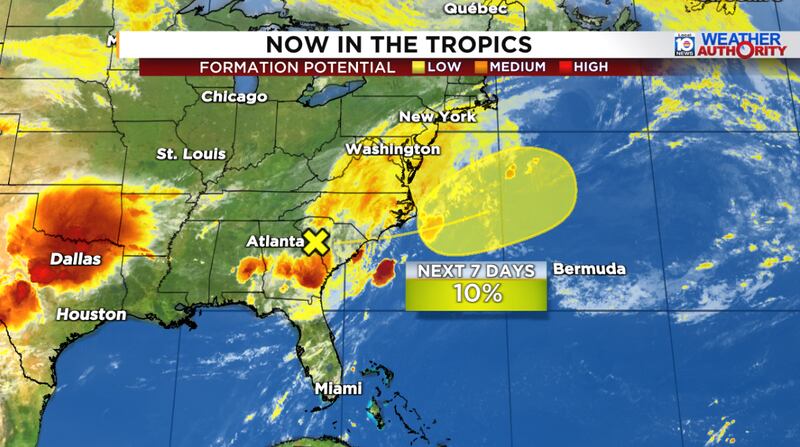
The low-pressure system will swing off the Carolina coast by Friday afternoon and head quickly into the western Atlantic. While models show an outside shot at re-development over the open Atlantic into early Saturday, any re-development will come primarily from non-tropical processes, and its proximity to frontal boundaries will keep the low-pressure area either non-tropical or subtropical at best.
Regardless of re-development, the low-pressure area will get whisked out to sea over the weekend and poses no additional threat to land.
Otherwise, tropical development isn’t expected across the rest of the Atlantic basin through next week.
Copyright 2026 by WPLG Local10.com - All rights reserved.
